Foot Prints of British Intelligence Services in the Post Independent Sri Lanka
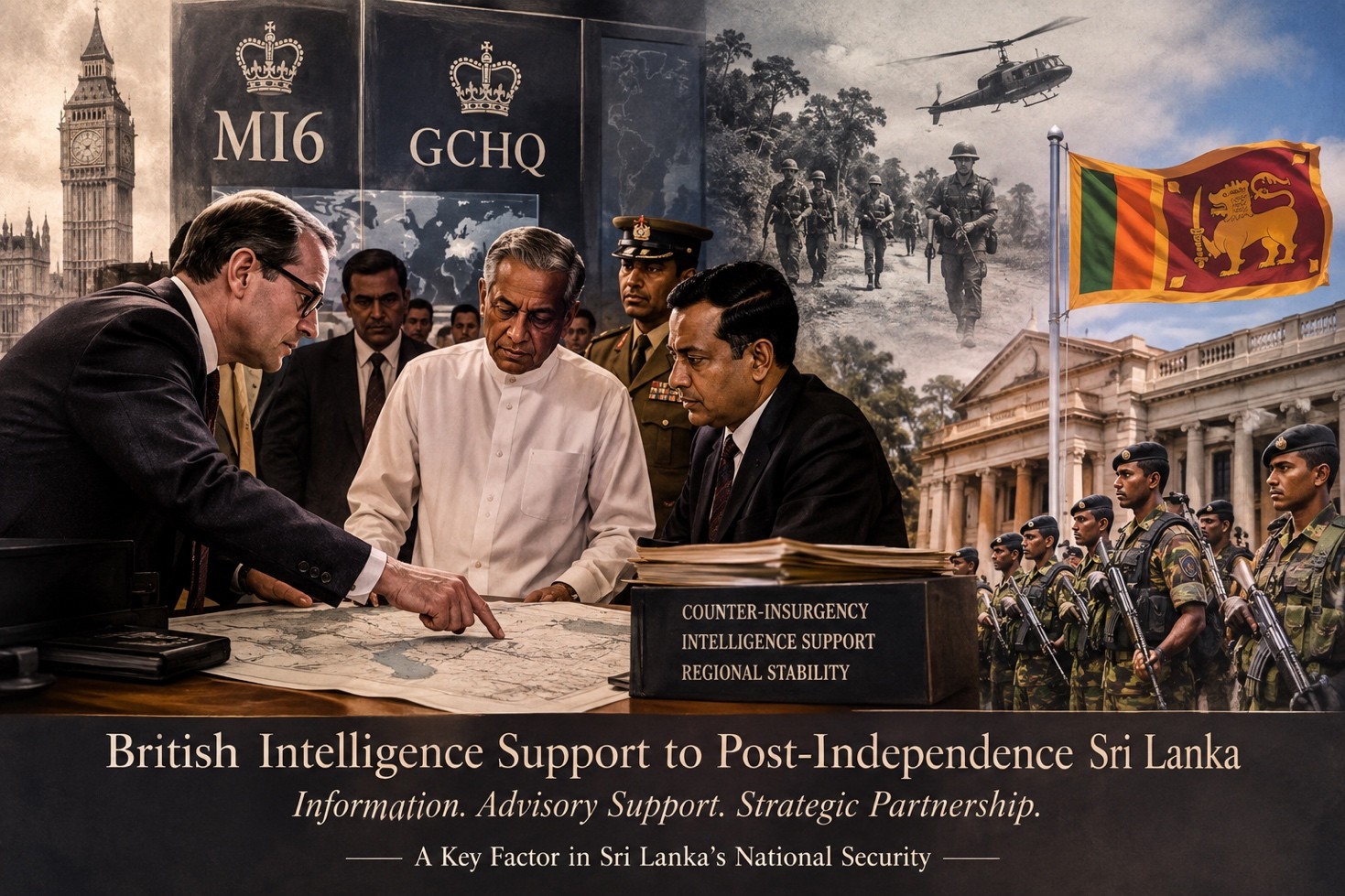
British intelligence maintained a significant presence in Sri Lanka long after the country gained independence, influencing its security institutions and political developments during the Cold War. This article traces the historical involvement of British intelligence services, particularly MI5 and MI6, in shaping Sri Lanka’s intelligence architecture and supporting successive governments in addressing internal security challenges. Drawing on historical accounts and declassified documents, it examines the activities of British intelligence officers, their involvement in counterinsurgency efforts, and the strategic considerations behind continued cooperation. The article highlights how geopolitical interests and colonial institutional legacies shaped intelligence relations between Britain and post-independence Sri Lanka.
The British Intelligence Service, known as SIS or MI6, was established in 1909 by Prime Minister Asquith to counter German subversive activities in the United Kingdom. The British government did not officially acknowledge the agency's existence until 1992. The secretive work of its agents has become part of public memory, largely due to espionage literature by authors such as Ian Fleming and John le Carré. Agents often operated as missionaries, scholars, planters, or archaeologists, concealing their identities with characteristic British eccentricity. The story of Col. T.E. Lawrence, who played a key role in the Arab Revolt against the Ottomans, exemplifies this tradition.
The influence of British Intelligence agents within the Commonwealth endured long after the decline of the empire, enabling Whitehall to observe the affairs of newly independent former colonies amid the shifting currents of the Cold War. Cambridge historian Christopher Andrew has observed that the bond between MI5 and the intelligence services of many erstwhile colonies remained exceptionally strong, with several permitting the permanent presence of a liaison officer from MI5.
British interest in Ceylon and its influence on the country’s politics after independence make for an intriguing story. Ceylon’s strategic importance led Britain to keep a close eye on its former colony. The British took a paternalistic interest in shaping the colony’s national security apparatus, formalised in the Ceylon–British Defence Pact signed by D. S. Senanayake’s government and Britain. Against this backdrop, the British helped establish the country’s intelligence service several years before independence. Known as the Special Branch, it was established by the British in Ceylon in 1941, marking the birth of the country’s first organised intelligence service. Its first chief, Berti Langron, laid a strong foundation for the island’s intelligence culture. His early trainees, including John Attygalle and S. H. Scharenguivel , later became prominent intelligence officers in post-colonial Ceylon.
In addition to offering structural support for the early development of security organisations in Ceylon, the British periodically deployed agents to the island. Declassified documents from UK archives, which contain extensive historically relevant details, demonstrate that British intelligence officers continued operations in Ceylon under diplomatic cover. Notably, the political developments following the emergence of SWRD Bandaranaike in 1956 generated significant attention, as his policies reversed the previously pro-British orientation of Ceylon.
In his well-known monograph, Yossi Cohen, former chief of Mossad, commends British intelligence for their effective use of human intelligence (HUMINT) through traditional espionage methods. Cohen’s observations are particularly relevant when analysing the strategies employed by British agents operating under various covers in post-independence Ceylon to gather intelligence. A notable example supporting this analysis is the case of Major Gordon Burrows at Trinity College, Kandy.
After the SEAC headquarters moved to Peradeniya Gardens in Ceylon in April 1944, Major Gordon Burrows served on Lord Louis Mountbatten’s staff as an intelligence officer. He later rose to become Mountbatten’s Chief Intelligence Officer. The SEAC was then a vital command centre, coordinating many of the Allied forces’ defensive operations. It also oversaw the British-led campaign to recapture Burma.
After the end of the war, Major Burrows joined Trinity College, Kandy as its choir master and taught Latin. Ostensibly, the teaching part was a pretext used by him to stay in post-independence Ceylon, and he closely monitored the local politics in the island with his access to the highest echelon of power through Trinity’s prestigious old boys network . Although Burrows name has faded somewhat into oblivion, a recently released declassified document from the CIA under the title " Friends: Britain’s post-war intelligence "carries his name, proving the British knack for relying on HUMINT.
The first Janatha Vimukthi Peramuna (JVP) insurrection in 1971 revealed the continuing symbiotic relationship between British intelligence and the Sri Lankan government. Declassified documents from the UK National Archives shed light on the shadowy British role in aiding Sri Lanka in quelling the insurrection. Prime Minister Sirimavo Bandaranaike was particularly impressed by Jim Patrick, an MI5 officer stationed in Colombo, whose expertise in counterterrorism operations significantly contributed to suppressing the JVP.
But why would British intelligence assist an anti-imperialist leader like Sirimavo Bandaranaike, whose foreign policy was inimical to British interests? The explanation lies in geopolitics. Britain grew increasingly wary of the Soviet Union’s naval activities in Sri Lanka’s strategically significant Trincomalee harbour. In this complex dance of geopolitical pragmatism, even old adversaries became temporary allies.
The support provided by British intelligence to J. R. Jayewardene’s government as the security situation deteriorated, preceding the rapid rise of both LTTE and JVP militancy in Sri Lanka, was significant. British involvement in the government’s security architecture arguably helped prevent the state from descending into complete instability. In Lost Revolution, Rohan Gunaratna refers to an MI6 agent stationed at the British High Commission in Colombo who advised President Jayewardene on matters of national security.
John Morton was another notable British intelligence officer associated with British intelligence activities in Sri Lanka during Jayewardene’s administration. In particular, the documents compiled by British investigative journalist Phil Miller appear to portray Morton’s activities in somewhat favourable terms. Morton was a staunch imperialist who had served the Crown in colonial India before rising to prominence within MI5, where he became Director of the Counter-Subversion Branch, with particular responsibility for Commonwealth territories. His interest in Sri Lanka must therefore be understood within this broader institutional and imperial context. In 1979, following his retirement from MI5, Morton was recalled to examine the situation in Sri Lanka after Jayewardene requested the Foreign Office’s assistance in developing a national security strategy against Tamil militant groups. The precise details of these visits remain difficult to establish because the Foreign Office destroyed a file from 1979 entitled Sri Lanka: Defence Visits from UK. Nevertheless, according to Rohan Gunaratna, Morton advised Jayewardene’s government to establish the National Intelligence Bureau (NIB) to collect intelligence and recommended the creation of the Directorate of General Intelligence Services (DGIS) as the apex institution responsible for coordinating intelligence and operational activities. However, the extent of Morton’s involvement in Sri Lanka, particularly in relation to the reported arrival of SAS personnel to train the country’s commando units, remains difficult to assess. This is partly because another file destroyed by the Foreign Office, entitled UK Military Assistance to Sri Lanka, 1980, may have contained relevant information.
The extent of British interest in Sri Lanka and the activities of its intelligence personnel also reveal the broader Cold War dynamics that shaped British strategic concerns. It can be argued that, before the Tamil diaspora in the United Kingdom began to exert substantial political influence, British attitudes towards successive Sinhalese-led governments in Sri Lanka were generally favourable. During this period, Britain appeared willing to support the Sri Lankan government’s efforts to suppress militant movements.
(The views expressed are those of the author and do not represent views of CESCUBE)
Image Source: AI Generated
Dr Punsara Amarasinghe is a Lecturer at the Department of International Law, Faculty of Law, General Sir John Kotelawala Defence University. He is a PhD holder Public International Law from the Institute of Law, Politics and Development at (Sant Anna School for Advanced Studies) Scuola Superiore Sant Anna in Pisa, Italy. He holds LL.M from South Asian University, New Delhi and completed his undergraduate studies in law at the Faculty of Law, University of Colombo, Sri Lanka. He completed another Master’s degree in International Relations from the HSE, Moscow. He has held two visiting research fellowships at Global Legal Studies Centre in University of Wisconsin Madison and Sciences PO, Paris. His research interests deal with the Military Strategies, Asymmetric Warfare, Israel-Sri Lanka Relations and Indian Ocean Studies. He is a regular contributor to defence platforms like Romanian Military Thinking, Royal United Servicemen Institute in UK and Indian Defence Review and also a commentator for News X world TV in New Delhi, India. He served as a member of the Oversight Committee on National Security in Sri Lankan Parliament in year 2024 and attended RAISINA dialogue in New Delhi in 2025.