16 Years in the Making: What India's Javelin Deal Really Signals
India’s acquisition of the US-made Javelin anti-tank missile system, sixteen years after its initial proposal, reflects a broader shift in the country’s defence procurement strategy. Tracing the prolonged negotiations, alternative procurement arrangements, and indigenous missile development, this article examines the strategic and institutional factors shaping the deal’s timing. It explores how India is increasingly pursuing foreign acquisitions alongside domestic defence programmes while maintaining defence cooperation despite bilateral trade tensions. The article argues that the Javelin agreement illustrates a more pragmatic approach to strategic autonomy, characterised by parallel procurement decisions, selective partnerships, and the continued pursuit of indigenous defence capabilities.
Introduction
On 28 August 2026, the Indian Army signed a Letter of Offer and Acceptance with the United States for 100 FGM-148 Javelin anti-tank guided missiles, one evaluation round and 25 Lightweight Command Launch Units, worth an estimated $45.7 million, executed on the US Foreign Military Sales route.1 The package is hardly remarkable in its own right, given India's defence budget. What it demonstrates is the value of the time lag. India first announced in Parliament that it had the intention to seek the Javelin in August 2010.2 Sixteen years, three alternative procurement tracks, and one indigenous missile programme, later, that letter of intent has finally become a signature. The interesting question is not that the deal happened, but why it happened now, and what its timing indicates about how India practices strategic autonomy, not in how it says it.
Sixteen Years of Delays and Shifting Procurement Priorities
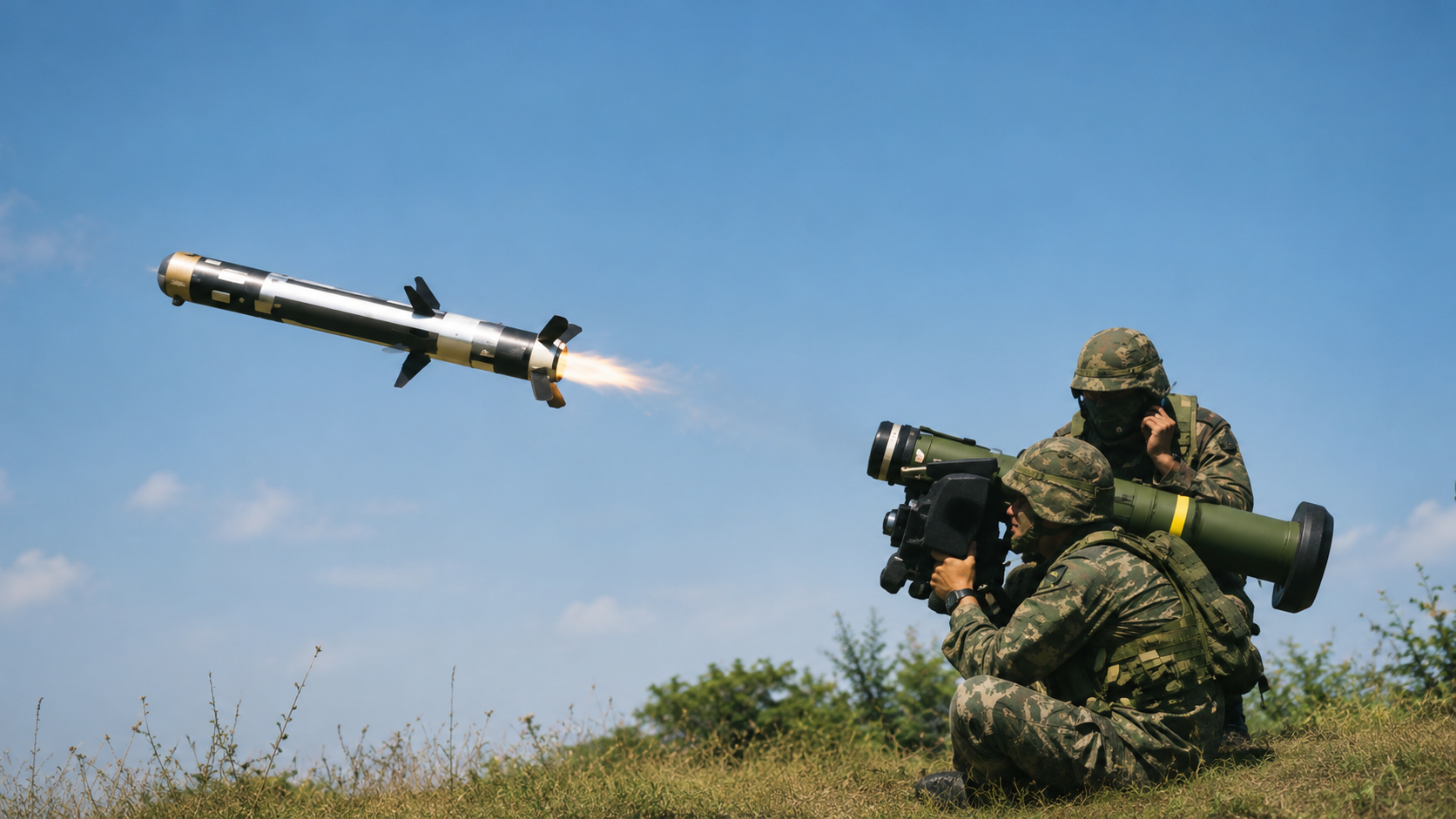
The Javelin is a third-generation anti-tank missile, which means it has a range of over fifty kilometers and can loiter or hover above ground while waiting to engage targets. As such it represents a quantum leap in India's anti-vehicle capabilities. Yet its Indian history begins in August 2010, when Defence Minister A.K. Antony informed the Lok Sabha that his ministry planned to send a Letter of Request to Washington for its acquisition, with technology transfer to Bharat Dynamics Limited built into the ask.3 That ambition ran straight into the limits of what Washington was then prepared to share. American firms would not part with seeker and other sensitive know-how on India's terms, and the US side was reluctant to submit the system to the field trials New Delhi wanted.4 Talks effectively died by 2012. India then hedged in two directions at once, as it would repeatedly do over the following decade: outward, toward Israel's Spike, and inward, toward DRDO's own programmes. Delhi selected the Spike in 2014, rejecting the US offer even as Washington lobbied hard for it, only to cancel that deal in December 2017 in favour of the homegrown Man-Portable Anti-Tank Guided Missile after DRDO argued no technology transfer was required at all.5 The Spike order was revived weeks later during a visit by Israeli Prime Minister Benjamin Netanyahu, cancelled again in 2019 when DRDO promised MPATGM delivery by 2021, and partially resurrected regardless through emergency procurement of a limited Spike batch to bridge the gap while the indigenous missile matured. The whiplash is the point: for a decade and a half, India has treated import and indigenisation as substitutes, cycling between them rather than running them side by side.
Strategic and Institutional Drivers of the Javelin Deal
Two developments during the twelve months preceding LOA offer more credibility to the timing than does missile technology alone. First, on 31 October 2025, India and the United States concluded a ten-year Defence Framework Agreement at Kuala Lumpur, signed by defence minister Rajnath Singh and US secretary of war Pete Hegseth on the sidelines of the ASEAN Defence Ministers' Meeting-Plus.6 Analysts at the time were careful to note that the framework agreement came against a backdrop of tariff disputes, delivery delays in existing US contracts, and friction over India’s continued Russian oil purchases, in other words, that the defence relationship was being walled off from the trade relationship, not merged with it.7 Second, and more immediately, the army had a gap to fill quickly: its purchase of Javelins was pushed through the sixth tranche of an Emergency Procurement mechanism open after Operation Sindoor, enabling the armed forces to fast-track purchases up to a value ceiling and avoid the slower process of the Defence Acquisition Council.8 Taken together, the sequence suggests less a change of heart about American technology and more an institutional habit finally catching up with a shopping list: a framework agreement lowered the political cost of buying American, and an emergency procurement mechanism gave the Army a fast lane to use it.
Javelin and MPATGM: Parallel Paths to Defence Modernisation
It would be an error to interpret the Javelin acquisition as India's de facto abandonment of the MPATGM. Just under seven months before the LOA, on 11 January 2026, DRDO successfully fired the third-generation, fire-and-forget MPATGM with top-attack capability against a moving target at KK Ranges, Ahilya Nagar, Maharashtra, in a test DRDO's own leadership declared a prerequisite for induction into the Army.9 Bharat Dynamics and Bharat Electronics are the development-cum-production partners poised to take MPATGM into series production. Nothing about the Javelin deal detracts from their position. What the two events together reveal is India's willingness to pursue parallel indigenous and imported development tracks, rather than sequential ones: Javelin addresses an immediately defined operational requirement (a mature combat-proven system the Army can employ with less delay), whereas MPATGM continues its trajectory towards induction on its institutional timeline, with its own set of champions and budget line.10 This is a substantially different posture from the 2010s pattern of reserving either track as a hedge against the other's shortcomings.
Defence Industrial Cooperation and the Limits of Technology Transfer
The LOA did not come alone. On 31 August 2026, Tata Advanced Systems Limited and the Javelin Joint Venture — Raytheon, now RTX, and Lockheed Martin; signed a memorandum of understanding to explore co-production of the Javelin All-Up Round in India, which US officials drew attention to as a signal the relationship is evolving from platform acquisition towards industrial integration.11 That language should be taken in context. The very first Javelin approach in 2010 was also framed around technology transfer, structured within the bilateral Next Steps in Strategic Partnership initiative, and it collapsed precisely because Washington would not hand over the missile's seeker technology on a full transfer basis.12 A memorandum to “explore” co-production is not an authorisation to manufacture, and India has watched similar language precede similarly stalled outcomes before. What is genuinely new is the context in which the deal was signed: as India absorbed a steep US tariff regime and continued buying discounted Russian crude, two irritants that might once have been expected to bleed into defence procurement decisions.13 That they evidently did not is itself a signal: that Indian policymakers are increasingly willing to compartmentalise the defence-industrial relationship from the trade relationship, treating the two as separate negotiating tracks rather than a single basket of US-India friction.
The Future of Co-production and Indigenous Capability Development
The true test of the deal's signal will not be the LOA itself, but what happens to the TASL–JJV co-production talk in the next two to three years. Should seeker technology and production know-how actually arrive on Indian soil, if the Javelin turns out to be the first case in this saga where the American industrial promise survived the signing ceremony, this is a telling comparison of how India-US defence-industrial cooperation measures up against India's experience with Russia and France. Should the co-production talk wither as NSSP's did after 2012, the deal will be remembered as a one-off FMS purchase dressed up in the language of partnership, and the story will truly be about the one that India has been quietly writing for itself, a domestically produced MPATGM entering service on schedule regardless of the Washington delivery.
Conclusion
Either way, the more enduring finding is about method than outcome. India's current posture is less a matter of ideology, of binary choice between self-reliance and alignment, and more a compartmentalised, interest-based hedge: take what serves an immediate capability gap, keep the indigenous line running regardless of the import decision, and treat defence cooperation as a track that can move independently of trade-level friction. The Javelin, with all its modesty of missilery, carries a pretty weighty argument about strategic autonomy as practised in 2026: not as a doctrine proclaimed in speeches, but a set of parallel, hedged bets made one procurement decision at a time.
References:
1. "India and US Sign Deal for Javelin Missiles, the Plan Eventually Is Co-Production," ThePrint, August 2026
2. "Inside India's Decision to Buy Javelin Missiles 16 Years Later," Outlook India, August 2026
3. "India and US Finalise Javelin Missile Deal with Co-Production Vision," Indian Defence News, August 2026
https://www.indiandefensenews.in/2026/08/india-and-us-finalise-javelin-missile.html
4. "India's 15-yr Quest for Anti-tank Missile: Israeli Spike, DRDO Option, Back to US for Javelin Talks," ThePrint, March 2, 2025
5. "India's Interest in the US's Javelin Anti-Tank Missile Is Back. Here's Why It Matters," The Wire, June 2026
6. "MPATGM," Wikipedia, accessed September 2026
https://en.wikipedia.org/wiki/MPATGM
7. "India, US Sign Landmark 10-Year Defence Framework to Boost Bilateral Defence Ties," The Statesman, October 31, 2025
8. Vivekananda International Foundation, "Framework for the US-India Major Defence Partnership 2025: Turning Point or Maintaining Pace?," November 7, 2025
9. "India Signs Deal for 60 US Javelin Anti-Tank Missiles," Drishti IAS
10. "DRDO Successfully Tests MPATGM with Top-Attack Capability," Construction World, January 14, 2026
11. "Javelin Comes to India: From Foreign Military Sale to Defence Industrial Partnership," Indian Aerospace and Defence Bulletin, August 31, 2026
(The views expressed are those of the author and do not represent views of CESCUBE)
Image Source: AI Generated

Aarthi DE completed her BA in Defence and Strategic Studies from Erode Arts and Science College, Tamil Nadu. She is currently pursuing an MA in Defence and Strategic Studies at the Central University of Jammu (2025–2027).