Between the Desert and the Savannah: Conflict and the Political Economy of Instability in the Sahel
The Sahel has emerged as one of the most persistent zones of political and security instability in Africa, shaped by the convergence of climate stress, weak governance, jihadist insurgency, resource competition and external intervention. This article examines the structural foundations of this instability through the lenses of political economy, necropolitics and the anthropology of the state. Rather than treating conflict in the Sahel as a consequence of isolated crises, it argues that contemporary instability is rooted in the region’s colonial administrative legacy, extractive economic structures, uneven state presence and the unequal distribution of resources and security. The article further examines how external security frameworks, including France’s Operation Barkhane and subsequent Russian involvement through the Wagner Group, have interacted with these structures rather than fundamentally transforming them. It also explores how climate-induced resource scarcity has intensified farmer-pastoralist tensions and created conditions that extremist groups such as JNIM and IS-Sahel have exploited to expand alternative forms of governance. The article concludes by highlighting how the political economy of insecurity continues to place the greatest burden on already marginalised communities.
I. Introduction:
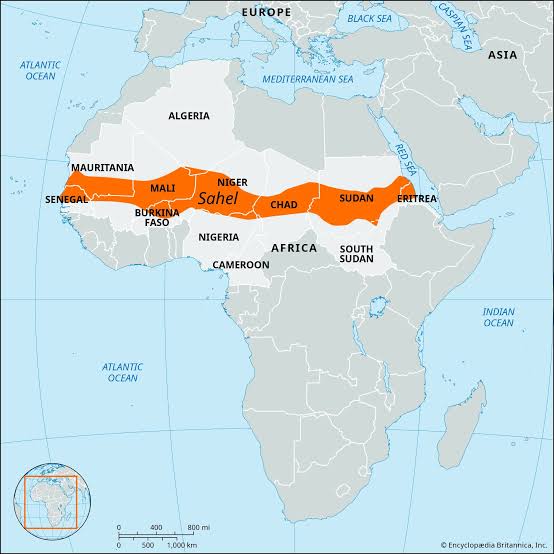
From the Arabic word 'sahil,' the Sahel means a shore, border, edge. It captures a transition, both geographically and politically; it has always been read as such, a space that’s defined by what lies on either side of it, by what it connects. To the north of the region lies the Sahara, sub-Saharan Africa to the south, the Atlantic to the west and the Horn to the east.1 The Sahel itself, however, remains perpetually suspended in between as a shore without a sea of its own. The consequence of this liminality is in how the region has been organised, governed, exploited and imagined by those who arrive from outside. The French colonial administrators mapped it as a corridor to be taxed and controlled. The Cold War strategists saw it as a buffer region to be managed.2 And now, in the early phase of the 21st century, the region is seen as a confluence of climate stress, governance failure, jihadist insurgency and great-power competition.3 The Sahel has always been defined by what is in between; however, the sheer volume of what is within is a matter of discovery.
Accounts of the crisis in the Sahel, as mentioned earlier, detail three independent variables: climate change, governance failure, and jihadist insurgency. Climate change-induced reduction in rainfall is shrinking Lake Chad, expanding the desert southward, and making pastoral land increasingly unreliable. Governance failure is leaving the communities that depended on this land without a state or a justice system to turn to. To add to this, jihadist insurgencies such as the JNIM in Mali and Burkina Faso, and ISWAP in the Lake Chad basin are exploiting both the space where the state doesn’t adequately occupy and the space that climate stress is now emptying. However, the account remains incomplete in how it treats these conditions as symptomatic of the region rather than as structurally related outcomes. It positions external actors in the region such as the French forces, the G5 Sahel, Wagner Group, Gulf state funders, and international NGOs as respondents to a crisis rather than as participants in its production.4
This article aims to illuminate the opposite. The instability in Sahel is not a natural condition that needs responding to but a structural condition produced by the inheritance of colonial governance designed for extraction rather than welfare, by economies that reward those who control access to security, life and resources rather than those who deliver it, by climate stress that is borne by communities whose capacity to absorb the shock are limited and most importantly by external intervention frameworks that manage rather than resolve insecurity because resolution would eliminate the justification for its presence. When this region is read through political economy, necropolitics, and the anthropology of the state, it produces a story that highlights where the shore is not simply where crisis washed up but where the pillars holding it up allow 21st-century conflict in their most legible and most concentrated form to cultivate.
In the Sahel, these conditions manifest in the form of land that communities held through customary arrangements for generations is suddenly insufficient to sustain them because of decades of colonial land tenure policy, post-independence state land legislation favouring settled agriculture, and now accelerating climate stress that perpetuates scarcity upon these communities without room for formal conflict resolution.5 Specifically, this looks like a gendarmerie post in a rural district that, while poised as security, is for extraction. Or a private military company from Moscow that enters with a security offer but leaves with a mining concession.6 While these can all seem like generalised chaos, it is structured. This article examines the structure to ask who benefits from its instability, what those benefits reveal, and what the Sahel therefore tells us about the structural conditions likely to redefine conflict. This shore, then, is the site to discuss all these aspects.
II. Who Draws the Map:
The unit that’s now called Sahel was largely produced by French colonial governance; the Afrique Occidentale Française organised the space around French administrative and resource extraction convenience rather than factors like seasonal migration, pastoral routes or cross-border kinship networks that are foundational to the unity of the region.7 The borders that form the general outline of the region, such as the Sahelian states of Mali, Burkina Faso, Niger, and Chad, were drawn through these communities and instead of around them. The result was fragmented ethnic, linguistic, and pastoral territories that have never corresponded to how people in the region actually navigate the space.
The postcolonial states inherited not just this territory but the administrative strategem embedded in how the territory had been organised. Violent extremism in the Sahel shares similar internal dynamics of inequality where state power tends to be concentrated in southern, urban regions while rural, northern areas remain underdeveloped and ripe for exploitation by extremist groups. This is why using this region as a metaphor for governance failure is only half the truth; the spatial logic of the region itself was never drawn to deliver welfare to the populations it administered.
When Western security frameworks entered the Sahel through Operation Barkhane and the G5 Sahel Force as counterterrorism movements, they reproduced this spatial logic.8 The Sahel became an “ungoverned space” that required external intervention to preserve the land; however, despite increased international involvement, the campaign against the militants caused the spread of militancy to countries across the Sahel.9 While this resulted in the eventual withdrawal of French forces from its former colonies, the framing of the Sahel as a vacuum of effective state authority positioned external military presence as the natural solution. What was not asked was whether the state authority being puzzled is what the population would benefit from.
Ungoverned space is a political construction that serves specific interests such as the justification of military deployment, the extraction of counterterrorism cooperation from fragile governments in exchange for security.10 The Sahel is thus produced as a crisis zone by the same actors who then intervene in it.
The exit of French forces from Mali, Burkina Faso and Niger between 2022 and 2023, followed by the entry of Russia’s Wagner Group and Gulf state actors, has not disrupted this spatial logic. Wagner’s presence in Mali and Burkina Faso has been organised around the exchange of security provision for access to mining concessions and resources.11 The spatial construction of the Sahel as a zone to be managed by external actors for external interests is not a feature of any particular power’s involvement.
III. Death- Worlds and the Living Dead:
To understand what critical geography does to the people. This article starts with Foucault’s biopolitics, which describes power that works by investing in life; it's in optimisation, management, and regulation. However, it does not account for what happens to populations that fall outside that investment. Here’s where Mbembe's necropolitics begins: it frames sovereignty as the power to decide who lives and who is left to die, not as an exception but as a governing principle.12
This matters for the Sahel because the Sahelian population does not fit the biopolitical frame. They are people whose colonial governance, and the postcolonial states that inherited its structure, never invested in at all. The state appears in their lives as a checkpoint, a gendarmerie post. The term used for what this produce is the ‘death-world’: forms of social existence in which vast populations are subjected to conditions that confer upon them the status of the living dead. Their condition remains nothing short of physical death; their labour and land are extracted and used, while their political claims, their welfare and their survival remain structurally irrelevant to the systems that continue to extract from them. Mbembe turns to plantations as an example. Exploring these regions as “repressed topographies of cruelty”, necropolitics reads these sites in which populations are held in the form of living death.13
What this reframes is the nature of the instability itself. It is not a failure of governance but a form of governance in which certain populations are almost rendered politically irrelevant and materially expendable. The next section argues that this is structurally profitable.
IV. Instability as Infrastructure:
The necropolitical framing begs the question of who the Sahel's instability is a resource for. Operation Barkhane, for instance, cost France approximately €600 million annually and deployed 5,000 troops across five countries. Even AFRICOM's Sahel operations, which built training programmes and drone infrastructure across the region, generate institutional interests because they are structurally tied to the persistence of the threat they nominally address.14 When large institutions organise around managing a problem rather than solving it, the management itself becomes the purpose, and the problem a justification. In Mbembe’s terms, this is an economy in which death is productive; it multiplies and invests in insecurity.15 The Sahelian populations caught between insurgency and counterinsurgency are not incidental to this economy but its material condition.
The military juntas that took power in Mali, Burkina Faso and Niger displaced French security frameworks, but not the political economy those frameworks were partly organised to protect. Resources like the gold in Mali and uranium in Niger remain the material stakes around which external security arrangements are organised. The Russian Wagner Group’s documented model replicates the colonial period, where security provision was exchanged for mining concessions.16 At the same time, people bore the cost of casualties and displacement and the resource value flowed outward. The insecurity that produces civilian death and displacement also produces the justification for continued military presence; it is thus the product of a system that, from the perspective of those who control it, functions.
The Gulf states and Turkey have extended their presence through the establishment of religious institutions and political alignment with specific coup governments.17 These positional investments secure space for influence in migration routes and secure significant resource reserves. The conditions that make the Sahel ungovernable for its inhabitants make it available for external strategic competition. Mbembe describes how contemporary powers are compelled to construct ultimate enemies, a stark opposite, in pursuit of whom states of exception are created. Spaces that operate outside the normal rules of accountability and civilian protection, extending into everyday life. 18
The Sahel has become one such extended state of exception, in which the suspension of those rules operates under the guise of a counterterrorism emergency and is profitable for the actors who maintain it. While this is not to say that this is a Sahelian peculiarity, it is a structure that emerges wherever governance fragility, resource value, and great-power competition converge in a space whose populations have been rendered politically expendable.
V. The State that Takes:
In the postcolonial Sahelian landscape, across Mali, Burkina Faso, and Niger, state power has historically been concentrated in southern, urban regions while rural, northern areas remain underdeveloped. These northern areas, vulnerable to exploitation, were first exploited by a colonial administration and then by the governments that inherited its structure without measurement. Amenities like schools, health infrastructure, and legal courts arrived in capital and secondary cities; however, these peripheral states were left with clothes that didn’t quite fit. The gendarmerie were stationed here, and when things escalated, the military took their place. To say that this was a government failure is only half the problem when the structure itself needs change too.
This is also what IS-Sahel and JNIM walked into. Their expansion across the Liptako-Gourma tri-state region since 2017 has not been primarily military but has been administrative.19 These extremist groups are providing conflict-resolution services for Sahelians as land disputes worsen while also providing food and basic resources. In Tillabéry, Niger, some communities view IS-Sahel as more reliable at resolving land disputes and protecting livestock assets than the government. In parts of Burkina Faso, citizens actively turn to jihadist counsel over state services for land disputes, not out of ideological conviction but because of a lack of a credible alternative. What was described as a “last resort” by one community leader seeking militant support seems to stem from a lack of support from state institutions. 20
The counterterrorism response by external actors has compounded this. Despite increased international involvement, the campaign against militants caused the spread of militancy to countries across the Sahel. This framework seemed to reveal that military pressure without government reform does not eliminate insurgency but displaces it. The first six months of 2022, following the French withdrawal, saw a dramatic increase in attacks, particularly in the Liptako-Gourma area, with more than two thousand civilians killed. More telling still are reports from human rights observers that indicate that Burkinabé and Malian government forces have killed up to four times more civilians than jihadist groups have.21 The communal experience of counterterrorism and the experience of living under insurgency have become, in many documented cases, indistinguishable, with arbitrary violence and extraction running rampant.
VI. The Cost: Climate Scarcity and the Structure of Vulnerability:
Climate stress in the Sahel is not the origin of conflict but a mechanism through which existing conflicts have been exacerbated. With temperatures in the Sahel rising at 1.5 times the global average, climate change is intensifying pressures on natural resources and destabilising traditional livelihoods across the region.22 The question that political ecology scholarship seeks is not how fast the temperature is rising but who loses. Who loses access to land and water when the rains stop, the answer is not determined by climate alone but land tenure systems, state land policies and the relative political power of communities.
The farmer-pastoralist conflict illustrates this precisely. Over the past five years, there have been 450 incidents of conflict over resources between sedentary farmer and herder communities in the central Sahel, with resulting fatalities doubling in the same period.23 These clashes are routinely reported as ethnic; while this describes how the violence is organised, it doesn’t speak to why it exists. Traditional seasonal migration paths used by herders to move livestock between grazing areas are becoming unsustainable because of reduced water availability and shrinking arable land, forcing herder communities southward into closer contact with farming communities. The competition is over access to increasingly scarce resources, conducted through ethnicity because that’s the dominant political language.
In Niger, between 100,000 and 120,000 hectares of arable land are being lost annually to soil erosion. By 2050, the Klela basin in southern Mali could see groundwater recharge rates drop by as much as 49 percent. The informal economy, which sustains more than 95 percent of the working population in Burkina Faso, faces severe impacts from climate pressures, diminishing employment and stability.24 The communities absorbing these shocks are those with the least access to formal credit, state protection, or alternative livelihoods. This is not neutral ground; climate stress thus falls hardest on those who’re already outside the state’s zone of administration. Which is to say, it follows the same extractive logic described in the previous sections.
Violent extremist groups such as the JNIM and IS-Sahel have deliberately destroyed water infrastructure to control accessibility and force resource-scarce populations into dependency on non-state governance. Climate stress, in this sense, is not a background condition that extremists exploit passively. It is a resource that’s weaponised, deepening the scarcity that drives communities toward them and away from a state that was never reliably present to begin with.
VII. Conclusion:
In 2024, it was reported that about 51 per cent of global terrorism-related deaths occurred in the Sahel.25 The Sahel was governed as an extraction zone. The system inherited by the postcolonial states was largely unchanged, which compounded with climate change led communities that relied on that colonial land tenure to be pushed to the margins of viable agriculture and extreme resource scarcity. When jihadist groups moved into that space, they found populations waiting for a system of governance, a line of communication, which they offered at a price that was calculated to be lower than the price of abandonment. The external actors in the terrain: France, the G5 Sahel, the Wagner and the Gulf States operated within the same spatial logic. Security provision was organised around resource access and populations were positioned as the terrain of operations.
What ties all of this together is a structure that lets the brunt of these consequences be borne by one community. The Fulani herder whose seasonal route is no longer viable because of a combination of climate shift, state land policy, and agricultural encroachment does not appear in the counterterrorism data as a victim of structural conditions. He appears as a recruitment risk. The community that accepts jihadist dispute resolution because no court has ever been accessible to them does not appear as evidence of governance failure. It appears as evidence of radicalisation. The civilian killed in a counterinsurgency operation involving Wagner and the Malian army does not appear as a product of the political economy of intervention. He appears as collateral damage in a war against extremism. This is what the Sahel makes legible, the transparency of a system that seems to be failing. The shore, in the end, is not a metaphor for marginality. It is a description of what happens when the tide goes out and the structure beneath is finally visible. The Sahel did not become this but made into this.
Endnotes:
1. International Fund for Agricultural Development, Facing the challenges of sustainable development in the Sahel, https://www.ifad.org/en/west-and-central-africa/sahel.
2. Catrina Doxsee, Jared Thompson, and Marielle Harris, The End of Operation Barkhane and the Future of Counterterrorism in Mali, 2022, https://www.csis.org/analysis/end-operation-barkhane-and-future-counterterrorism-mali.
3. Center for Preventive Action (Council on Foreign Relations), Violent Extremism in the Sahel, 2026, https://www.cfr.org/global-conflict-tracker/conflict/violent-extremism-sahel.
4. Center for Preventive Action (Council on Foreign Relations), Violent Extremism in the Sahel, 2026, https://www.cfr.org/global-conflict-tracker/conflict/violent-extremism-sahel.
5. OECD, An Atlas of the Sahara-Sahel, Geography, Economics and Security, 2014, https://www.oecd.org/content/dam/oecd/en/publications/reports/2014/12/an-atlas-of-the-sahara-sahel_g1g49274/9789264222359-en.pdf.
6. Center for Preventive Action (Council on Foreign Relations), Violent Extremism in the Sahel, https://www.cfr.org/global-conflict-tracker/conflict/violent-extremism-sahel.
7. Permanent Mission of France, France’s action in the Sahel, 2021, https://onu.delegfrance.org/france-s-action-in-the-sahel.
8. European Council on Foreign Relations, Mapping armed groups in Mali and the Sahel,2019, https://ecfr.eu/special/sahel_mapping/operation_barkhane.
9. Paige Allen, What is Necropolitics?, 2023, https:// www.perlego.com/knowledge/study-guides/what-is-necropolitics.
10. Achille Mbembe, Necropolitics (Duke University Press, 2019)
11. Achille Mbembe, Necropolitics (Duke University Press, 2019)
12. Center for Preventive Action (Council on Foreign Relations), Violent Extremism in the Sahel, https://www.cfr.org/global-conflict-tracker/conflict/violent-extremism-sahel.
13. Paige Allen, What is Necropolitics?, 2023, https://www.perlego.com/knowledge/study-guides/what-is-necropolitics
14. Achille Mbembe, Necropolitics (Duke University Press, 2019)
15. OECD, Military Coups, Jihadism and Insecurity in the Central Sahel, 2024, https://www.oecd.org/content/dam/oecd/en/publications/reports/2024/05/military-coups-jihadism-and-insecurity-in-the-central-sahel_4f7f928f/522f69f1-en.pdf
16. Paige Allen, What is Necropolitics?, 2023, https://www.perlego.com/knowledge/study-guides/what-is-necropolitics
17. OECD, Military Coups, Jihadism and Insecurity in the Central Sahel, 2024, https://www.oecd.org/content/dam/oecd/en/publications/reports/2024/05/military-coups-jihadism-and-insecurity-in-the-central-sahel_4f7f928f/522f69f1-en.pdf
18. Center for Preventive Action (Council on Foreign Relations), Violent Extremism in the Sahel, 2026, https://www.cfr.org/global-conflict-tracker/conflict/violent-extremism-sahel.
19. Achille Mbembe, Necropolitics (Duke University Press, 2019)
20. OECD, Military Coups, Jihadism and Insecurity in the Central Sahel, 2024, https://www.oecd.org/content/dam/oecd/en/publications/reports/2024/05/military-coups-jihadism-and-insecurity-in-the-central-sahel_4f7f928f/522f69f1-en.pdf
21. Center for Strategic and International Studies, The End of Operation Barkhane and the Future of Counterterrorism in Mali, 2022, https://www.csis.org/analysis/end-operation-barkhane-and-future-counterterrorism-mali
22. Center for Strategic and International Studies, The End of Operation Barkhane and the Future of Counterterrorism in Mali, 2022, https://www.csis.org/analysis/end-operation-barkhane-and-future-counterterrorism-mali
23. Kitty Mant, Jaynisha Patel and Sandun Munasinghe, From Crisis to Conflict:: Climate Change and Violent Extremism in the Sahel,2024, https://institute.global/insights/geopolitics-and-security/from-crisis-to-conflict-climate-change-and-violent-extremism-in-the-sahel.
24. Kitty Mant, Jaynisha Patel and Sandun Munasinghe, From Crisis to Conflict:: Climate Change and Violent Extremism in the Sahel,2024, https://institute.global/insights/geopolitics-and-security/from-crisis-to-conflict-climate-change-and-violent-extremism-in-the-sahel.
25. Kitty Mant, Jaynisha Patel and Sandun Munasinghe, From Crisis to Conflict:: Climate Change and Violent Extremism in the Sahel,2024, https://institute.global/insights/geopolitics-and-security/from-crisis-to-conflict-climate-change-and-violent-extremism-in-the-sahel.
26. Security Council Report, West Africa and the Sahel, 2025, https://www.securitycouncilreport.org/monthly-forecast/2025-04/west-africa-and-the-sahel-14.php.
(The views expressed are those of the author and do not represent the views of CESCUBE)
Image Source: https://www.britannica.com/place/Sahel
Moumita Arun is a sophomore at Symbiosis School for Liberal Arts, currently double majoring in International Relations and Economics. She situates her research interests at the intersection of these two fields, specifically in terms of cultural studies, gender, and security. She has hands-on experience in research and community engagement, contributing articles to campus publications, moderating international panels, and working on service-learning projects focused on education, gender equity, and access.