The Architecture of Cooperation: Navigating East Asia's Geopolitical Landscape
East Asia is usually discussed in terms of competition. Rivalry between the United States and China, tensions on the Korean Peninsula, and disagreements among China, Japan, and South Korea have made the region increasingly complex. However, there is another side to this. These countries continue to trade and work together through regional institutions on issues ranging from energy to security. This raises the question of how regional institutions and strategic partnerships support cooperation among East Asian states.
However, there does not exist any one institution which unites East Asia. Rather, cooperation has come about through a number of different institutions and partnerships. The ASEAN-led forums serve as forums for dialogue while economic arrangements have been used for engagement while strategic partnerships serve as a means of working together in specific areas. These various ways of cooperation do not diminish geopolitical tension. They give countries a way to manage these differences while continuing their relations.
ASEAN and the Regional Space for Dialogue:
ASEAN has a central place in this regional system. Its position is not based on having the largest economy or the strongest military. What gives ASEAN influence is its ability to bring states with very different interests into the same regional framework. ASEAN+3, the East Asia Summit (EAS) and the ASEAN Regional Forum (ARF) are some of the main platforms through which this happens.
This role is generally described as ASEAN centrality. Yoshimatsu (2023) argues that ASEAN built its position through institution-building and by bringing larger powers into regional arrangements. China and Japan have much greater material capabilities, yet both continue to participate in ASEAN-led mechanisms. The strength of ASEAN thus derives from its ability to bring together regional institutions for diverse actors. Yoshimatsu (2023)
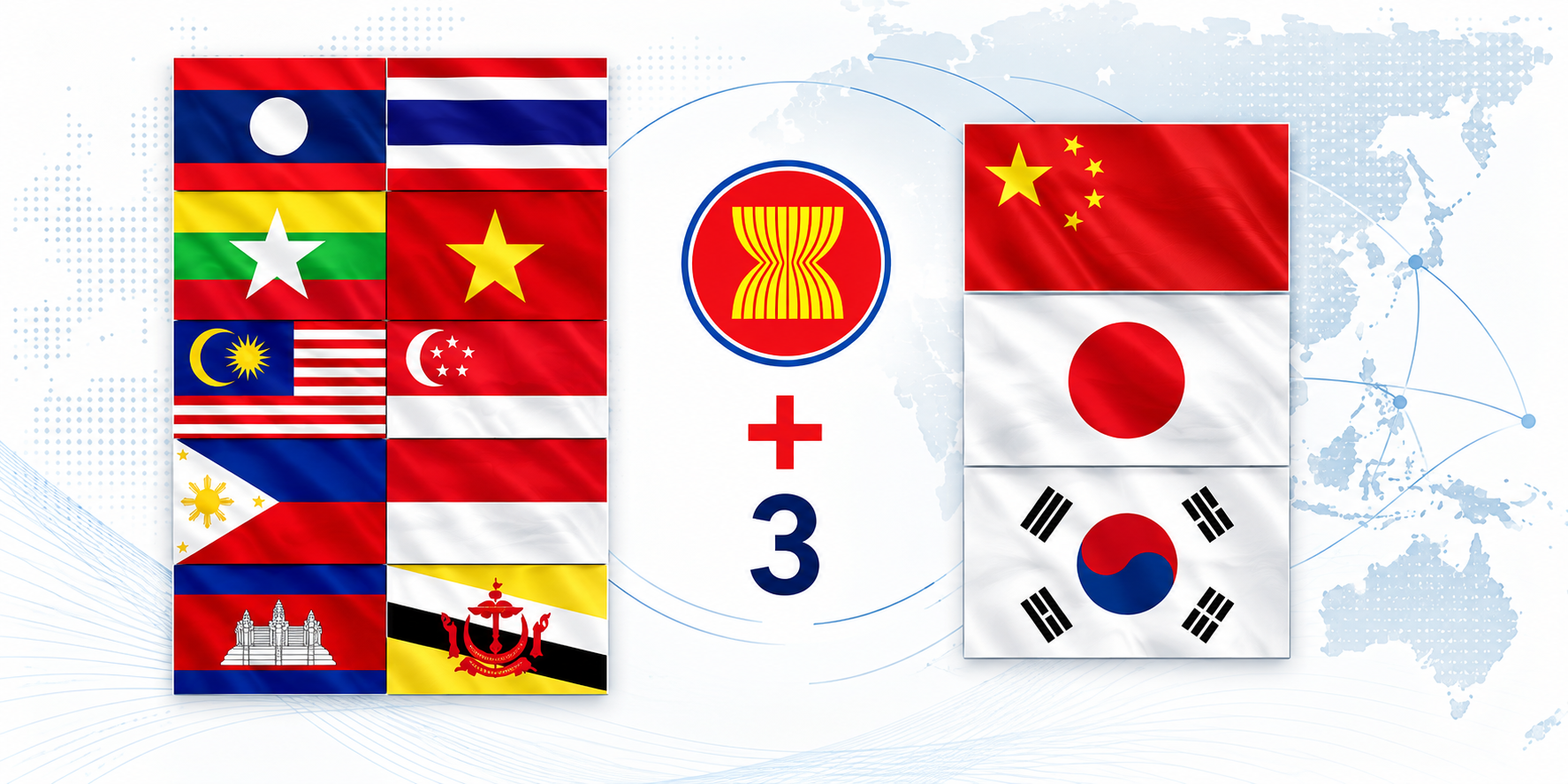
ASEAN+3 is a good example of this. It brings the ten ASEAN members together with China, Japan and South Korea. It began in 1997 and was formally established in 1999. Since then, it has expanded into political, economic, and social areas. The economic relationship is especially significant. In 2024, trade between ASEAN and the three Plus Three countries reached about US$1.217 trillion, while foreign direct investment from China, Japan and South Korea into ASEAN reached US$44.4 billion. ASEAN Plus Three (2025)
The significance of these numbers goes beyond the size of the trade itself. They show how much the economies of the region are connected. A political dispute can make relations difficult, but it does not automatically end the need for trade or investment. ASEAN+3 gives these states a regular setting in which such interests can still be discussed.
Security cooperation works somewhat differently. The ASEAN Regional Forum focuses on confidence-building and preventive diplomacy. Its approach moves gradually from confidence-building to preventive diplomacy and, eventually, conflict management. ASEAN Regional Forum (2024) “The ASEAN Regional Forum: A Concept Paper,” (1995) section “The Challenges,” para. 6, p. 3.
The ARF is not a military bloc; thus, it cannot compel states to resolve their disputes. The forum may have limited functions but it is still functional because it acts as an avenue for communication amid distrust among states. Sometimes, keeping countries talking is an important part of preventing a difficult relationship from becoming an even more difficult one.
Economic Interdependence as a Reason to Cooperate:
There is also the economic dimension of this regional architecture. There are close economic ties between ASEAN, China, Japan and South Korea. Economic cooperation has been deepened further with the RCEP agreement.
It is important to note that economic cooperation has not removed strategic competition. The 2025 ASEAN+3 Leaders' Statement has identified economic fragmentation and disruptions to trade and investments as some of the major risks. This means that economic and financial cooperation, as well as increased regional resilience, is needed in this region. ASEAN Plus Three Leaders' Statement (2025)
This is perhaps one of the more practical reasons cooperation survives in East AsiaOne of the reasons that can explain why there is continued cooperation in this region could be that countries do not just cooperate because they trust each other but also because they stand to benefit from it. Economic interests cannot be easily forgotten even when political relations turn hostile.
Strategic Partnerships and Selective Cooperation:
Broad regional institutions are useful, but they can be difficult places to reach agreement, particularly when many states are involved. Strategic partnerships provide another option. They are usually narrower and allow governments to concentrate on issues where they have more immediate common interests.
Japan and South Korea offer a useful example. Their relationship has been affected for years by historical disputes and territorial disagreements. Even so, both countries have recently increased cooperation in areas such as energy security, defence and supply chains. In 2026, the two sides moved towards greater coordination on crude oil and LNG procurement and discussed ways to improve the resilience of their energy supplies. Nippon.com (2026)
The point is not that Japan and South Korea have suddenly put all of their disagreements behind them. They have not. Instead, they have identified areas in which both countries face similar challenges. Energy security is one such area, while supply-chain security and defence cooperation provide others. Niquet (2026) similarly notes that security concerns, economic security and technology have created greater room for strategic convergence between Tokyo and Seoul. Niquet (2026), Foundation for Strategic Research
This sort of selective cooperation is increasingly common in East Asia. There is no need for the two states to find agreement on all important issues before they start to cooperate with one another. It is possible to concentrate on a certain issue, cooperate when the interests coincide and leave the complicated ones aside.
Cooperation in a Competitive Region:
Taken together, these examples point towards a regional system built from several layers. ASEAN-led institutions provide a broad diplomatic space. Economic links make continued engagement useful. Strategic partnerships offer more focused forms of cooperation.
At the same time, this system is under pressure. US-China competition has made the regional environment more difficult, while newer minilateral groupings have created additional channels for strategic cooperation outside ASEAN-led institutions. The Association of Southeast Asian Nations itself has some contradictions, which sometimes hinder it from making a collective response to important events in the region. For ASEAN centrality to remain meaningful, it needs to continue proving that its institutions are useful to states with very different interests. Yoshimatsu (2023)
It would therefore be difficult to describe East Asian cooperation as a process of regional integration in the traditional sense. There is no single political project, and there is certainly no disappearance of strategic rivalry. What exists instead is a much more flexible arrangement in which countries cooperate where they can.
Perhaps that is also what makes the regional architecture durable. States are not being asked to choose cooperation over competition. They are finding ways to do both. ASEAN keeps the diplomatic space open, economic interdependence gives states reasons to remain connected, and strategic partnerships allow more focused cooperation when common interests emerge. East Asia's cooperation architecture has not removed rivalry from the region. Its importance lies in making sure that rivalry is not the only relationship states have with one another.
References:
1.ASEAN
Plus Three. (2025). Joint media statement of the 28th AEM Plus Three
consultation.
https://aseanplusthree.asean.org/joint-media-statement-of-the-28th-aem-plus-three-consultation/
2.ASEAN Plus Three. (2025). Leaders' statement on strengthening regional economic and financial cooperation. https://asean.org/wp-content/uploads/2025/10/APT-Leaders-Statement-on-Strengthening-Regional-Economic-and-Financial-Cooperation.pdf
3.ASEAN Regional Forum. (2024). “The ASEAN Regional Forum: A Concept Paper,” (1995) section “The Challenges,” para. 6, p. 3.https://aseanregionalforum.asean.org/wp-content/uploads/2024/08/0712.pdf
4.Niquet, V. (2026). Japan-ROK relations since 2025: Toward a sustainable strategic convergence? Foundation for Strategic Research. https://www.frstrategie.org/en/programs/korea-security-and-diplomacy-program/japan-rok-relations-2025-toward-sustainable-strategic-convergence-2026
5.Nippon.com.
(2026). Japan and South Korea advance strategic coordination amid global
instability.
https://www.nippon.com/en/in-depth/d01238/japan-and-south-korea-advance-strategic-coordination-amid-global-instability.html
6.Yoshimatsu, H. (2023). Meanings, norms, and social constitution: Revisiting ASEAN centrality in East Asian regionalism. Japanese Journal of Political Science, 24(4), 409-423. https://doi.org/10.1017/S1468109923000257
(The views expressed are those of the author and do not represent the views of CESCUBE)
Image Source: AI Generated

Devangi Sandhu is a final-year B.A. (International Relation) (Hons. / Hons. With Research) student at Amity University Uttar Pradesh, Noida with a double major in Defence and Strategic Studies. She has been studying Mandarin for over two years, reflecting her strong interest in East Asian affairs and cross-cultural engagement. Her academic interests include Indo-Pacific geopolitics, maritime security, regional security, and foreign policy. She has contributed to research through internships with policy and international affairs organizations and has authored an opinion piece on Taiwan's international space. Passionate about policy research and global affairs, she is committed to producing evidence-based analysis and contributing to informed discussions on contemporary international issues.