The Fifth Plenum Resolution and the Distribution of Power in the CPC
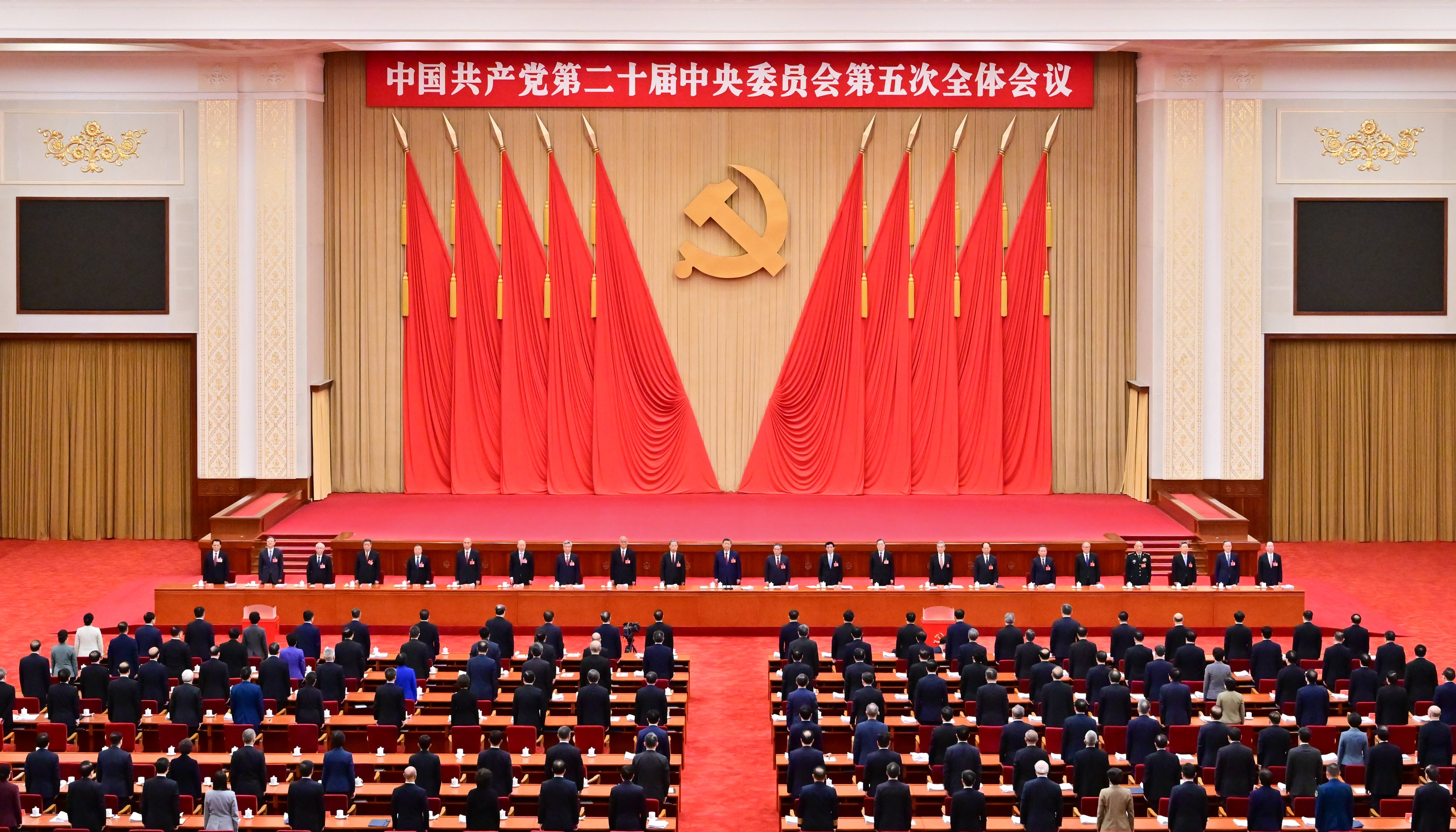
The Fifth Plenum Resolution on full and rigorous Party self-governance reveals a distinct asymmetry in the distribution of power within the Chinese Communist Party (CPC). While the Resolution imposes restrictions on personal authority among lower-level Party leaders, it simultaneously affirms Xi Jinping’s central position. This article examines the institutional mechanisms of oversight, the role of the Central Committee, and the implications of recent expulsions for political accountability within the Party. It argues that the Resolution consolidates authority at the centre while limiting its concentration at subordinate levels, raising important questions about the distribution and oversight of power in the CPC.
Introduction
On 29 October 2026, the fifth plenary session of the 20th Central Committee of the Communist Party of China (CPC) adopted a Resolution on full and rigorous Party self-governance (全面从严治党, quanmian congyan zhidang). The Resolution contains two provisions that point in opposite directions on the question of personal authority. The first forbids the head of any Party committee to demand that subordinates uphold the head’s personal authority (个人权威, geren quanwei). The second calls the establishment of Xi Jinping’s core position (核心地位) a major political achievement of decisive significance. Read together, the two provisions form a single design, in which personal authority is concentrated at the centre and prohibited at every level below it. The checks in the Resolution send information upward, from each level of the Party to the level above it. In formal terms, the top leadership answers to the Central Committee, but that body has itself been reduced by expulsions and refilled by promotion.
Restrictions on Leadership Team Heads
Section III of the Resolution regulates the “number one” (一把手, yibashou), which is the term the Chinese text uses for the head of a Party committee or a leading Party members group. Major issues must be decided through collective discussion, and no decision may be forced when there are major differences of opinion on key issues. The head must be the last to express opinions in a meeting (末位表态制), and special meetings of Party committee secretaries (书记专题会议) may not replace meetings of the standing committee. Heads must also resist dictatorial and paternalistic styles of work (一言堂, 家长制), and they may not change a collective decision on their own. The Resolution also strengthens peer oversight (同级监督), under which members of a leadership team must raise problems directly with the head and report serious problems to the higher-level Party organisation. Every one of these checks moves information about a head to the level above that head.
Authority Established at the Centre
The Resolution treats authority at the top of the Party in a very different way from authority below it. Its introduction says that establishing Mr. Xi’s core position and the guiding role of his Thought is of decisive significance (决定性意义), and its section on loyalty asks members to understand the “Two Establishments” (两个确立) and to follow the leadership core. A search of the official Chinese text finds no mention of 中央政治局 (the Political Bureau), 总书记 (the General Secretary) or 中央军委 (the Central Military Commission), and the English text has none of them either. The silence on the commission matters because, by the count of an Asia Society Policy Institute analysis, the CMC has been reduced to two members, Mr. Xi as chairman and General Zhang Shengmin, and the communiqué named no new members. When the Resolution refers to the central Party leadership (党中央), it asks lower organisations to request instructions from it and submit reports to it (请示报告). It also says that the oversight of officials should start with high-ranking officials (从高级干部抓起). This instruction says where oversight begins, but it gives no reporting or review procedure for any person or body at the top of the Party.
The Principal Objection and a Response
The strongest objection rests on Section III.1, which says that all organisations and members of the Party defer to the National Congress and the Central Committee (全国代表大会和中央委员会). The Resolution’s guiding principles also say that strict self-discipline should proceed starting from the Central Committee (从党中央做起). On this reading, the top leadership is accountable to a formal body, but the record of the fifth plenum does not support that view. The Central Committee elected in 2022 had 205 full members and 171 alternate members, while only 162 full members and 117 alternate members attended the plenum. The Political Bureau presided over the session, and the plenum confirmed the Political Bureau’s earlier decisions to expel 33 members, 17 civilian and 16 military, before filling empty seats by promoting ten alternates. Since 2017, Political Bureau members have had to submit annual written reports to the Central Committee and to Mr. Xi as General Secretary. In my assessment, these facts show that the body to which the leadership formally answers now ratifies the decisions of the body it is meant to check.
Assessment of the Plenum’s Design
In a single session, the fifth plenum confirmed a large number of expulsions and adopted a rule against personal authority below the centre, and these two acts are best read as parts of one project. Mr. Xi set the requirements for drafting the Resolution and explained it to the plenum, so the text that names no check on the apex was prepared under the direction of the apex itself. The expulsions reached both the civilian and the military hierarchies, while the Resolution makes it harder for any future head of a Party committee to build the kind of personal following that the core is allowed to hold. This reading makes no claim about the motives of Mr. Xi or the Political Bureau, which the documents do not reveal, and rests only on what the text prescribes and what the communiqué counts. The outcome is a system in which concentrated authority at the top is called an achievement, while the same concentration in a province, a ministry or a state enterprise is treated as a breach of democratic centralism (民主集中制).
Indicators for the 21st Party Congress
The argument can be tested before the 21st National Congress, which the communiqué has scheduled for the second half of 2027. The first test is the set of implementing regulations that will follow the Resolution, and the second is the make-up of the 21st Central Committee and the Central Military Commission. The communiqué also mentions a new round of elections at all levels, and these elections will show whether the rules on heads are applied when new provincial and local leadership teams are chosen. If the implementing regulations place the Political Bureau and the Central Military Commission under reporting and oversight procedures similar to those now set for the heads of Party committees, the argument made here will be weaker and will need revision.
(The views expressed are those of the author and do not represent views of CESCUBE)
Image Source: Ministry of Foreign Affairs People’s Republic of China, https://www.mfa.gov.cn/eng/xw/zyxw/202610/t20261029_12049543.html

Venkatakrishnan Asuri is an undergraduate student at the Indian Institute of Technology Madras. His research spans South Asian security, Chinese strategic affairs, India's neighbourhood, and the dynamics of the Indo-Pacific, with a particular focus on strategic affairs, defence, and foreign policy. He is fluent in English, Tamil, and Hindi, with working proficiency in Russian.