China's Surveillance Architecture in the Bay of Bengal and Its Strategic Implications

Introduction
India's National Maritime Security Strategy 2026, released in April, was the first Indian naval doctrine to formally state that the next phase of Bay of Bengal competition would be shaped not by naval orders of battle but by ports, logistics networks, dual-use facilities, and sustained pressure below the threshold of armed conflict. By the time it was released, many of the components of such an architecture were already in place across Bangladesh's territory, the product of a sequence of bilateral arrangements and commercial contracts with individual plausibility insulating them from scrutiny.
This article argues that China's commercial and defense infrastructure presence in Bangladesh constitutes a de facto dual-use architecture whose strategic value lies in its persistence and geographic concentration rather than in any single component. Each layer of this surveillance architecture addresses a different strategic limitation, while the underlying logic remains commercial plausibility: every component passes bilateral legitimacy tests in isolation, which is precisely what makes the aggregate difficult to challenge through conventional policy instruments. India's Parliamentary Standing Committee on External Affairs entered its own assessment of this picture into the parliamentary record on July 30, 2026.
The Signals Layer
The telecommunications layer rests in two separate, but consequential parts. In December 2021, Huawei and state-owned Teletalk jointly launched Bangladesh's first 5G network in Dhaka, and the following year Grameenphone, the country's largest private operator, conducted 5G trial runs across all divisional cities in partnership with Huawei and ZTE, with the Bangladesh Telecommunication Regulatory Commission's chairman present at the launch event. Bangladesh's regulatory framework mandates, separately, that this infrastructure be interceptable in real time by national security agencies. The 2024 BTRC unified licences committed all four operators to build-outs on existing network architectures, and the 2022 spectrum auctions in the 2.3GHz and 2.6GHz bands extended that dependency across a 15-year term.
Clause 25 of the BTRC 4G licence agreement obliges every mobile network operator to enable real-time access to user information, bulk data interception, and live database monitoring by security agencies, specifically the National Telecommunication Monitoring Centre. The BTRC's own licensing documentation requires operators to maintain traffic data, call detail records, and IP detail records for six months and to provide remote access at any time. The Integrated Lawful Interception System, built by US-based Yaana Technologies at a cost of $51.7 million, draws from this substrate and is capable of capturing all electronic communications originating, terminating, or passing through Bangladesh.
In November 2023, an NTMC database exposed to the open internet was found to contain communications metadata, which Wired magazine described as the "who, what, how, and when" of everyone's communications, alongside fingerprints, passport details, and vehicle registrations. The NTMC Director General acknowledged the exposure but characterized the data as "sample data provided to vendors for development purposes," a framing that confirms, at minimum, vendor access to the data architecture. The signals layer is legally mandated, operationally active, and running on a network Huawei built.
The Airborne Layer
On January 27, 2026, the Bangladesh Air Force signed a government-to-government defense agreement with CETC International, the export arm of China Electronics Technology Group Corporation. The agreement, worth approximately $55 million and formally designated "Establishment of Manufacturing Plant and Transfer of Technology for Unmanned Aerial Vehicles," covers the manufacture and domestic assembly of Medium Altitude Long Endurance drones with vertical take-off and landing capability. CETC's core expertise spans radars, electronic warfare systems, secure communications architecture, and sensor fusion, all of which are embedded in the ground control station and data link infrastructure that accompanies the drone platform. Chinese Ambassador Yao Wen attended the signing ceremony alongside Air Chief Marshal Hasan Mahmood Khan, a detail that marks the deal's weight in bilateral terms.
The mechanism by which this creates potential Chinese-attributable operational reach is navigational. CETC platforms navigate on BeiDou, China's state-operated satellite navigation system, rather than GPS. BeiDou operates a two-way short-message service that enables real-time tracking of registered assets, a capability the US government's GPS advisory board assessed in 2023 as now exceeding GPS in several technical respects. The US Treasury has sanctioned Chinese entities for supplying navigation components to Iranian UAV manufacturers through civilian trading networks, establishing the regulatory recognition that this telemetry pathway constitutes a controlled export.
When Bangladesh Air Force platforms fly Bay of Bengal ISR missions on BeiDou navigation, their positioning and telemetry data transits Chinese-controlled satellite infrastructure as a consequence of that design. Whether ISR payload data, the imagery and signals the platform actively collects, follows the same pathway is not established in open sources and should not be asserted as such. The operational implication of this is documented in the Bloomsbury Intelligence and Security Institute's April 2026 documentation of China's Iran drone architecture confirms that navigational and sensor-layer dependency produces real-world operational reach for China without requiring a single Chinese crew member in the partner's territory. During Operation Sindoor in May 2025, Pakistani infiltrators used Huawei satellite phones linked to BeiDou for navigation and communication, the same enabling-layer model, in the same security theatre, one year before CETC drones begin manufacturing in Dhaka. The navigational dependency is documented. The broader ISR data access question is assessed rather than confirmed, and the analysis is calibrated accordingly.
The geographic context is equally specific. MALE platforms of the class covered by the BAF-CETC agreement have operational radii sufficient to monitor the Siliguri Corridor, which constitutes India's only land connection to its eight northeastern states. Lalmonirhat airbase, 12-15 kilometers from the Indian border and approximately 135 kilometers from the Corridor, has been revived since early 2025, with Chinese official site visits documented, a 4-kilometer runway resurfaced for heavier platforms, and a hangar constructed for medium-lift aircraft and UAVs. In India’s official response, in a Lok Sabha written reply, Minister of State for External Affairs Kirti Vardhan Singh stated that India had noted reports on Lalmonirhat, sought assurances from Dhaka, and "continues to monitor all developments having a bearing on national security."
Maritime Architecture
Chinese survey vessels have been documented operating near four separate sensitive Indian military activities between March 2024 and December 2025, including during the August 2024 Bay of Bengal subsurface firing exercise and what analysts assessed as a K-series SLBM trial in December 2025. In July 2025, a Chinese research vessel was tracked by French maritime intelligence firm Unseenlabs operating approximately 120 nautical miles from Indian waters with its Automatic Identification System switched off, assessed as conducting seafloor mapping and submarine transit corridor identification consistent with anti-submarine warfare preparation. These operations carry strategic weight, and are episodic.
The strategic function of China's Bangladesh maritime architecture is with regards to establishing a permanent Chinese logistical capacity. BNS Pekua, inaugurated in March 2023 at Pekua in Cox's Bazar District, was built by Chinese contractors at a cost of $1.21 billion, can simultaneously accommodate six submarines and eight warships, and houses two Chinese-manufactured 035G submarines with Chinese training personnel in residence. Senior PLA Navy officers attended the inauguration ceremony. Cox's Bazar is also where Bangladesh's SEA-ME-WE-4 cable landing station operates and where SEA-ME-WE-6 will land, with BTRC policy mandating a surveillance terminal at the cable landing station. A submarine base and international cable infrastructure coexist in the same coastal district, with a mandatory monitoring point at their geographic intersection.
Mongla Port extends the maritime footprint toward India's western coastal approaches: the Mongla Port Authority signed a government-to-government contract with China Civil Engineering Construction Corporation in March 2025 to expand the port's container handling capacity from 150,000 to 400,000 TEU annually, and in June 2026, during Prime Minister Tarique Rahman's Beijing visit, Bangladesh formally awarded CCECC the Mongla Port Economic Zone on 110 acres that had been reserved for Indian investment since 2015. The Yunus interim government and the Rahman elected government each signed successive agreements at the same site across an 18-month period.
Conclusion
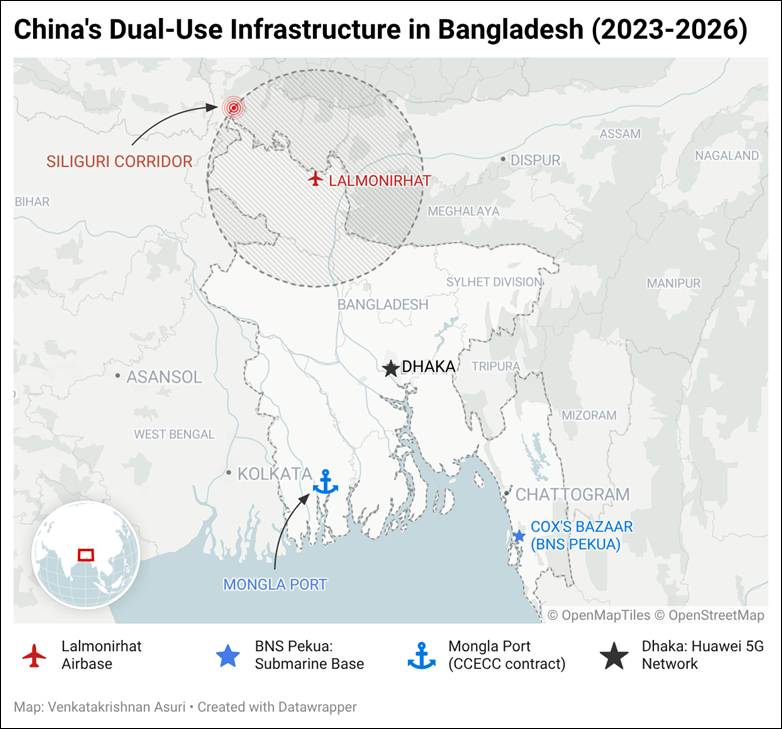
The Parliamentary Standing Committee on External Affairs, in its July 30, 2026 report, named BNS Pekua, Mongla Port, and Lalmonirhat airbase in a single paragraph, characterizing all three as components of "the increasing Chinese footprint in Bangladesh, particularly in infrastructure development, port expansion, and defence cooperation," and specifying concern for the Siliguri Corridor and the Bay of Bengal. The committee observed that BNS Pekua has capacity for eight submarines while Bangladesh operates two, a discrepancy with no commercial or purely defensive explanation. India therefore, confronts not a collection of Chinese projects but the cumulative weight of infrastructure built, component by component, through commercial contracts and bilateral cooperation agreements that are individually legitimate and collectively consequential.
(The views expressed are those of the author and do not represent views of CESCUBE)
Image Source: AI Generated

Venkatakrishnan Asuri is an undergraduate student at the Indian Institute of Technology Madras. His research spans South Asian security, Chinese strategic affairs, India's neighbourhood, and the dynamics of the Indo-Pacific, with a particular focus on strategic affairs, defence, and foreign policy. He is fluent in English, Tamil, and Hindi, with working proficiency in Russian.