Prism of Dragon’s Maritime Assertiveness: Regional Implications and India’s Strategic Options
Introduction
China's aggression in the Indo-Pacific region has put the region's existing status quo and rules-based order under pressure. One major aspect of this is the use of Grey Zone Tactics, which are just below the line of open military conflict. These strategies involve diplomatic, economic, military, paramilitary, cyber and information instruments to apply pressure, but not necessarily through a conventional response. The South China Sea is clearly the most obvious example of this policy, especially since a number of Southeast Asian countries have overlapping claims with China.
Michael Mazarr's research contributed to the emerging concept of 'grey-zone' operations as a method of 'strategic competition' that seeks to ‘scare' adversaries away from conflict but still engage them in ways that are not viewed as outright aggression. Influence and coercion can also be applied just below the level of armed conflict, as David Kilcullen's discussion of the continuum of conflict can explain. This is the near-identical concept to Sun Tzu's ubiquitous concept of winning without fighting. Beijing has, in fact, no doubt inculcated this in practice and assembled the tools to achieve that goal from the military, the paramilitary, and the civilian spheres.
Therefore, the Chinese approach is not solely to be seen in terms of naval deployments. Economic connectivity, infrastructure, commercial ports, maritime research, and information operations can also serve as long-term means of influence. A common dispute over China's overseas infrastructure and port projects is their potential to create economic dependency and strategic access points. Not all such projects are necessarily military, nor are all commercial links strategic traps. However, commercial links, logistics and political cooperation can begin to affect the strategic situation over time. The big picture is important to understanding China's maritime strategy.
China’s Militia in the South China Sea
The People's Armed Forces Maritime Militia (PAFMM) and Chinese Coast Guard (CCG) are the key actors in China's grey zone maritime operations. They can perform functions like those of civilian or law-enforcement agencies and promote Chinese strategic interests. These forces are more likely to be present and gradually extend their control over contested waters, making it hard for other states to determine when to escalate the response to a military one. The method is gradual; that is, it is done in small stages, not all in one big shot.
As a result, the PAFMM, the CCG, and state-sponsored fishing fleets can be considered grey-zone enforcers. They're engaged not just in maritime activity but also in legal arguments, claims of sovereignty, and psychological pressure. Andrew Erickson and Ryan Martinson have highlighted the importance of the Maritime Militia and its close relationship with the Chinese state. This uncertainty is also edifying because neighbouring governments have to deal with such an activity, which may be ostensibly civilian in nature, without necessarily knowing if it has a more strategic purpose.
In an onset of 2025, CCG operations were concentrated at key flashpoints also in the first half of 2026, maritime surveillance data is an evidence that there is considerable increase in CCG activity near Scarborough Shoal. This is very simple lesson: the presence of a persistent vessel at sea can be a means as well as aim to control.
Grey-zone competition also takes place in the information space. It seems Beijing has been depicting the building of islands and other activities in the South China Sea as peacebuilding, scientific, humanitarian or environmental efforts. The competition is thus more than just about ships and territory. It is also the struggle over competing understandings of sovereignty, of legality and legitimate maritime rights.
China’s Strategy in the Indian Ocean
This is very different from China's action in the South China Sea. In the Western Pacific, its grey-zone operations have tended to align with the territorialities of its claims and bolster de facto control over contested waters. In the Indian Ocean, the focus seems to be more on strategic presence, intelligence gathering, maritime familiarisation, and the progressive buildup of operational access. This is important when evaluating China's aims in various oceans.
The research vessels and fishing fleets from China have thus become more noticeable from a naval geostrategic perspective. Research ships are legitimate civilian vessels, and it would be wrong to characterise any and all scientific efforts as hostile. Meanwhile, hydrographic data, seafloor information, and other maritime know-how can be used in the future for naval activities, in addition to their dual use. Concurrently, hydrographic data has a dual use for naval operations in the future, as does seabed data and other forms of maritime knowledge. It is this "grey zone" between scientific activity and strategic value that is contributing to the broader conversation about China's grey zone competition.
The ambiguity was visible when the Chinese scientific ship, Xiang Yang Hong-33, was seen near Kalayaan Island Group in May 2026, and CCG and maritime militia ships were seen around the islands. Civilian research, coast guard activity, and maritime militia operations might also occur in the same strategic setting. Beijing may not only be attempting to replicate the South China Sea model in the Indian Ocean. But also these exists a havoc that, knowledge and influence can be achieved over time through research, commercial relationships, and repetition.
What Lies in India’s Strategic Options?
The growing grey-zone operations by China pose a threat to India that can only be mitigated through measures other than military might. More awareness of maritime issues, more institutions, and more regional cooperation are needed due to the unclear situation regarding research vessels, fishing fleets, and coast guard operations.
The first would be to boost Maritime Domain Awareness in the Indian Ocean region in India. But more surveillance and information sharing would help ensure that there isn't a significant amount of maritime activity that goes unobserved; that doesn't mean every civilian or scientific vessel is necessarily antagonistic. This is a significant advantage for India due to its geographical location. The Andaman and Nicobar Islands are located near the eastern entrance to the Indian Ocean and the Strait of Malacca, a major shipping lane that links the Indian and Pacific Oceans. Enhanced surveillance systems, information systems, and naval strength can help India keep a check on activities in the Bay of Bengal and the Andaman Sea and safeguard the sea lines of communication.
Second, there is a need for firmer institutional and legal answers to the activities that do not reach the level of armed conflict in India. The issue with grey-zone tactics is that they lead to exactly that. What should a state do when an activity is concerning but too far for a military response? Greater coordination should be established among all maritime institutions, including the Indian Navy and Coast Guard, to enable a more flexible response to vessels and activities that fall between civilian and strategic uses.
Third, India needs to further strengthen cooperation in the region. Cooperation among the Quad nations and Indian Ocean littoral states can enhance information sharing, transparency and collective awareness among nations of the Indian Ocean. This should not be seen as an anti-China measure. The more beneficial goal is to enhance maritime security, freedom of navigation and regional states' capacity to safeguard their legitimate interests. The Indian initiatives, such as SAGAR and the Indian Ocean Initiative of MAHASAGAR, for greater practical cooperation, capacity development and interoperability.
Last but not least, India needs to build its own asymmetric capabilities. This is not to copy what China does – its coercive methods. Instead, India should be able to handle uncertainty without escalating each incident to a military level. A robust and improved Coast Guard, with enhanced technological monitoring, information operations, and appropriate legal tools, would provide New Delhi with more choices than armed conflict would. The Indian response to grey-zone competition should thus be a mix of geography, technology, institutional readiness, and regional partnerships.
Conclusion
China's assertiveness in the sea manifests through military, economic, technological, and informational parameters, without intrusion into conventional battle. The solution for India is not to match China, just to match China, vessel by vessel. In order to acknowledge the evolving nature of the maritime competition and to harness the opportunities it has already created. Greater awareness, robust institutions, regional cooperation, and better use of geography can help India safeguard its interests without compromising its strategic autonomy. That could be more useful than a heavy reliance on naval power in an Indo-Pacific expected to be competitive but not in open conflict.
(The views expressed are those of the author and do not represent the views of CESCUBE)
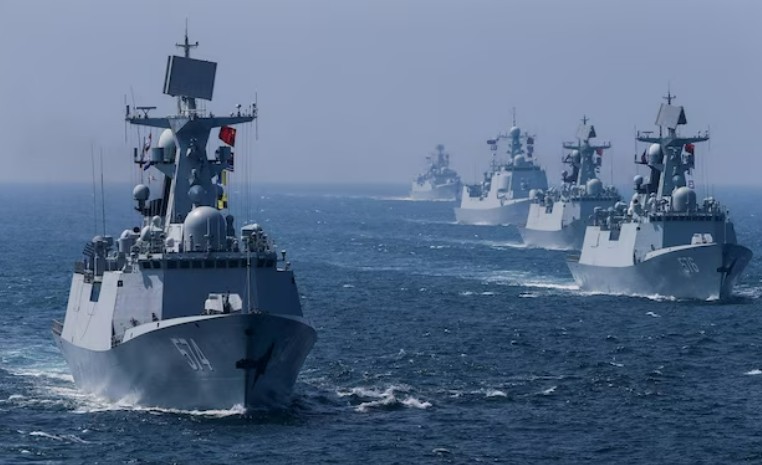
Image Source: India Today, https://www.indiatoday.in/world/story/will-china-join-iran-war-us-trump-hormuz-strait-blockade-2896439-2026-04-15

Priyangshu Chakraborty is currently working as Operation Head at Hegemoniq, Geopolitical Think tank based at North-eastern state of Assam in India. He pursued his Masters in Political Science from Assam (A central) University with keen interest with International Relations. His research area induces with Indian Foreign Policy particularly with Southeast and South Asian countries, Indo-Eurasia limelight and Northeast Indian paradigm. Sumanta Khatiwara is an international relations researcher. He pursued Integrated M.A. in Political Science, Pondicherry University, India. His research interests include International Relations, Public Policy, Governance, Political Economy, Northeast India, and South Asian geopolitics, with a particular focus on India-Nepal relations, diaspora diplomacy, and digital governance.