Sports, Strategy and Statecraft of Mega Sporting Events as Geoeconomic Instruments: Qatar 2022 to Saudi Arabia 2034
Mega sporting events are increasingly becoming instruments of statecraft rather than merely celebrations of athletic competition. In an era where economic influence, international reputation, and strategic positioning are central to national power, events such as the FIFA World Cup provide governments with opportunities to project soft power, attract investment, strengthen diplomatic relationships, and accelerate domestic transformation. For resource-rich Gulf states seeking to diversify their economies and reduce dependence on hydrocarbons, hosting global sporting spectacles has emerged as a key component of broader geoeconomic and geopolitical strategies.
This article examines Qatar's hosting of the 2022 FIFA World Cup and Saudi Arabia's preparations for the 2034 tournament through the lenses of geoeconomics, soft power, and economic statecraft. It argues that these events function as strategic policy instruments designed to enhance international influence, attract global capital, modernise infrastructure, and support long-term economic diversification agendas. The article also explores debates surrounding sportswashing, institutional legitimacy, human capital development, and the role of sport in national transformation. By linking global sporting events to broader questions of economic resilience, international standing, and domestic reform, the article demonstrates how football has become an increasingly important arena of twenty-first-century geopolitics and strategic competition.
Introduction
FIFA World Cups used to be about football. Not anymore. Mega sporting events have evolved into calculated instruments of geopolitical influence that are now deployed by states with the same deliberation they bring to trade negotiations, bilateral treaties, and multilateral institutional positioning (Boykoff, 2022). The concept of Geoeconomics, as formulated by Robert D. Blackwill and Jennifer M. Harris, attests the deployment of economic instruments by a state to promote and defend national interests, producing geopolitical outcomes without recourse to military force (Blackwill & Harris, 2016)
Applying this geoeconomic lens alongside theories of soft power and competitive advantage to the much talked about the last FIFA World Cup held in Qatar in 2022 and a promising next, announced FIFA World Cup in Saudi Arabia 2034, reveals a coherent strategic architecture. Viewed through this framework, mega sporting events become geoeconomic assets: states deploy financial resources into globally visible sporting infrastructure to generate long-term economic competitiveness, diplomatic leverage, and strategic influence. Both Gulf states are deploying sovereign wealth to accelerate their structural transition away from a demonstrably perilous dependence on hydrocarbon revenues. Beyond economic diversification, they are leveraging the global visibility of these events to restructure their international standing and embed themselves within the governance architecture of major international institutions (Brannagan & Reiche, 2025).
Soft Power and the "Push-Pull" of Geopolitical Renegotiation
How, precisely, does a sporting tournament accomplish objectives of a certain magnitude? The answer begins with soft power theory and with the "push-pull" dynamics of geopolitical recognition.
Soft power, famously from Joseph Nye's foundational formulation, denotes a state's capacity to attract and persuade through cultural appeal rather than material inducement or coercive threat. When Nation states host mega sporting events, they construct expansive global platforms to project cultural sophistication, technological capability, and organizational competence, generating signals of institutional credibility to which foreign investors and diplomatic counterparts demonstrably respond. To grasp the more precise strategic logic at work, Sharples & Lee ( 2026) advance a more exacting claim: hosting nations do not passively attract international prestige; they execute simultaneous dual manoeuvres. On one hand, they "pull" diplomatic recognition, foreign capital, and institutional partnerships. On the other hand, they exploit the international leverage their elevated status confers to "push" against constraining political relationships and neutralise regional rivals that impede autonomous economic development.
Yet this framework has a well-documented ceiling. Critics characterize this noted broader strategy as "sportswashing", the instrumentalization of sporting spectacle to obscure poor human rights records and deflect scrutiny from authoritarian governance (Boykoff, 2022). Hosting a major global tournament demonstrably intensifies, rather than diminishes, international media scrutiny of domestic political conditions. Shifting mass public opinion through a sporting association is not merely difficult; it is, in all probability, a secondary objective.
What, then, is the primary objective? Institutional normalisation through structural financial embedding. By channelling sovereign wealth into the commercial and operational infrastructure of international sporting bodies like FIFA, these states render themselves financially indispensable to those organisations' continued functioning. The logic parallels that of an anchor tenant in commercial real estate: once a party underwrites structural viability, extracting that party dismantles the edifice entirely. Gulf states have embedded themselves so thoroughly within the business architecture of global sport that severance would impose prohibitive practical and financial costs on Western counterparts, making institutional exclusion effectively untenable as a policy instrument. (Devendra, 2025)
Geoeconomics and the Post-Hydrocarbon Competition
The resource curse literature documents what Saudi Arabia and Qatar have experienced: economies constructed so thoroughly around crude oil and natural gas export revenues that commodity price volatility triggers cascading fiscal crises at the national level. Hydrocarbon revenues account for the overwhelming proportion of Saudi Arabia's national budget, leaving the tourism, services, and manufacturing sectors in a condition of prolonged structural underdevelopment.
Nicolescu & Barbu, (2024) Contend that oil rich states Qatar and Saudi primarily are now deploying mega sporting events as calculated geoeconomic instruments of economic restructuring, enacting precisely the competitive upgrade logic that Michael Porter's framework prescribes: deliberate, state directed investment in foundational national assets, infrastructure, technology, and human capital, to establish durable competitive positions in high value global industries. Qatar deployed the 2022 World Cup to modernise its urban infrastructure at compressed speed, repositioning a small Gulf state as an internationally recognised hub for sports tourism and business services. Saudi Arabia is pursuing this logic with considerably greater ambition: Vision 2030's development targets are directly integrated with the 2034 World Cup hosting mandate, establishing goals of attracting 150 million tourists annually and generating 1.6 million new tourism sector jobs by 2030.
However, a significant counterargument demands our direct engagement. The immediate return on investment calculus is unfavourable on practical terms when considering immediate payback from the investment: ticket revenues and visitor expenditure during a World Cup tournament period rarely approach, let alone recover, the billions committed to construction and infrastructure development.
Scholars who raise this fiscal objection are not mistaken about the numbers; they are, however, measuring the wrong variable. The 2034 World Cup is not configured as a revenue-generating event. It functions as a catalytic enabling investment, inducing far broader transformations in hospitality capacity, transport connectivity, and development initiatives of the scale of NEOM and Qiddiya. The FIFA world cup tournament thus acts as the ignition mechanism; whereas the permanent competitive position in global leisure and services constitutes the intended structural outcome.
It is necessary to acknowledge, however, that precise quantification of the economic returns from restructuring at this systemic scale remains methodologically contested. Conventional economic modelling tools were not designed to capture economy wide transitions of this magnitude, and longitudinal outcome data is still preliminary. What the available evidence does establish is directional: these events function as temporal compression mechanisms, accelerating structural transformations that would otherwise unfold across several decades (Remy-Miller, 2017)
Domestic Returns: Human Capital and Social Equity
The investment calculus governing these mega events does not terminate at airports and football stadiums. These events serve a precise endogenous purpose: the deliberate construction of a healthier, more economically productive national workforce.
In contemporary International Relations, state power is increasingly assessed not only through military capabilities but also through the quality of human capital, public health resilience, and economic productivity. Since the COVID-19 pandemic, healthy populations have come to be understood. as strategic national assets underpinning economic competitiveness and geopolitical influence. Against this backdrop, Saudi Arabia's investment in sport infrastructure through Vision 2030 serves not merely domestic welfare objectives but contributes directly to its broader geoeconomic strategy. The scale of Saudi Arabia's public health challenge is significant and well documented. The country's adult obesity rate stands at 40.6%, driven by structurally embedded patterns of physical inactivity, a condition that simultaneously constrains workforce productivity and imposes substantial fiscal pressure on state healthcare expenditure. Physical activity participation is correspondingly low: only 13% of Saudi citizens currently exercise at least once weekly. The government has established a target of 40% participation by 2030. The 2034 World Cup is consciously configured as a top-down behavioural catalyst, harnessing the mobilizing power of global sporting events to shift population level health behaviours in ways that conventional public health interventions have demonstrably failed to achieve at scale. (Boykoff, 2022)
What emerges from closer analysis is how consequentially this logic extends to community-level infrastructure investment. The $23 billion Sports Boulevard project in Riyadh, a figure that, for context, exceeds the annual GDP of numerous low-income states, creates permanent public infrastructure designed to normalise physical activity as an everyday civic practice. As we traced in analysis of structural institutional embedding, the pattern recurs here: investments that appear narrowly sectoral generate compounding systemic returns. The accelerated development of women's sports and the establishment of the Saudi Women's Premier League represent measurable social progress amid calculated political liberalization, one in which sporting events provide the legitimating international context for domestic reforms that would otherwise encounter considerably stronger internal resistance. (Nikolaou et al., 2023)
The human capital argument ultimately integrates the domestic and the geopolitical into a coherent whole. A healthier, more economically active citizenry reduces the healthcare expenditure burden on state finances, expands the productive labour force, and sustains the consumer services economy that Vision 2030 requires for long-term viability. This convergence, where the domestic development imperative and the international repositioning agenda become mutually reinforcing rather than competing priorities, constitutes the central analytical finding of this article.
Conclusion
Examined through appropriate analytical frameworks, Qatar 2022 and Saudi Arabia 2034 do not resemble conventional sporting events. They resemble precisely engineered policy instruments, ones that happen to involve football.
As this article has traced across four interconnected arguments, Nye's soft power push pull dynamics, Blackwill and Harris's geoeconomic framework, Porter's competitive advantage logic, and the domestic human capital thesis, these events function as multilayered instruments of deliberate state strategy. They attract investment, tourism, and international partnerships while simultaneously repositioning host states within regional and global power structures.
More than this, they serve as pivotal catalysts for long term economic diversification, compelling infrastructure modernization, accelerating human capital formation, and constructing entirely new competitive sectors in an international environment where hydrocarbon dependency has become an acute and intensifying strategic vulnerability. Qatar and Saudi Arabia are not pursuing short-term financial returns from ticket revenues. They are deploying month long global spectacles to consolidate decades of economic transformation, institutional positioning, and international status elevation. In an era where economic resilience, institutional influence, and strategic reputation increasingly define international power, mega sporting events should be understood not merely as spectacles of global entertainment but as instruments of twenty-first-century statecraft. While the debate around sports washing garners attention and criticism, what might get overlooked here is the strategic statecraft through human development.
References:
1. Blackwill, R. D., & Harris, J. M. (2016). The lost art of economic statecraft. Restoring an American Tradition. Foreign Affairs, 95 (2, 99–110.
2. Boykoff, J. (2022). Toward a theory of sportswashing: Mega-events, soft power, and political conflict. Sociology of Sport Journal, 39 (4, 342–351).
3. Brannagan, P. M., & Reiche, D. (2025). Saudi Arabia and the 2034 FIFA World Cup: Context, strategy, critique. International Journal of Sport Policy and Politics, 17 (4, 705–715.
4. Devendra, N. (2025). Soft power or geoeconomic contest? A comparative study of Gulf sport diplomacy. Public Relations Inquiry, 15 (1, 97–118.
5. Nicolescu, L., & Barbu, A. (2024). The impact of mega sports events on the strength of the national soft power. A Comparative Analysis. Proceedings of the 18th International Conference on Business Excellence, 335–345.
6. Nikolaou, E. E., Konteos, G., Kalogiannidis, S., & Syndoukas, D. (2023). Mega sporting events and their socio-economic impact: Case study of the 2022 FIFA World Cup. Journal of Infrastructure.
7.Remy-Miller, K. (2017). Sports in the desert: How Qatar, Abu Dhabi, and Dubai are employing sports to make economic, political, and international gains. Brandeis University.
8. Sharples, B., & Lee, J. W. (2026). Sport mega-events, geopolitical renegotiation, and soft power: Introducing a framework of pushing and pulling. Sport in Society. Advance online publication. https://doi.org/10.1080/17430437.2026.2635447
(The views expressed are those of the author and do not represent the views of CESCUBE)
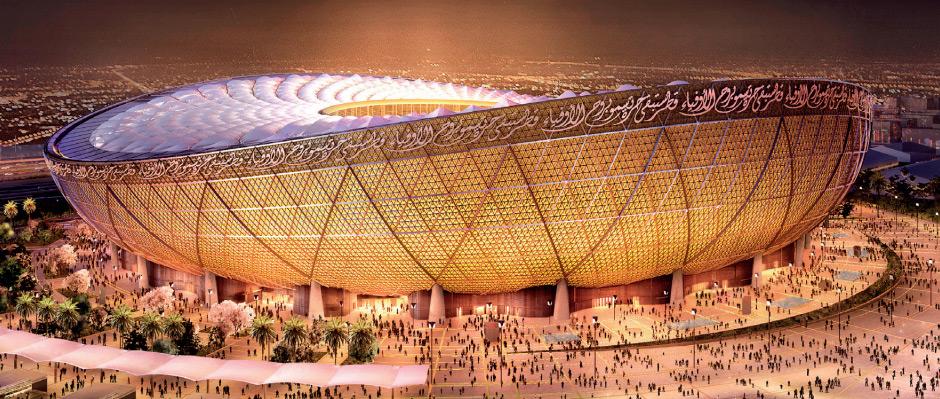
Image Source: Lusail Stadium, StadiumDB.com, https://stadiumdb.com/news/2015/03/qatar_2022_foster_to_design_the_iconic_lusail_stadium

Aaditya Dewansh is a postgraduate scholar of International Relations at South Asian University, New Delhi. His research interests include Geoeconomics, Grand Strategy, and the Geopolitics of the Indian Ocean Region. He also holds a Master’s degree in Arts and Aesthetics from Jawaharlal Nehru University. Beyond academia, his wider interests include travel & tourism, world cinema, and global popular culture.