Great Power Rivalry and the Crisis of the United Nations
The United Nations was established in 1945 with the ambitious goal of preserving international peace, promoting collective security, and preventing future global conflicts. For decades, it has served as the primary forum for diplomacy, conflict resolution, humanitarian assistance, and international cooperation. Yet as the international system transitions from a largely US-led order to an increasingly multipolar world, the effectiveness of the United Nations has come under growing scrutiny. Intensifying competition among major powers, repeated use of the Security Council veto, and the inability to respond decisively to major international crises have raised fundamental questions about the organisation's relevance and credibility in the twenty-first century.
This article examines how great power rivalry has contributed to the ongoing crisis of the United Nations and the broader challenges facing multilateral governance. It analyses the structural limitations of the Security Council, the political implications of veto power, and the impact of geopolitical competition on international decision-making. Drawing on contemporary examples ranging from Gaza and Ukraine to broader US–China strategic competition, the article argues that the current institutional framework reflects the power realities of 1945 rather than those of today's world. It further explores proposals for Security Council reform, including expanding representation and placing limitations on the use of the veto. Ultimately, the article contends that preserving the relevance of the United Nations will require reforms that balance great-power participation with greater accountability, legitimacy, and responsiveness to contemporary global challenges.
The international system is undergoing a profound transformation, marked by a gradual shift from a US-led, rules-based international order towards an increasingly multipolar world (Szewczyk, 2012). In this evolving geopolitical environment, major powers are placing greater emphasis on nationalism, strategic competition and bilateral partnerships rather than broad-based multilateral cooperation (Romero and Patrick, 2026). This shift has weakened political and financial support for multilateral institutions, including the United Nations, which now faces persistent budgetary constraints, operational challenges and growing difficulties in fulfilling its global mandate (Areddy, 2026).
In the immediate aftermath of the Second World War, world leaders gathered in San Francisco in 1945 to establish an ambitious multilateral institution known as the United Nations (UN). Led by the victorious Allied powers such as the United States (US), the Soviet Union and Great Britain and supported by delegates from 50 countries, the conference laid the foundation for a new international order based on collective security, international cooperation and the peaceful resolution of disputes. Officially established on 24 October 1945, the UN embodied the shared determination to replace the rule of force with the rule of law and to prevent future generations from experiencing the devastation of another global war (Lissowsky, 2025).
However, since its establishment as the successor to the League of Nations, which failed to prevent the Italian invasion of Abyssinia, the Japanese invasion of Manchuria and the outbreak of the Second World War, the UN has also struggled to fully realise the objectives enshrined in its Charter (Simma, Khan, Nolte & Paulus, 2024). While some scholars argue that the UN has played a significant role in preventing another global conflict on the scale of the First and Second World Wars, this achievement cannot be attributed solely to the UN. Rather, the deterrent effect of nuclear weapons and the doctrine of mutually assured destruction have arguably been more decisive factors in preventing direct military confrontation among the major powers (Cooley, 2025).
One of the principal reasons for the United Nations’ inability to fully implement the principles and objectives enshrined in its Charter has been the persistence of great power rivalry. The Charter calls upon member states to resolve disputes peacefully through dialogue, respect the sovereignty and territorial integrity of states and refrain from the threat or use of force against one another. In practice, however, major powers have repeatedly violated these principles with relative impunity (Hynes, 2026). Political influence, military superiority and the veto power in the Security Council have often shielded powerful states from meaningful accountability, exposing the absence of an effective international enforcement mechanism capable of ensuring compliance with international law.
In June 2025, the UN Security Council convened to vote on a resolution calling for an immediate ceasefire in Gaza and the unimpeded delivery of humanitarian assistance to civilians affected by the ongoing conflict. Fourteen of the Council’s fifteen members voted in favour of the resolution. However, the US exercised its veto power as a permanent member of the Security Council, preventing the resolution from being adopted (Knell, 2025). Consequently, the Council was unable to take collective action to enforce a ceasefire, and the hostilities, along with restrictions on the delivery of humanitarian assistance, continued. The episode underscored the structural limitations of the Security Council, where the veto power of a single permanent member can override overwhelming international support for collective action.
This was not the first occasion on which a permanent member of the United Nations Security Council (UNSC) used its veto power to block collective action. In previous years, both Russia and China exercised their veto power to prevent the adoption of resolutions relating to the conflict in Syria (UNSC, 2026). The Security Council consists of five permanent members, such as China, France, Russia, the United Kingdom and the United States, each of which possesses the power to veto any substantive resolution. In practice, a single veto is sufficient to prevent a resolution from being adopted, regardless of the level of support it receives from the remaining members.
During the Cold War, which began shortly after the end of the Second World War, the UNSC was effectively paralysed by repeated vetoes cast by the United States and the former Soviet Union (Gowan, 2025; Dallas, 2018). Whenever draft resolutions conflicted with their geopolitical interests or those of their allies, the two superpowers blocked their adoption, rendering the Council incapable of responding effectively to many international conflicts. This pattern demonstrated how great power rivalry could undermine the UN’s collective security system and weaken its ability to uphold the principles of its Charter.
The veto power also enables one permanent member to override the collective will of the majority, often leaving the Security Council unable to respond effectively to major international crises. As a result, the veto has become one of the principal structural constraints on the Security Council’s effectiveness and credibility. The Security Council’s decision-making process has often been likened to a courtroom in which each permanent member possesses the unilateral authority to invalidate a collective decision through the exercise of the veto, which has limited the Council’s ability to act decisively.
In addition, the current challenges facing the UN system are not new phenomena. Rather, many of these structural weaknesses emerged soon after its establishment. The onset of the Cold War transformed the UN into an arena of ideological and geopolitical competition between the two superpowers of the era, the US and the Soviet Union. Beyond using the Security Council as a platform to advance their strategic interests, both powers supported proxy conflicts and, at times, engaged in military interventions in weaker states, challenging the principles of sovereignty and non-aggression enshrined in the UN Charter (Heller, 2025).
Several major conflicts and interventions have contributed to perceptions of the UN’s declining authority, including the US-led war in Vietnam, the Soviet invasion of Afghanistan in 1979, the US-led invasion of Iraq in 2003, Russia’s war with Georgia in 2008, the NATO-led intervention in Libya in 2011, which resulted in regime change and prolonged instability, Russia’s invasion of Ukraine in 2022, the ongoing humanitarian crisis in Gaza and the US-Israel bombing of Iran. These episodes have raised fundamental questions about the UN’s ability to enforce international law consistently, particularly when major powers are directly involved.
The problem lies not merely with individual states preventing the UN from acting, but with the structural limitations embedded within the veto system itself. As the victors of the Second World War, the five permanent members of the Security Council were granted special privileges, including the authority to block any substantive resolution that conflicts with their strategic interests or those of their allies (Carlos, 2022). However, despite growing calls for Security Council reform, none of these permanent members has shown a willingness to relinquish this privilege, as the veto remains a central instrument of their global influence and diplomatic power.
Furthermore, intensifying competition among the world’s major powers has increasingly rendered the UN unable to broker lasting solutions to contemporary global crises. Rivalries between the collective West, led by the United States and Russia have contributed to a prolonged stalemate in the Russo–Ukraine war, which began in February 2022 and continues with no clear end in sight. Likewise, strategic competition between the US and China has hampered coordinated international responses to conflicts in the Middle East and Myanmar, while the ongoing Sino–US trade war has further deepened divisions within the global economic order.
At the same time, the UN’s institutional structure reflects the geopolitical realities of 1945 rather than those of the twenty-first century. The distribution of power has shifted significantly over the past eight decades, with countries such as India, Brazil and several influential African states playing increasingly important roles in global affairs. Yet these emerging powers remain excluded from the Security Council’s permanent membership and do not possess the veto privileges enjoyed by the five permanent members. This growing disconnect between the UN’s power structure and contemporary geopolitical realities has fuelled calls for comprehensive reform of the organisation.
Despite persistent calls, particularly from the Global South, for comprehensive reform of the UNSC, the realities of international politics suggest that meaningful change is unlikely. The UN is not a sovereign authority capable of abolishing power politics, enforcing international justice uniformly, or compelling sovereign states to subordinate their national interests to a global legal order. Rather, it remains an intergovernmental organisation whose effectiveness ultimately depends on the political will of its member states, especially the major powers.
Moreover, expanding the membership of the UN Security Council is unlikely to resolve its structural shortcomings. While greater representation may enhance the Council’s legitimacy, it would not necessarily improve its ability to respond decisively to global crises. On the contrary, adding more permanent members could create additional veto holders, increase the likelihood of deadlock and extend the very privilege that has long impeded collective action. Without fundamental changes to the veto system and the political interests that underpin it, institutional reform alone is unlikely to make the UN more effective.
However, International Relations scholars and influential world leaders argue that the changing distribution of global power makes reform of the UN Security Council both necessary and overdue. The geopolitical landscape of the twenty-first century bears little resemblance to that of the post-Second World War era, when the Council’s current structure was established. Consequently, the UNSC should be expanded to include new permanent members from underrepresented regions, particularly Africa, Latin America and Asia, whose growing political and economic influence is not adequately reflected in the existing system.
Equally important is reform of the veto power. Rather than abolishing it altogether, which is a politically unrealistic proposition, the veto right should be subject to clear limitations, especially in cases involving genocide, war crimes, crimes against humanity and other mass atrocities. Another option would be to require that the exercise of the veto receive the support of a majority of the permanent members, rather than allowing a single state to block collective action unilaterally. Alternatively, where permanent members disagree over the use of the veto, mechanisms should exist to review, amend and re-table the resolution instead of allowing one objection to terminate the decision-making process. Such reforms would preserve the principle of great-power participation while reducing the paralysis that has increasingly undermined the Security Council’s credibility and effectiveness.
In conclusion, the United Nations was established in the aftermath of the Second World War by the victorious allied powers as a beacon of hope for a more peaceful and cooperative international order. It was designed to succeed the failed League of Nations, whose inability to prevent another global conflict exposed the need for a stronger multilateral institution. The unprecedented devastation across Europe and Asia convinced world leaders that lasting peace could only be achieved through collective action rather than unilateral power politics.
Inspired by the vision of US President Franklin D. Roosevelt and British Prime Minister Winston Churchill, representatives of the major powers gathered in San Francisco in 1945 to draft and sign the UN Charter, which laid the foundation for a new system of international cooperation. The organisation was established to provide a forum for dialogue, negotiation, mediation and the peaceful settlement of disputes while promoting international peace and security.
The principles enshrined in the UN Charter remain as relevant today as they were eight decades ago. The organisation continues to play an indispensable role in delivering humanitarian assistance, protecting human rights, promoting sustainable development and upholding international law.
However, today the United Nations operate in a vastly different geopolitical environment, where strategic rivalry among major powers has increasingly constrained its effectiveness. Preserving the organisation’s relevance therefore requires reforms that reflect contemporary global realities while remaining faithful to the ideals upon which it was founded. A more representative and accountable United Nations, supported by genuine political commitment from its member states, offers the best hope for addressing the complex challenges of the twenty-first century.
References
1. Areddy, J.T. (2026). The U.N. Is Going Broke as the U.S. and China Withhold Billions. Wall Street Journal, https://www.wsj.com/world/the-u-n-is-going-broke-as-the-u-s-and-china-withhold-billions-bd1fae5e.
2. Lopez-Claros, A. L. (2022). The Origins of the UN Veto and Why it Should be Abolished. https://globalgovernanceforum.org/origins-un-veto-why-it-should-be-abolished/.
3. Cooley, A. (2025). The UN is Turning 80. Is It Still Relevant? https://globalaffairs.org/commentary/analysis/un-turning-80-it-still-relevant.
4. Dallas, F. E. (2018). The Security Council’s sine qua non: The Veto Power. unstudies.rutgers.edu.
5. Gowan, R. (2025). The U.N. Security Council is Struggling. We Still Need It. https://time.com/7319232/u-n-security-council-is-struggling/.
6.Heller, K. J. (2025). The Great Powers and the Formation of International Law: Implications for Denmark. https://cms.polsci.ku.dk/publikationer/the-great-powers-and-the--formation-of-international-law--implications-for-denmark/Great_powers_-_digital_bog.pdf.
7. Hynes, A. (2026). Actually, the UN is broken – and that’s exactly why reform matters. https://www.lowyinstitute.org/the-interpreter/actually-the-un-is-broken-and-that-s-exactly-why-reform-matters.
8. Knell, Y. (2025). US blocks UN call for Gaza ceasefire for sixth time. https://www.bbc.com/news/articles/ce3yj41083no.
9. Lissowsky, M. (2025). The UN Charter turns 80 - A Reminder of a Vision. https://www.freiheit.org/human-rights-hub-geneva/un-charter-turns-80-reminder-vision.
10. Romero, G. & Patrick, S. (2026). Retreat, Rebel, Replace, or Reform? Making Sense of Multilateralism Under Trump 2.0. https://carnegieendowment.org/research/2026/06/retreat-rebel-replace-or-reform-making-sense-of-multilateralism-under-trump-20.
11. Szewczyk, B.M.J. (2012). Variable Multipolarity and U.N. Security Council Reform, Harvard International Law Journal, 53(2).
12. Simma, B., Khan, D. E., Nolte, G., & Paulus, A. (2024). The Charter of the United Nations: a commentary. Oxford University Press.
13. UNSC. (2026). Living with the Veto. https://www.securitycouncilreport.org/atf/cf/%7B65BFCF9B-6D27-4E9C-8CD3-CF6E4FF96FF9%7D/Veto_report_2026_F.pdf.
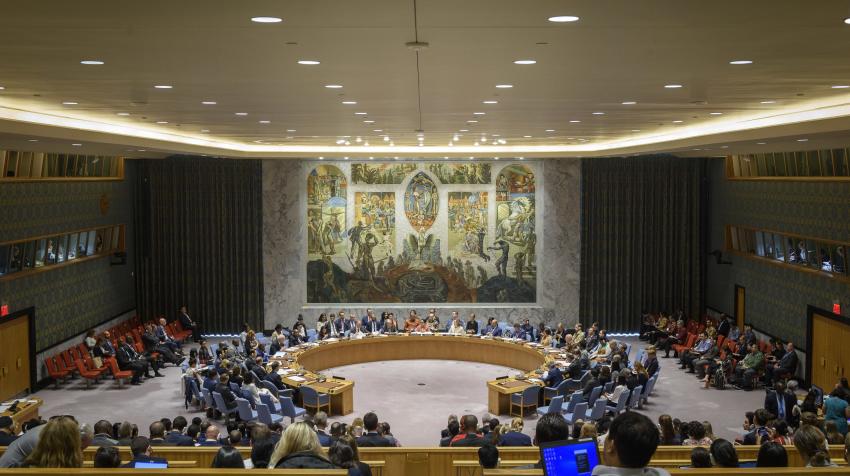
Image Source: UN Photo/Loey Felipe, https://www.un.org/en/ccoi/security-council-chamber
(The views expressed are those of the author and do not represent the views of CESCUBE)
Dr Saber Salem is an Associate Professor of International Relations and Diplomacy at the University of Fiji. Prior to joining academia, he worked with the United Nations in various roles and capacities and served as a Policy Analyst with the Canadian International Development Agency (CIDA). Dr Salem has authored and co-authored numerous scholarly articles published in Scopus-indexed journals in India and the United States. His research interests include foreign aid, conflict resolution, and climate change. He holds a Doctorate in Politics and International Relations from O.P. Jindal Global University.