Silent Depths, Loud Signals: Nuclear Deterrence Infrastructure and the Crisis-Stability Costs of India’s Indo-Pacific Maritime Partnerships
Introduction:
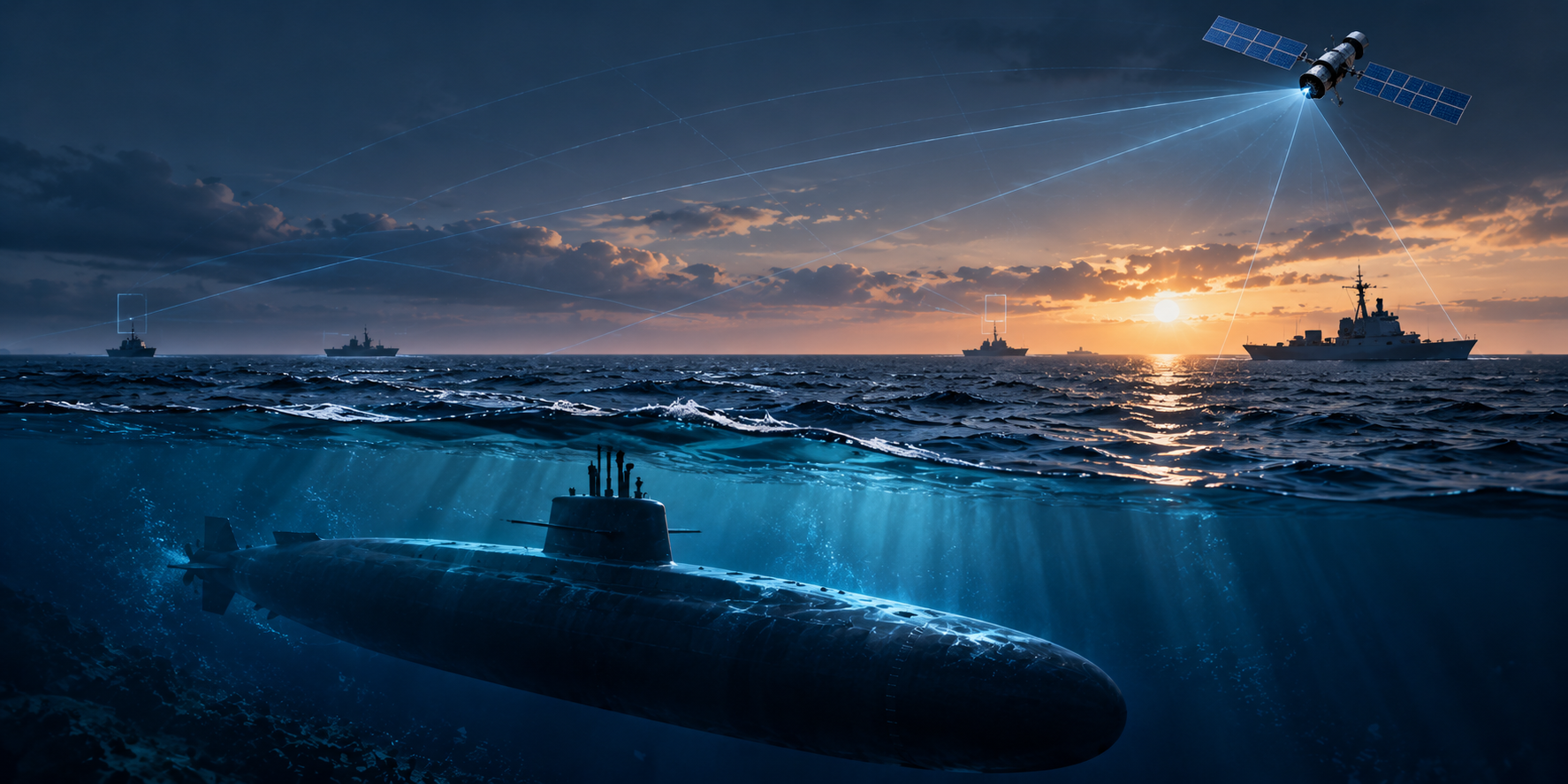
India’s nuclear submarine programme has spent most of its life outside the public eye. Even the commissioning of INS Aridhaman, the country’s third ballistic-missile submarine, in April 2026 came without a formal government announcement-just a cryptic post from the defence minister and a great deal of inference by defence journalists.1 That instinct for quiet is not incidental. A sea-based nuclear deterrent only works if the enemy cannot find the submarine carrying it, and secrecy is what keeps it findable to no one. At more or less the same time, though, India has been building the opposite kind of capability at a rapid pace: wide-area maritime surveillance, shared in real time with partners like the US, Japan, and Australia through the Quad’s new Indo-pacific maritime surveillance collaboration. This article asks a question that has not had much space in the existing literature, which tends to treat India’s nuclear deterrent and its conventional Indo-pacific partnerships as separate stories: what happens when the infrastructure built to make Indian submarines invisible sits inside the same strategic environment as infrastructure built to make everyone else’s submarines visible? It looks first at how India’s sea-based deterrent has developed, then at what the new surveillance-sharing arrangements actually involve, and finally at where the tension between the two sits and what might be done about it.
India’s Sea-Based Deterrent: A Programme Built on Concealment
India’s doctrine has always leaned on assured rather than first use. The 2003 nuclear doctrine commits India to no-first-use, which means the credibility of its deterrent rests almost entirely on the enemy believing that a first strike could never wipe out India’s ability to hit back.2 Land-based missiles and aircraft can, in principle, be targeted and destroyed in a well-executed first strike. A Submarine at sea, submerged and unlocated, cannot-which is why the SSBN leg of the triad is treated as the one that actually does the deterring, rather than the one that merely completes it on paper.3 India’s program has matured quickly by its own historical standards, INS Arihant was commissioned in 2016 and completed its first deterrence patrol in 2018; INS Arighat followed in 2024; and INS Aridhaman, with double the missile capacity of its predecessors, joined the fleet in April 2026.4 A fourth boat, expected to be named INS Arisudan, is undergoing sea trials with induction targeted for 2027, which would give India, for the first time, four hulls in rotation-enough, in theory, to keep at least one continuously on patrol while the others cycle through maintaining and training.5 These submarines carry India’s indigenous K-series submarine-launch ballistic missiles, and the newer boats expanded vertical launch capacity has been read as a direct response to concerns that a single, thinly-defended arsenal could be neutralized by an adversary’s improving counterforce options.6 None of this works, however, without the boat staying hidden. Everything about an SSBN’s design and operating pattern-low acoustic signature, irregular patrol routed, minimal communication-exists to deny an adversary the piece of information that would make the deterrent worthless: the submarine’s location. This is worth dwelling on because it is the premise the rest of this article rests on, and it is a premise India shares with every other country that has ever built this kind of capability.
The Other Side of the Ledger: Maritime Surveillance Sharing
At the same time as it has been quietly expanding its SSBN fleet, India has been loudly building out its conventional maritime surveillance architecture-doing so as a matter of declared policy rather than discretion. The clearest example is the Indo-pacific maritime surveillance collaboration, announced by Quad foreign ministers in New Delhi in May 2026 at India’s own proposal, which uses satellite data and tracking technology to give participating states real-time visibility into vessel movements across the Indian ocean.7 This sits within a wider set of institutional commitments: India’s chairmanship of the Indian ocean naval symposium from 2026 to 2028, its hosting of a twelve-nation table top exercise in Kochi, the MAHASAGAR framework for regional security cooperation, and an expanding set of bilateral agreements with partners such as Australia.8,9,10 The purpose of all this is, on its face, straightforward and defensible: China’s growing fleet of ostensibly civilian research vessels has been mapping the Indian Ocean seabed in ways that Indian defence observers read as directly useful for submarine navigation and concealment, and better maritime domain awareness is the obvious countermeasure.11 A recent observer research foundation analysis of maritime domain awareness cooperation in the Indo-pacific captures the underlying dilemma well: states remain genuinely cautious about sharing raw or sensitive data-submarine tracking and classified naval movements in particular-precisely because a data feed that looks routine to the state sharing it can look like actionable intelligence to the state receiving it.12 That is a general problem for maritime domain awareness cooperation everywhere. For India specifically, it has a sharper edge, because India is not only a consumer of this kind of shared picture but also the operator of a submarine fleet whose entire value depends on staying out of exactly the kind of picture it is helping build.
Where the Two Tracks Meet:
The tension is not that India’s partners are trying to track Indian submarines-there is no indication of that, and the surveillance-sharing architecture is explicitly framed around tracking Chinese activity. The tension is structural rather than intentional. Wide-area maritime surveillance builds around satellite tracking. AIS data fusion, and undersea sensing does not stop working nearly at the edge of what its designers meant it to see. A system built to flag un unusual Chinese research vessel near the Ninety East Ridge is, by the same technical logic, a system that could in principle flag an unusual pattern of Indian naval activity near its own SSBN patrol areas-not because any partner intends to look, but because the infrastructure does not know the difference between a target of interest and ally’s asset unless it is deliberately told to.13 This is compounded by the fact that the data-sharing architecture is still young and its governance arrangements-who sees what, at what resolution, and with what restrictions-are still being workout as the partnerships mature.14 India has, to its credit, kept its SSBN program unusually opaque even by the standards of nuclear-armed states, avoiding the kind of official confirmation that other nuclear powers routinely give their submarine commissionings.15 That instinct is sound, but it is not, on its own, a substitute for a deliberate policy on what categories of maritime data India is prepared to share through multilateral architecture and what categories of maritime data India is prepared to share through multilateral architecture and what categories it is not. The absence of that kind of explicit data-tiering is arguably the real gap here-not a failure of intent on anyone’s part, but the ordinary risk of building fast in an area where the rules have not caught up with the technology.
Managing the Tension:
A few adjustments would go some way toward closing this gap without requiring India to step back from either track. The first is explicit data-tiering within IPMSC and similar arrangements-distinguishing, in the architecture itself, between wide area vessel tracking meant for shared situation awareness and higher-resolution undersea or acoustic data that should stay within India’s own systems.16 The second is geographic and temporal carve-out around known SSBN transit corridors and patrol areas, similar in spirit to the kind of operational deconfliction navies already practice for other sensitive activity. The third is institutional: keeping the navy’s conventional MDA-sharing functions organizationally separate from India’s strategic forces command, so that the same officers and systems are not simultaneously responsible for making Indian ocean traffic more visible and for keeping India’s own deterrent invisible. None of these are radical proposals, and versions of all three likely already exist in some informal form. The point is that they deserve to be treated as an explicit, named part of India’s Indo-pacific maritime strategy rather than an implicit assumption that the two tracks will simply stay out of each other’s way.
Conclusion:
India’s sea-based nuclear deterrent and its conventional Indo-pacific maritime partnerships have developed on largely separate tracks in the way they are discussed, even as they have developed in parallel in practice. The SSBN fleet exists unable to find: the surveillance architecture exists to make the ocean more findable for everyone. Neither ambition is wrong, and there is no evidence of any partner turning surveillance tools against India’s own deterrent, but the two tracks now occupy the same physical and technical space, and the governance question of how India keeps them from interfering with each other has not yet had the kind of explicit, public treatment that its expanding submarine fleet arguably warrants.
References:
1.International
Institute for Strategic Studies, "Deepening Deterrence: India's Expanding
SSBN Capability," Military Balance+, May 14, 2026
https://www.iiss.org/online-analysis/military-balance/2026/05/deepening-deterrence-indias-expanding-ssbn-capability/
2."The
Coming of Age of India's Nuclear Triad," Carnegie Endowment for
International Peace, April 24, 2026
https://carnegieendowment.org/posts/2026/04/the-coming-of-age-of-indias-nuclear-triad
3."India's
Submarine Deterrent: Why SSBNs Are Built to Prevent Wars," Indian Defence
News, June 2026
https://www.indiandefensenews.in/2026/06/indias-submarine-deterrent-why-ssbns.html
4."India
to Commission Final Arihant-Class Nuclear-Powered Submarine INS Arisudan by
2027," Army Recognition, January 5, 2026
https://www.armyrecognition.com/news/navy-news/2026/india-to-commission-final-arihant-class-nuclear-powered-submarine-ins-arisudan-by-2027
5.Sarosh
Bana, "Indian Ocean Primacy," Indo-Pacific Defense FORUM, February 2,
2026
https://ipdefenseforum.com/2026/02/indian-ocean-primacy/
6."Who
Sees the Sea? Capacity Building as the Foundation of Maritime Domain
Awareness," Observer Research Foundation, July 10, 2026
https://www.orfonline.org/research/who-sees-the-sea-capacity-building-as-the-foundation-of-maritime-domain-awareness
7."What
Does Quad's New Surveillance Initiative Mean for Indian Ocean Security?,"
The Diplomat, May 29, 2026
https://thediplomat.com/2026/05/what-does-quads-new-surveillance-initiative-mean-for-indian-ocean-security/
8."IONS
Maritime Exercise 2026," Drishti IAS
https://www.drishtiias.com/daily-updates/daily-news-analysis/ions-maritime-exercise-2026
9."Anchors
of Stability: India Advances Maritime Collaboration Amidst Global
Upheaval," Eurasia Review, April 2, 2026
https://www.eurasiareview.com/02042026-anchors-of-stability-india-advances-maritime-collaboration-amidst-global-upheaval-analysis/
10.South Asia Monitor,
"Chinese 'Research Vessels' in Indian Ocean Raises Red Flags in Indian
Maritime Circles"
https://www.southasiamonitor.org/indo-pacific-china-watch/chinese-research-vessels-indian-ocean-raises-red-flags-indian-maritime
11.National Maritime
Foundation, "India–Australia Maritime Cooperation 2026," August 2026
https://maritimeindia.org/india-australia-maritime-cooperation-2026-from-strategic-convergence-to-operational-cooperation-the-modi-effect/
(The views expressed are those of the author and do not represent views of CESCUBE)
Image Source: AI Generated

Aarthi DE completed her BA in Defence and Strategic Studies from Erode Arts and Science College, Tamil Nadu. She is currently pursuing an MA in Defence and Strategic Studies at the Central University of Jammu (2025–2027).