The Pacific: Strategic Competition and the Return of Power Politics
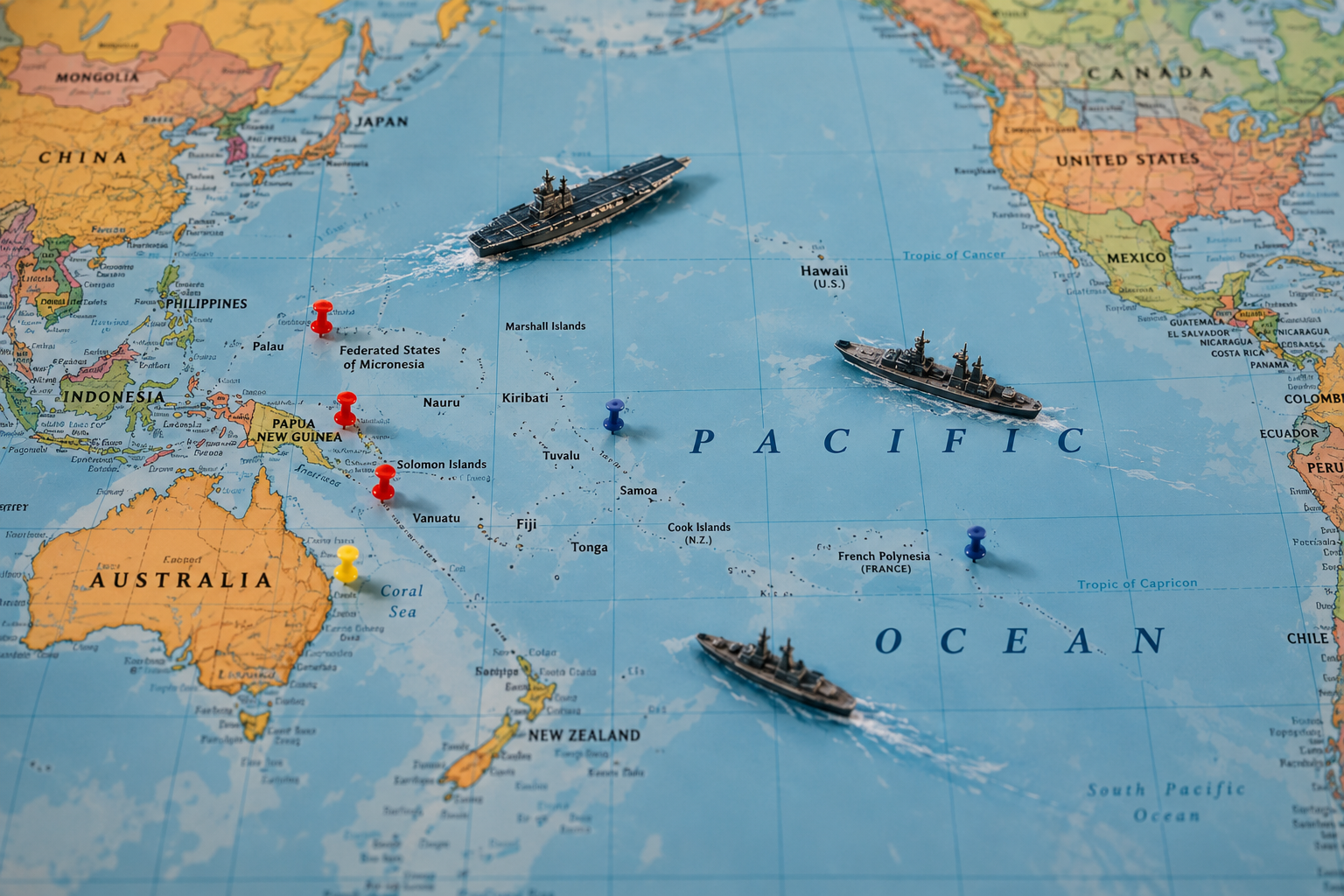
The Pacific region is once again becoming the epicentre of realpolitik amongst great powers, where both regional and extra-regional powers are competing to expand their sphere of influence. In recent years, China has deliberately, methodically and steadily expanded its diplomatic, economic and security footprint across the region. This growing presence has heightened concerns in the US and amongst its allies, since it has the potential to challenge the security of US military installations and broader strategic interests in the Pacific. Thus, the US and its like-minded democratic partners could counterbalance Beijing’s expanding influence by strengthening their economic engagement, increasing development assistance, and deepening their diplomatic presence across the Pacific.
Introduction
In recent decades, the Pacific region has once again emerged as a microcosm of great power politics[i], which has attracted renewed strategic competition amongst regional and extra-regional powers. During the Second World War, the region became a critical theatre of military operations, where Japan sought to expand its imperial influence while the United States, Britain, France, Australia and New Zealand worked to halt Japanese expansion and preserve Allied control over the Pacific region.
Imperial Japan aimed not only to weaken the Anglo-French colonial powers but also to dislodge them from the region and establish its own sphere of influence. However, following a series of decisive Allied victories, Japan was ultimately defeated and the region came under Allied control.
In addition, following the end of the Second World War, decolonisation gradually transformed the political landscape of the Pacific. The erstwhile British and French colonies gained independence over subsequent decades, while the United States remained the predominant strategic power in the region.
During the Cold War, the United States (US) considered the region as a key part of its containment policy against the former Soviet Union[ii]. Although the region was not the main theatre of rivalry between the two powers, its key geo-strategic location, sea lines of communication and key military installations made it a vital part of the US security strategy in the wider Indo-Pacific region.
Decline of Strategic Importance
The strategic importance of the Pacific region diminished significantly after the collapse of the former Soviet Union in 1991, which resulted in the peaceful end of the Cold War. After the collapse of its arch geopolitical competitor, the US re-examined its global strategic priorities and reduced its engagement in the South Pacific region markedly[iii]. The US foreign aid dwindled significantly, several USAID programmes and offices were either scaled back or closed and the United States reduced its diplomatic presence across many Pacific Island nations.
Furthermore, after the Cold War geo-strategic realignment during 1990s, the US not only reduced its military deployments outside the United States but also closed a number of key military bases such as Subic Bay Naval Base and Clark Air Base in the Philippines[iv]. This policy realignment by the Clinton Administration reflected a shift towards reducing defense expenditures and focusing more on domestic economic priorities and emerging security challenges emanating from the Middle East. The reduction in the US footprint in the South Pacific region created space for emerging economic and military powers such as China, India and Taiwan.
China in the Pacific
In recent decades, the People’s Republic of China (PRC) has expanded its diplomatic footprint across the Pacific region, with an aim to fill the gap created by periods of reduced US engagement. Strategically, PRC has adopted a two-pronged policy. The first one is based on soft power through diplomacy and provision of foreign aid, concessional loans and the other through a visible security presence[v]. China has funded and built numerous high visibility infrastructure projects, which has now become one of the largest aid donors and, in some cases, has surpassed traditional donors in aid allocations[vi].
Coupled with its fast-paced socio-economic growth, PRC’s security ambitions have also evolved. In the past China’s military focus was confined to its immediate neighborhood. However, today, its ambitious geo-strategic policies extend far beyond East Asia. Under the leadership of current president Xi Jinping who assumed power in 2013, Beijing has steadily and rapidly expanded its strategic foothold across the Indian and Pacific Oceans.
In addition, China aims to showcase its growing capabilities on the international stage by projecting economic influence and military power beyond the “First Island Chain.”[vii] It also wants to demonstrate to its regional and extra regional rivals that it has the capacity and capability to operate far beyond its shores.
Analysts believe that China’s current expansionist policies are attributed to Xi Jinping’s leadership. However, these policies are culmination of a decades-long evolution in China’s approach to diplomacy and international defense engagement. For example, during Mao Zedong, PRC’s military had adopted a policy of limited interaction with foreign armed forces, which reflected the party’s ideological isolation. When Deng Xiaoping came to power and succeeded by Jiang Zemin, ‘defense diplomacy’ was closely aligned with China’s economic reforms and its integration into the global system[viii].
Military engagement was predominantly used to support economic growth and build stable international relations. Nevertheless, the Hu Jintao administration adopted a more assertive foreign policy. Beijing’s isolationist foreign policy became more outward-looking, with the People’s Liberation Army (PLA) becoming more actively involved in transnational peacekeeping operations, foreign aid, disaster relief and counter-piracy missions[ix].
Furthermore, when President Xi Jinping came to power, it marked a huge transformation in China’s strategic outlook[x]. Defense diplomacy has become an important tool of statecraft, which is aimed at serving objectives that extend far beyond traditional military cooperation. Today, Beijing’s security engagement aims to protect its global investments, citizens, expansion of strategic influence and the creation of environments favorable to China’s long-term geopolitical ambitions. Moreover, the rapid modernisation of the PLA, expansion of its naval power, development of transborder logistical support hubs and deepening of security ties with foreign governments all echo this strategic shift.
Beijing’s diplomatic and economic engagement with the small island nations of the Pacific region goes back to the 1970s, when the newly independent countries established diplomatic relations with PRC after they got their independence from Anglo-French colonial powers. During this period, Beijing’s engagement anchored mainly on diplomacy, diplomatic recognition and foreign aid[xi].
However, over time, China has steadily expanded its policy from mere economic cooperation to encompass security and defense engagement. Although the region is relatively small to China in purely economic terms, it occupies a strategically significant maritime zone, which links the Pacific with the broader Asia-Pacific. With that in mind, PRC has sought to expand its sphere of influence through policing cooperation, security agreements, infrastructure development, military assistance, defense diplomacy and capacity-building initiatives[xii].
Furthermore, an important turning point occurred in 2022 when Beijing inked a bilateral security agreement with the Solomon Islands[xiii]. The agreement showed how quickly China’s security footprint in the region could expand when geo-political opportunities emerged. Since then, Beijing has initiated police training programmes, donations of security equipment, institutional partnerships and expanded law enforcement cooperation across several Pacific nations. These initiatives will gradually normalise Beijing’s security presence in a region that has been regarded as the strategic sphere of influence of the US, Australia and New Zealand.
In addition, part of the explanation for Beijing’s expansionist foreign policy lies in its competition with Taiwan for diplomatic recognition[xiv]. PRC regards Taiwan as a breakaway province that must be reunified with the mainland under the “One China Policy.” However, Taiwan, which is officially known as the Republic of China (ROC), aims not only to preserve its current de facto independent status but eventually get full independence. Thus, the country is working hard to expand its international diplomatic recognition by providing foreign aid to aid-dependent nations around the world.[xv]
Out of the 14 independent island countries in the Pacific region, only three such as the Marshall Islands, Palau and Tuvalu maintain diplomatic relations with ROC. However, the remaining countries recognise the One China Policy[xvi]. As a result, the two Asiatic economic giants have been competing for diplomatic recognition by providing foreign aid, concessional loans and foreign direct investment to these aid-dependent island nations.
In addition to that, both PRC and ROC are after diplomatic support in multilateral institutions, such as the United Nations (UN)[xvii]. Despite their small population size, the island nations each have an equal vote in the UN. Collectively, their vote at the UN account for approximately 7%, which makes their diplomatic support strategically important[xviii]. As a result, the two Asiatic economic giants have added conditionality to their foreign aid. Countries that receive their aid must recognize their respective donors and support their positions in international fora.
The diplomatic competition between PRC and ROC presents both threats and opportunities for the Pacific island nations. On one hand, their competition enables these aid dependent nations to leverage rivalries in order to secure more foreign aid, social development and foreign direct investments. On the other hand, high dependence on foreign powers undermine their autonomy and expose them to geopolitical pressure. The Solomon Islands’ decision to deepen relations with China by signing the 2022 China–Solomon Islands Security Agreement, demonstrates how the island nations seek to benefit from great power rivalry[xix].
As PRC expanded its footprint in the Pacific region, it prompted the US to make a strategic comeback. The Obama administration adopted the “Pivot to Asia” later referred to as “Rebalance to Asia” strategy, which was considered as one of the most significant shifts in US foreign policy since the end of the Cold War[xx].
The policy shifted diplomatic, military and economic attention from the Middle East towards the Indo-Pacific region. The core objectives of the policy were to strengthen alliances, expand economic engagement, preserve freedom of navigation and manage Beijing’s growing political, economic and military influence[xxi]. It also included increased military deployments, deeper security cooperation with regional allies and partners and efforts to promote new regional trade and investment arrangements.
However, China viewed the Pivot to Asia policy as a method of containment aimed at constraining its peaceful rise[xxii]. In response, PRC fast tracked the modernisation and expansion of its army, Navy and bolstered its position in the South China Sea. It also started extensive island-building, and launched the ambitious Belt and Road Initiative (BRI) to expand economic interconnectedness and interdependence across the Pacific, Asia, Africa and Latin America. These strategic plans were formulated to deepen China’s economic influence and “counterbalance US-led strategic partnerships and reshape the regional order in ways more favorable to China”[xxiii].
Diplomatic and economic competition for influence in the Pacific region is going to intensify more as Beijing is working hard to reduce Taiwan’s remaining diplomatic partners. China also aims to counter the growing influence of the Quadrilateral Security Dialogue (Quad), which includes Australia, Japan, India and US. PRC views the Quad as an exclusionary strategic grouping, which aims to contain its economic and military influence in the region.
In addition, Chinese officials have time and again blamed the Quad as a “small clique” that promotes bloc politics and heightens regional tensions[xxiv]. Thus, the Pacific Island nations have appeared as a pawn where strategic competition between great powers is likely to continue. It, therefore, necessitates that Pacific governments must carefully balance their development needs with their national sovereignty and long-term strategic interests.
However, as far as the US is concerned, the Pacific region is of huge strategic importance because of its geostrategic maritime location and its close proximity to US military installations and defense facilities across the region[xxv].
The US views the establishment of a permanent Chinese military presence in the region a serious threat and it would certainly alter the regional balance of power. Not to mention that Chinese military foothold in the region could threaten critical sea lines of communication, and challenge the security architecture that the US and its regional allies have maintained since the end of World War Two[xxvi]. Thus, the US and its like-minded democratic partners, must deepen their diplomatic, economic, and security engagement with the small island nations of the Pacific in order not to leave an operating space for its adversaries.
Moreover, the Pacific region continues to face significant development challenges and remain heavily dependent on foreign aid, concessional loans, foreign direct investment and tourism to fund social development, climate adaptation, healthcare, education and economic growth[xxvii]. It is due to these needs and vulnerabilities that PRC has usurped the opportunity and expanded its regional engagement through high-profile infrastructure building, foreign aid, and concessional loans.
Critics often describe this approach as “chequebook diplomacy,” arguing that Beijing utilizes its considerable financial resources to expand its diplomatic influence and strategic presence across the Pacific[xxviii]. Whether viewed as development cooperation or strategic statecraft, China’s growing economic engagement has undoubtedly increased its political influence in the region. It is, therefore, important that the US along with its regional allies adopt a more proactive and sustained engagement strategy to counterbalance China’s expanding influence in the Pacific region, an area that has traditionally been regarded as part of the United States’ strategic sphere of influence.
Conclusion
Given the Pacific’s proximity to critical US military bases and its importance for regional maritime security, the US and its regional allies must deepen and widen their economic, diplomatic, and security partnerships with Island nations.
As far as the Pacific governments are concerned, the renewed strategic competition among the great powers will have opportunities as well as threats. Pacific’s bilateral economic cooperation with traditional and emerging donors can bring much-needed investment and foreign aid. However, it also requires careful diplomacy to preserve national sovereignty, maintain strategic autonomy, and ensure that external partnerships contribute to sustainable long-term development rather than economic dependence.

Dr Saber Salem is an Associate Professor of International Relations and Diplomacy at the University of Fiji. Prior to joining academia, he worked with the United Nations in various roles and capacities and served as a Policy Analyst with the Canadian International Development Agency (CIDA). Dr Salem has authored and co-authored numerous scholarly articles published in Scopus-indexed journals in India and the United States. His research interests include foreign aid, conflict resolution, and climate change. He holds a Doctorate in Politics and International Relations from O.P. Jindal Global University.