Arctic Geopolitics: From Frozen Frontier to Global Contest
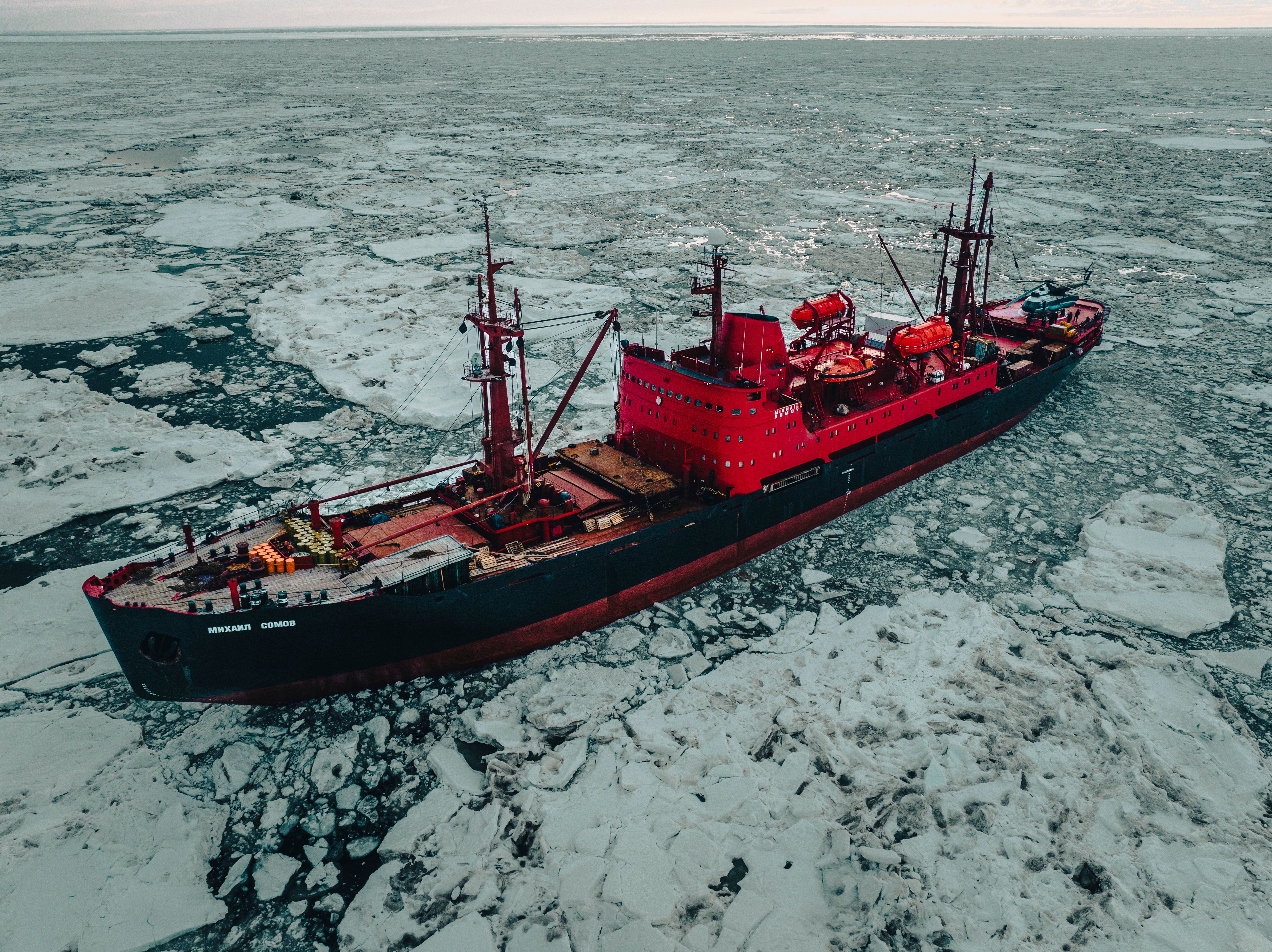
The Arctic is emerging as a critical arena of geopolitical competition, where climate change, shifting maritime routes, military expansion, and resource interests are reshaping the strategic landscape. This article examines how Russia's militarisation and control over the Northern Sea Route, the United States' emphasis on Arctic deterrence, and China's expanding presence through the Polar Silk Road are transforming the region's geopolitical significance. It also explores the strategic importance of Greenland, Alaska, and the GIUK Gap within evolving security calculations. As great-power competition intensifies, the article considers how India can move beyond scientific engagement to establish a more consequential strategic presence in the Arctic.
Introduction:
As per UNCLOS in 1982, parts of the Arctic Ocean were established as international waters, in the backdrop of certain territorial claims and debates. Despite these legal conditions, Russia has consistently asserted sovereign rights over portions of the ocean. The geopolitics of the Arctic recently took an even sharper turn. While it has withstood a long test of annexations like that of Crimea (2014), the Russia-Ukraine war has certainly brought various integral considerations into the globe’s purview. This has intensified with the gradual but alarming changing climate patterns, bringing global partners like the US and China into the Arctic game.
Russia’s Arctic Strategy: Militarisation, Resources and the Northern Sea Route
Russia, sharing the longest coastline with the Arctic, uses its geography cleverly by asserting a broader interpretation over strategically valuable territories in the region and consequently conducts military exercises to strengthen its position. The Arctic Ocean is exceptionally integral to Russia because it taps its economic, military, and environmental development with a special emphasis on the usage of the Northern Sea Route as an important transportation system.
Melting permafrost in the Arctic has been a common occurrence since the mid-to-late-2000s, which has served disadvantageous to Russia. While these circumstances have opened up avenues for ice-free navigation via the NSR, Russia has for long used the heavy ice to cover SSBNs (ballistic missile submarines) from any visual detection and aerial surveillance.
Changing climatic conditions has visibly enabled NATO allied states to encircle Russia from various sides, thus perceiving threats from the East via the Bering Strait or even the West, from Greenland-Norway. Thus, situational factors have helped Russia shape its Arctic military policy accordingly.
It has built a developmental strategy, Strategy for Developing the Russian Arctic Zone and Ensuring National Security through 2035, formally adopted by President Vladimir Putin in 2020 as the. It proposes a futuristic economic and foreign policy, resource extraction, export via the NSR, dual use facilities, and the strengthening of the Arctic’s military defences.
Russia has successfully expanded its military presence in the Arctic catering to three objectives; enhancement of homeland defence contextual to increasing international investment in the Arctic, a secure economic future, and creating a staging ground to showcase power in the North Atlantic. The uniting factor behind this plan is to prevent foreign incursion, which is being dealt with by using these very changing climatic conditions to its advantage. Thus ironically, melting permafrost is what has made military buildup logistically possible in the Arctic.
Russia’s total military expenditure has risen to approx. 16 trillion rubles ($190 billion USD), 2025, which accounts for 7.5% of its GDP. This boost in Russian defence has been evidenced by its plan of action across its East-West Arctic fronts. Russia uses entirely distinct military approaches for each front. Wrangel Island and the Bering Strait (East) are aided with radar stations such as the Sopka-2. A protective dome enables Russia to secure its vast coastline that it shares with the Arctic and track enemy vessels and aircrafts. These systems provide ease in the air and maritime domains.
Further West (Kola Peninsula, Novaya Zemlya, Alexandra Land), this area is much closer to NATO members than the East. It is surrounded by Norway, Finland, Sweden and opens into the North Atlantic via the GIUK Gap (Greenland, Iceland, UK). Therefore, Russia has packed its heaviest military assets here including “potential offensive capabilities”; nuclear submarine fleet and a multilayered preparation constituting air, sea, land military machinery.
Additionally, Russia is using the NSR calculatedly by capitalising out of its sovereign rights over it. It imposes strict unilateral controls - requiring prior transit permission, mandatory Russian pilots, state-controlled icebreaker escorts, thus transforming it into a new global shipping artery. Russia has begun expanding its military capabilities in the NSR, by reopening Soviet-era military bases, constructing new ones and deploying icebreakers.
Russia’s strategy with NSR is not merely toll-based. This maritime passage guarantees access to the Atlantic-Pacific. Kola Peninsula, where the Northern Fleet is stationed, is expected to defend the SSBNs (which represents two-thirds of Russia’s naval nuclear deterrents) thus reflecting a reemergence of the Soviet-era bastion.
Conclusively, the Arctic has gradually become an area of turbulence since its advancement as a resource-rich region. While decades-long efforts have been made to maintain cooperation, Arctic geopolitics took a heightened turn with the Russia-Ukraine war and its exclusion from the Arctic Council (2022).
The United States: Arctic Deterrence and Strategic Containment
As the Arctic opens up with newer maritime passages and shipping routes, the USA finds it imperative to act strategically, by tackling any possible disruptors, namely; Russia, China, Canada. Its adversaries extend from the First Island Chain down to NATO’s Eastern borders touching Turkiye. Therefore, USA’s military strategies in the Arctic are two-fronted; containment alongside military-economic restructuring. America’s national security plan has therefore been garnered by majorly two strategically significant Arctic regions; Greenland & Alaska.
Greenland: Strategic Geography and Great-Power Competition
Greenland (Kingdom of Denmark), is a vital linchpin to US security such that US President Donald Trump has made repeated demands of obtaining Greenland “one way or another”. Denmark's lack of threat assessment and defence framework and Russian-Chinese ships “surrounding” the island, are America’s justifications for gaining control over Greenland “for the protection of the world”. With Greenland having indicated greater investment from China, Russia-China rapidly developing “precise mass” (autonomous air, sea, undersea forces) with the goal of increasing military presence in the Arctic, the US has been undergoing a heightened frequency of insecurity.
Trump’s efforts to grab Greenland are driven not just by its treasure trove of critical minerals, but because it is the single geostrategic cornerstone that connects Arctic-North America-Europe. Furthermore, Pituffik Space Base, stationed by the US in North-West Greenland, is America’s Northernmost installation, giving it an upperhand in defence matters.
GIUK Gap & NATO’s Role:
Trump’s interest in buying Greenland is likely linked to its focal position as part of the GIUK Gap. The American Navy re-established its 2nd fleet to redirect activities in the North Atlantic (2018) and subsequently announced the creation of a Joint Force Command Norfolk, (2018 NATO Brussels Summit). European waters, for the first time in years, observed the deployment of a US carrier, USS Harry S. Truman, in the Arctic Circle. This was followed by NATO’s largest military Exercise Trident Juncture (2018), since the Cold War.
What started as a one US show in 2018, has gradually permeated into a greater NATO mission. While European allies have outright rejected Trump’s territorial claims over Greenland, within weeks many of the same states have rushed to join the Arctic Sentry. This paradoxical instance shares its own coercive charm.
The Arctic Sentry, led by the same Joint Force Command Norfolk (2018), is an example of how America aims to unite NATO allies into a single, operational plan. Numerous exercises have been held by NATO countries, or non-NATO bilateral/multilateral exercises, under the NATO banner. Various countries have agreed to join the Arctic Sentry; Sweden, UK, Canada, Denmark (Greenland & Faroe Islands included), Norway, Finland. As Mark Rutte puts it, having all NATO activities supervised under a single command, i.e. the Arctic Sentry, would help achieve a bigger impact.
America’s attempts at greater control of Greenland, has reached partial success. Trump has claimed to have gained “total access” to Greenland, on a permanent basis (World Economic Forum, Switzerland, January 2026).
Alaska: The Frontline of North American Arctic Defence
Alaska, highlighted as a primary military hub, is the only US territory above the Arctic Circle, acting as the foundation for American geopolitical influence. Its westernmost point sits 55 miles from Russia’s Chukotka Peninsula. Unlike Greenland, which serves a dual-purpose by countering Russia-China, Alaska does not necessarily have to independently watch China. Rather, it supervises Russia-China’s growing relationship, especially contextual to the recent maximised access that China has gained through the NSR.
The US has strongly emphasised on a greater role for Alaska in its DoD Arctic Strategy 2024. Greater Russia-China activity - joint exercises in the Arctic, PLAN & Russian Navy ships operating unitedly off Alaska’s coast, and the signing of an MoU between the Chinese Coast Guard and Russian Federal Security Service - has motivated USA into giving Alaska greater military responsibility. Thus, it has been defined as the anchor of North American Arctic homeland defence, hosting aerospace warning-control and maritime control capabilities of NORAD (North American Aerospace Defence Command).
Important exercises with regard to Alaska’s growing participation have been reflected via Arctic Edge (DoD’s premier Arctic exercise), Northern Edge (run by Indo-Pacific Command integrating North, Europe, Indo-Pacific commands), Operation ICE Camp, and the rotational role of the Joint Pacific Multinational Readiness Centre.
Fort Greely (Alaska), hosts the Ground-Based Midcourse Defense (GMD) interceptors, forming a critical component of US homeland defence against ballistic missiles and its Air Defense Identification Zone (ADIZ) making Alaska a primary forward zone for monitoring and deterring adversary movements.
China’s Arctic Ambitions: The Polar Silk Road and Strategic Access
China has faced partial paralysis due to growing tensions at important chokepoints like the Bab-al-Mandeb and Strait of Hormuz coupled with the ‘Malacca Dilemma’ down south-east. Thus, in the backdrop of blocked or possible blockades of chokepoints, China has been trying to find alternate shipping and maritime passages by using its self-proclaimed status as a Near-Arctic state, and taken to its own measures to expand its presence in the region. This has been guided via its “Polar Silk Road”, alternatively “Ice Silk Road”, which is an extension to its Belt and Road Initiative.
Recent inroads in this initiative have been evidenced by China’s newly formed shipping route from Ningbo (China’s East coast), travelling through the Arctic Circle along the NSR, terminating at Felixstowe (Eastern England). Transits via this route could take 18-21 days, as compared to the 40 days plus route via the Suez. Thus effectively, this passage has the potential to replace the Suez Canal and Red Sea as important waterways.
Although, it comes with its own disadvantages. This route via the NSR may only act as a “seasonal supplement”, as it will be accessible only during the summer months of the Northern Hemisphere when there is lesser ice. Moreover, understanding it as a global replacement is a tedious forecasting because permits through the NSR are issued by NSRA (Northern Sea Route Administration) operating under Rosatom, a Russian agency. President Xi Jinping back in 2017, had already pushed for a joint development on the NSR. Yet, China gained greater access to Russian trade routes only 2022 onwards. This conclusively means that unless not granted status as a ‘global common’, this route can’t be a concrete alternative.
While this is a more recent development, the Ice Silk Road initiative has been running since 2013, which was formalised as the Polar Silk Road through a white paper (2018). Besides shipping, this plan is actually aiming to build a foundation on Russia-China Arctic partnership. For example, in matters of energy and resource investment, Yamal LNG, a significant liquified natural gas plant on Russia’s Arctic coast, involves Chinese state companies (CNPC and Silk Road Fund) owning a 29.9% stake and Arctic LNG a follow up project. These form the economic backbone of China-Russia Arctic partnerships.
China, being only a Near-Arctic state, has additionally used its scientific expertise and exploratory curiosity for greater involvement in the Arctic. As evidenced by its Yellow River Research Station in Ny‑Ålesund, Svalbard (Norway), (since 2004). This form of soft legitimacy frames its position uniquely, besides its military-economic strategies because unlike general views with regard to China’s geopolitically invasive characteristics, scientific exploration gives it a more dignified, and non-threatening identity in the Arctic.
Therefore, if China strategically manoeuvres the American scepticism and maintains good relations with the Arctic actors, it has the potential to profit from the long game.
Conclusion:
The Arctic was deemed seemingly unreachable and an impenetrable frontier. Yet, climate change transformed the rules of the game; Russia’s militarization, America’s dual-front strategy, and China’s Polar Silk Road making it the globe’s next most contested region. As great powers entrench themselves, it is integral for emerging actors like India to stage a foothold in this region. Its strengths lie in sharing observer status in the Arctic Council, its Himadri research station in Svalbard, and growing cooperation with Russia on the NSR question. This way, India has the potential to project itself as someone greater than a peripheral actor. But its Arctic engagement shall not be restricted solely to scientific legitimacy. It shall push for greater strategic influence in this maritime field, just like it has been projecting over the Malacca Strait.
References:
1.Al Jazeera, “Trump’s Greenland Pact Will Demand Allies Boost Arctic Security, NATO Chief,” January 22, 2026. https://www.aljazeera.com/news/2026/1/22/trumps-greenland-pact-will-demand-allies-boost-arctic-security-nato-chief.
2.Andrey Todorov, “Russia – Arctic,” in Elgar Concise Encyclopedia of Polar Law, ed. Donald R. Rothwell, Evan T. Bloom, Suzanne Lalonde, Jeffrey McGee, and Madison Durham (Cheltenham, UK: Edward Elgar Publishing, 2025), 392–395. https://research-portal.uu.nl/en/publications/russia-arctic/
3.Asia Times, “Arctic: A Missile Defense Corridor Emerging as National Security Node,” July 2026. https://asiatimes.com/2026/07/arctic-a-missile-defense-corridor-emerging-national-security-node/.
4.Center for Strategic and International Studies (CSIS), “China Launches Polar Silk Road,” January 25, 2018. https://www.csis.org/analysis/china-launches-polar-silk-road.
5.CNBC, “Greenland, Trump, NATO, Denmark,” July 8, 2026. https://www.cnbc.com/2026/07/08/greenland-trump-nato-denmark.html.
6.CNBC, “EU, Greenland, von der Leyen, Trump, Arctic,” September 5, 2026, https://www.cnbc.com/2026/09/05/eu-greenland-von-der-leyen-trump-arctic.html.
7.Encyclopaedia Britannica. “Ukraine: The Crisis in Crimea and Eastern Ukraine.” Last modified 2026. https://www.britannica.com/place/Ukraine/The-crisis-in-Crimea-and-eastern-Ukraine.
8.European Security, “Denmark: In Putin’s Crosshairs,” December 15, 2025.
9.https://european-security.com/en/denmark-in-putins-crosshairs/
10.Government of the People’s Republic of China, “China’s State Council News Release,” June 26, 2024. https://english.www.gov.cn/news/202406/26/content_WS667bda0ac6d0868f4e8e8958.html.
11.Foreign Policy Watchdog, “The Arctic’s Fractured Consensus: Resource Competition and the Erosion of Great Power Diplomacy,” June 14, 2026. https://foreignpolicywatchdog.com/united-states/the-arctics-fractured-consensus-resource-competition-and-the-erosion-of-great-power-diplomacy.
12.Heather A. Conley and Matthew Melino, “The Ice Curtain: Russia’s Arctic Military Presence,” Center for Strategic and International Studies (CSIS), March 2016.https://www.csis.org/analysis/ice-curtain-russias-arctic-military-presence.
13.International Institute for Strategic Studies (IISS), “Gauging the Gap: The Greenland–Iceland–United Kingdom Gap — A Strategic Assessment,” May 2022. https://www.iiss.org/globalassets/media-library---content--migration/files/research-papers/2022/05/gauging-the-gap_the-greenlandicelandunited-kingdom-gap__a-strategic-assessment.pdf.
14.Kevin McGwin, “Greenland’s Military Possibilities for the United States,” War on the Rocks, September 14, 2020. https://warontherocks.com/greenlands-military-possibilities-for-the-united-states/.
15.Liselotte Odgaard, “How We Turn the Northern Sea Route to Our Advantage,” Hudson Institute, July 25, 2023. https://www.hudson.org/defense-strategy/how-we-turn-northern-sea-route-advantage-liselotte-odgaard.
16.Michael C. Horowitz, “Battles of Precise Mass: Technology and the Future of War,” Foreign Affairs, July/August 2025. https://www.foreignaffairs.com/world/battles-precise-mass-technology-war-horowitz.
17.Michael Paul, “Russia’s Arctic Strategy through 2035,” Stiftung Wissenschaft und Politik (SWP) Comment 57, December 2020. https://www.swp-berlin.org/10.18449/2020C57/.
18.NATO Defense College, “Strategy of Development of the Arctic Zone of the Russian Federation and the Provision of National Security for the Period to 2035,” NDC Policy Brief No. 10, July 2020. https://www.ndc.nato.int/strategy-of-development-of-the-arctic-zone-of-the-russian-federation-and-the-provision-of-national-security-for-the-period-to-2035/.
19.Peterson Space Force Base, “Pituffik Space Base, Greenland (Video ID 879118),” United States Space Force, 2023. https://www.petersonschriever.spaceforce.mil/Pituffik-SB-Greenland/videoid/879118/.
20.Politico, “US Will Take Greenland ‘One Way or the Other,’ Donald Trump Says,” March 5, 2025. https://www.politico.eu/article/us-will-take-greenland-one-way-or-the-other-donald-trump-says/.
21.Radio Canada International (RCI), “China Asked to Remove Stone Lions from Arctic Research Station in Svalbard,” April 22, 2025. https://www.rcinet.ca/eye-on-the-arctic/2025/04/22/china-asked-to-remove-stone-lions-from-arctic-research-station-in-svalbard/
22.Redalyc, “All this is owing to a phenomenon…” (article in Revista de Geografía Norte Grande).
24.Sandboxx, “NATO to Increase Its Arctic Presence in Response to Russian Activity,” February 2026. https://www.sandboxx.us/news/nato-to-increase-its-arctic-presence-in-response-to-russian-activity/.
25.The Arctic Institute, “A Blessing and a Curse: Melting Permafrost in the Russian Arctic,” February 27, 2019, 2026. https://www.thearcticinstitute.org/blessing-curse-melting-permafrost-russian-arctic/.
26.The Barents Observer, “Chinese Investors Could Finance Murmansk LNG,” September 2025. https://www.thebarentsobserver.com/arctic-lng/chinese-investors-could-finance-murmansk-lng/103747.
27.Thomas Christiansen, “Greenland Eyes China Amid Denmark–US Tensions, but Chinese Investors Won’t Rush In,” The Diplomat, April 10, 2025. https://thediplomat.com/2025/04/greenland-eyes-china-amid-denmark-us-tensions-but-chinese-investors-wont-rush-in/.
28.United Nations. United Nations Convention on the Law of the Sea. 1982. https://www.un.org/depts/los/convention_agreements/texts/unclos/unclos_e.pdf.
29.US Naval Institute News, “NATO Launches Arctic Sentry in High North in Response to Russian Activity,” February 16, 2026. https://news.usni.org/2026/02/16/nato-launches-arctic-sentry-in-high-north-in-response-to-russian-activity.
30.U.S. Department of Defense, “DoD Arctic Strategy 2024,” July 22, 2024. https://media.defense.gov/2024/Jul/22/2003507411/-1/-1/0/DOD-ARCTIC-STRATEGY-2024.PDF.
31.World Atlas, “How Far Is Russia from Alaska?” 2021. https://www.worldatlas.com/articles/how-far-is-russia-from-alaska.html.
(The views expressed are those of the author and do not represent views of CESCUBE)
Image Source: Photo by Dmitriy Ryndin on Pexels

Panishthi Mishra is an undergraduate student pursuing a B.A. (Hons.) in Political Science from Ramjas College, University of Delhi. She takes an interest in Defence, Strategic, and Maritime Studies, with an India-centric approach to understanding International Relations. Her research explores topics such as the Great Nicobar Project and the Strait of Malacca, India’s strategic engagement in the Mediterranean, and emerging geopolitical alliances in the UNGA based on voting patterns. She seeks to critically engage with India’s role in shaping global strategy and contribute to deeper academic and policy discussions.