The Shangri-La Dialogue: Assessing its role in shaping the Indo-Pacific Security Order
The Shangri-La Dialogue has emerged as a significant platform for defence diplomacy and strategic engagement in the Indo-Pacific amid increasing geopolitical competition and regional security challenges. This article examines the forum’s institutional evolution, its role in facilitating dialogue among major powers, and India’s participation in shaping regional security discussions. It also explores the key themes of the 2026 Dialogue, including maritime security, technological challenges, and preventive diplomacy. While highlighting the forum’s contribution to multilateral engagement and confidence-building, the article identifies persistent limitations in translating diplomatic discussions into concrete policy outcomes and coordinated regional security mechanisms.
The Indo-Pacific region is one of the most significant regions in contemporary world politics. The rising power and focus of the United States, and the increasing role of China, Japan, and Australia, have all, in a way, contributed to emerging security challenges in the region. In recent times, the region is characterised by military modernisation, geopolitical competition, maritime conflicts, and nuclear developments, which have altogether paved the way for tensions in the Taiwan Strait, South China Sea, and maritime borders of the nation. Against this backdrop, the need for a common platform for dialogue on these matters emerged, resulting in the “Shangri-La Dialogue”. It is one of Asia's premier defence summits where the ministers of various nations sit at the same table to raise their pressing security concerns, negotiate, and come up with better alternatives that, on a larger note, help shape the Indo-Pacific security order.
Evolution and institutional development:
The world order in the post-Cold War era has moved towards multilateral, cooperative, and collective security in the Indo-Pacific region. The fall of the bipolar world, growing non-traditional threats, and emerging second-track diplomacy bring about the need for this flexible dialogue platform. In the year 2001, the IISS president, John chipman has come up with a proposal for an Asian security conference, which was thereby supported by Singapore’s Ministry of Defence. Accordingly, the first Shangri-La Dialogue was organised in 2002, with the inclusion of ministers and senior officials of various countries. In the years 2002-2004, the participation and involvement of nations began to witness a growth. At the second stage, between 2005 and 2009, the numbers went high for instance, in 2006, 23 countries took part, with 17 defence ministers and also a few deputy ministers. The rapid institutional development of the dialogue started from 2010 onwards. Another major landmark in this development is the Memorandum of Understanding [MoU] with Singapore’s Ministry of defence to strengthen its institutional framework began to act as a base for further expansion. In that way, the introduction of the Southeast Asia Young Leaders Programme in 2016 further elaborated its reach, contributing to the evolving regional security architecture.
Role of major powers and India:
The Shangri-La Dialogue provides a space for major powers to raise their concerns and engage in negotiations. The participation of major countries like China, the United States, Japan, etc has reflected strategic competition as well as cooperation. India too has emerged as an independent strategic actor with a main emphasis on dialogue.
China's participation:
In the initial stages, involvement from the Chinese side was observed to be very limited, through lower-level officials with the view of a Western-led forum. Over the period of time, the interest shown in this increased, with high-level delegates attending the meetings from the year of 2007, and also the Chinese defence minister attending the meeting for the first time in 2011. China is constantly using the platform to express its regional defence ideas, international criticisms, and concerns. The spokesperson of China's Ministry of National Defense once said that China's defense departments and armed forces have always attached importance to the positive role played by various multilateral platforms, including the Shangri-La Dialogue, in promoting dialogue and exchanges and enhancing understanding and trust. The nation hopes that this platform will promote international cooperation and peace.
United States:
United States has utilised the platform to outline the nation's geopolitical goals and address the challenges like growing influence of China, regional instability, and so on. The nation also places its commitment to a free and open Indo-Pacific and rule based regional order to be formulated for the collective betterment of the nations. The speeches and discussions from the senior US officials have made the platform for multilateral regional security and strategic discussions and defence diplomacy.
India:
India views the Shangri-La Dialogue as a significant platform to advance its regional security vision and forge strategic partnerships between major powers like China, the United States, and Japan. India has been one of the active participants in this initiative by constantly sending officials to the meetings and taking stands on the discussions. India's engagement at the Shangri-La Dialogue has outlined its vision for “Stable, secure, inclusive”. India is also one of the main nations that retains its autonomy in every issue that it deals with and is not sidelined by any other nations. India's role and participation in the dialogues add value to the evolving regional security architecture.
Shangri-La Dialogue- 2026:
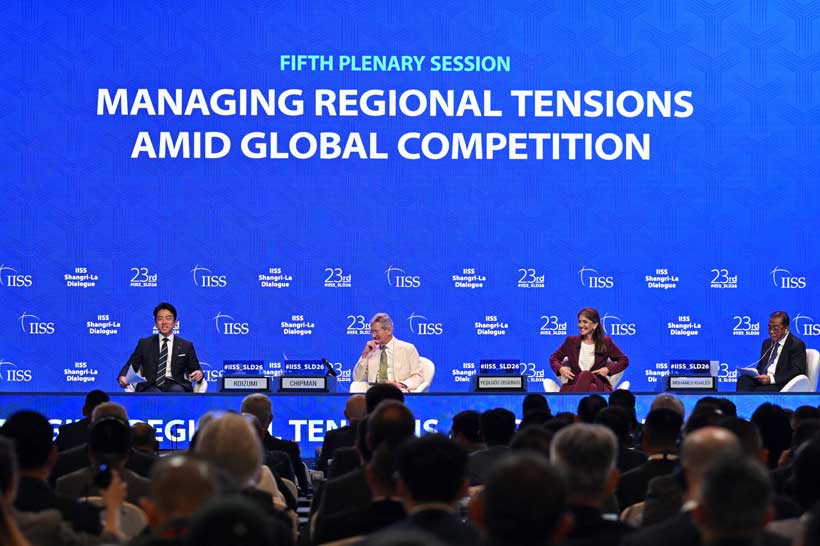
The 23rd edition of the Shangri-La Dialogue took place on May 29-31 in Singapore, bringing together security experts, top delegates, and defence ministers. Discussions have been initiated on various areas like military stability, maritime security, and the evolving balance of power. President of Vietnam delivered the key address, and other major nations used the forum for high-level official discussions and agreements. A few major takeaways need attention.
The dialogue firstly emphasized on rule based maritime order with the United Nations Convention on the Law of the Sea [UNCLOS] playing a central role in the peaceful settlement of disputes. Nations have expressed concerns over the growing influence of China and militarisation in the South China Sea. AI and cybersecurity are yet another important topic of discussion. Concerns have emerged, and discussions are being held on the use of AI and automated weapons in military operations. It heightens the chances of escalation and grey-zone conflict.
The third major area of focus was on preventive diplomacy, which refers to diplomatic warning systems between nations to prevent the escalation of a conflict. Early warning and communication networks can prevent the occurrence of a major conflict, but no major power has backed this idea. Officials from various nations have strongly advocated for a rule-based order, but have failed to bring practical mechanisms that actually bring it into effect. They have also given importance to the idea of self-reliance and strategic reliance, but coordinated actions have been limited.
Conclusion:
Shangri-La Dialogue has become difficult to replace, because of its strong institutionalisation and the attention it gained in recent years. It is striking that governments have maintained and, in many cases, intensified their engagement in the Shangri-La Dialogue. The dialogue in the coming years focuses on strengthening confidence-building mechanisms, preventive diplomacy, and greater global involvement and participation. On the whole, the forum aims to bridge the strategic differences and turn the dialogues and conversations into meaningful real-time operations. In conclusion, the Shangri-La Dialogue plays an irreplaceable role in shaping the regional security architecture of the Indo-Pacific region.
References:
1.Iran, Enduring, Mahsa Rouhi, and Christopher J. Fettweis. "Noteworthy: IISS Shangri-La Dialogue 2026." In Survival: August-September 2026, pp. 66-68. Routledge, 2026.
2.Zimmerman, Erin. "The International Institute for Strategic Studies and the Shangri-La Dialogue." In Think Tanks and Non-Traditional Security: Governance Entrepreneurs in Asia, pp. 123-150. London: Palgrave Macmillan UK, 2016.
3.20 years of Shangri-La Dialogue: Evolution, Characteristics and Prospects - International Conference - Specialties - International Cooperation Center. (n.d.). https://share.google/Y77pLfiyGgD9XxpCy
4.Capie, David, and Brendan Taylor. "The Shangri-La Dialogue and the institutionalization of defence diplomacy in Asia." The Pacific Review 23, no. 3 (2010): 359-376.
(The views expressed are those of the author and do not represent views of CESCUBE)
Image Source: Reuters

Sowbarnika Shasikumar is a final-year undergraduate pursuing a Bachelor of Arts in political science, passionate about public policy, governance, and international relations, with research interests. Through academic projects, internships, and leadership roles, she strives to combine analytical thinking with practical experience and aspire to build a career in public service.