Structural Parallels in American Coercive Diplomacy: The US-Cuban and US-Iranian Conflicts
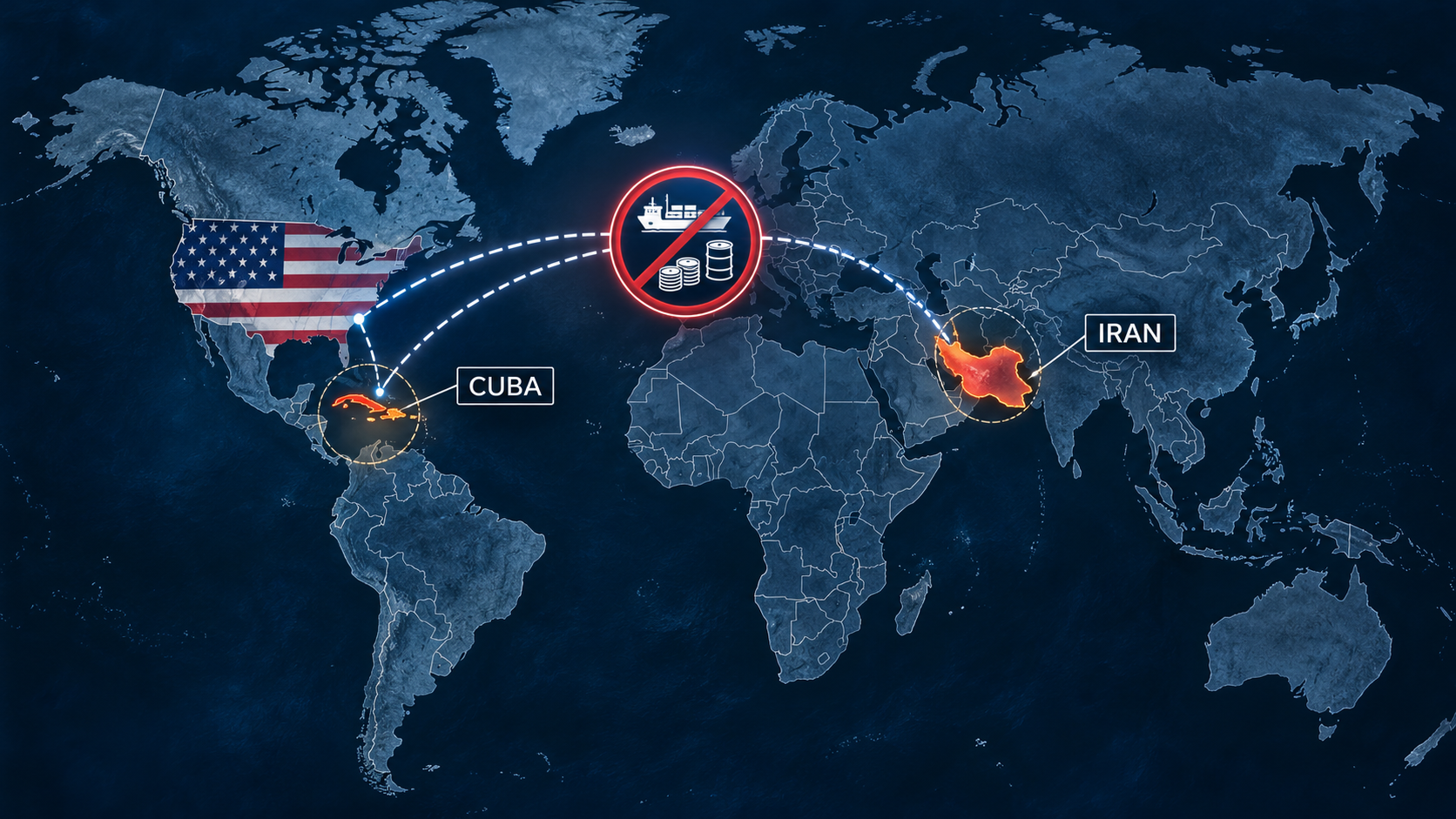
The political conflicts between the United States, Cuba, and Iran reveal significant structural parallels in the use of economic sanctions and coercive diplomacy. This commentary examines how Washington has employed economic restrictions, financial isolation, maritime enforcement, and diplomatic pressure to constrain the geopolitical influence of both revolutionary states. It also explores how Cuba and Iran have adapted to prolonged external pressure through asymmetric defence strategies, domestic economic centralisation, informal trade networks, and closer partnerships with Russia and China. The comparison highlights the limitations of economic coercion as a tool for achieving major foreign policy objectives.
The political relationships between the United States, Cuba, and the Islamic Republic of Iran represent two of the longest-running power struggles in modern global politics. Even though Cuba is in the Caribbean Basin and Iran is located polar opposite in the Middle East, both conflicts share remarkably similar political patterns. At their core, both disputes began when domestic political revolutions replaced pro-American leaders with anti-Western governments focused on national sovereignty. In response to these revolutions in both Cuba and Iran, Washington took retaliation via economic sanctions, financial isolation, maritime interdiction, and persistent diplomatic pressure to limit their geopolitical reach. Over several decades, these American actions forced both Cuba and Iran to build highly adaptive defense strategies, rely on heavy state control, and form military and economic alliances with strategic rivals of the United States like Russia and China. Examining these two cases side by side helps explain how small or medium-sized nations survive under prolonged economic coercion, while also revealing the structural limits of relying primarily on economic punishment to achieve major foreign policy objectives.
The historical starting point for both conflicts was a popular political revolution that transformed regional geography and upset the hegemonic international order. In 1959, the Cuban Revolution led by Fidel Castro overthrew the military dictatorship of Fulgencio Batista, bringing a socialist government to power just ninety miles off the southern coast of Florida, USA (1). Two decades later, the 1979 Iranian Revolution led by Ayatollah Ruhollah Khomeini replaced the American-backed Pahlavi monarchy with a Shia Islamic republic (2). Both revolutionary regimes built their political identity around explicit anti-imperialist narratives opposing American global influence. Cuba quickly aligned itself with the Soviet Union during the Cold War, while Iran adopted a foreign policy path aimed at opposing both Western capitalism and Soviet communism under the guiding banner of "Neither East nor West" (3). In both instances, American foreign policy leaders viewed these domestic political transformations not merely as localized regime changes, but as direct threats to regional stability and global strategic control.
Rather than launching full-scale military invasions to overthrow these new revolutionary governments, the United States relied heavily on economic sanctions as a primary tool of coercive diplomacy (4). The basic theory behind economic sanctions is simple: by restricting international trade, blocking foreign banking transactions, and cutting off external capital investments, the target nation's economy will suffer enough economic distress to force its political leaders to alter their foreign policy decisions or face popular political uprisings at home. Against Cuba, Washington established a comprehensive commercial embargo using broad emergency authorities under the Trading with the Enemy Act of 1917 (5). Over time, American lawmakers tightened these restrictions by passing strict statutory mandates like the Cuban Liberty and Democratic Solidarity (LIBERTAD) Act of 1996 (6), commonly known as the Helms-Burton Act, which penalized foreign corporate entities that conducted business operations within Cuba.
For Iran, the United States built a complex web of economic sanctions aimed directly at restricting crude oil exports and cutting off access to global financial markets. Legislation like the Comprehensive Iran Sanctions, Accountability, and Divestment Act of 2010 (7) severed Iranian banking institutions from global financial networks, making basic foreign trade transactions extremely difficult and expensive. However, real-world events consistently demonstrate that maximum pressure campaigns often fail to produce their intended political results (8). Instead of forcing governments to surrender their core security goals, heavy economic sanctions primarily harm ordinary citizens, cause severe shortages of basic consumer goods, and encourage ruling political elites to tighten their centralized control over national resources.
A concrete incident demonstrating how sanctions enforcement has evolved involves the U.S. Department of the Treasury's Office of Foreign Assets Control targeting Iran's "shadow fleet" of oil tankers (9). To bypass Western financial clearings and energy export caps, Tehran developed an informal network of unflagged or flag-of-convenience vessels conducting ship-to-ship transfers in international waters to deliver crude to independent refineries in China. In response, U.S. enforcement moved beyond primary targets to hit secondary facilitators, including maritime insurance brokers, ship-management firms, and digital asset exchanges (10). This operational shift illustrates the mechanism of economic statecraft, primarily as target states adapt to isolation, the sanctioning authority must continuously widen its enforcement umbrella to penalize third-party commercial nodes across the global supply chain.
Because neither Cuba nor Iran possessed the conventional military power to match the United States directly, both nations adopted specialized asymmetric defense doctrines designed to survive persistent external pressure (11). Cuba developed a broad defense strategy called the War of All the People (Guerra de Todo el Pueblo), which organized local communities and civilian populations into territorial defense units while allowing state-run holding companies like GAESA (Grupo de Administración Empresarial S.A.) to centralize foreign currency flows (12). Iran constructed a forward-defense architecture utilizing specialized asymmetric naval tactics in the Strait of Hormuz, long-range ballistic missile development, advanced cyber warfare units, and military alliances with regional partners across the Middle East (13).
These asymmetric frameworks faced strong pressure. In Cuba, the military-led conglomerate GAESA became the explicit focal point of renewed U.S. executive enforcement, along with expanded U.S. State Department designations aimed directly at dismantling its financial holding capacity across the domestic economy (14). Simultaneously, the broader War of All the People concept faced severe operational stress due to a mounting U.S. energy blockade targeting foreign crude suppliers, leading to chronic fuel deficits, widespread power outages, and multi-province electrical grid collapses (15). Iran's forward-defense doctrine experienced a parallel stress test as regional kinetic friction and aggressive U.S. secondary enforcement campaigns increased, targeting shadow fleet logistics in international waters forced Tehran to rely more heavily on unflagged maritime transport networks and deep-space ballistic capabilities to preserve its regional leverage.
Instead of collapsing under international isolation, both political systems learned to use external sanctions to consolidate their internal domestic control. Political leaders in Havana and Tehran frequently point to American economic restrictions as the main cause of local financial hardship, using nationalist public messaging to unite domestic populations against a shared external opponent (16). In response to long-term financial isolation, both nations established extensive informal trade networks to bypass international trade barriers, manage local shadow markets, and import essential supplies outside conventional global banking channels.
The internal dynamic within both target states shifted toward survival-driven structural modifications. Under the pressure of acute domestic fuel shortages, the Cuban government moved to restructure state commercial controls, relaxing historical monopolies over foreign commerce to permit more direct trading pathways into local markets while retaining tight centralized political authority. Simultaneously, facing aggressive regulatory actions by the U.S. Treasury's Office of Foreign Assets Control against non-compliant energy brokers, Iranian trade operators expanded their use of decentralized digital clearing services and dark-docking transfers in international waters to maintain basic revenue streams despite stringent sanctions (17).
To balance against American global influence, Cuba and Iran have consistently sought strong security and trade relationships with major non-Western powers, particularly Russia and China. When Soviet economic support ended in the early 1990s, Cuba turned to subsidized oil shipments from Venezuela, and it now relies heavily on economic credit lines, trade shipments, and diplomatic support from Moscow and Beijing (18). Iran has similarly deepened its economic ties with Beijing through long-term energy sales, while expanding defense equipment collaboration with Moscow and joining multilateral organizations like BRICS and the Shanghai Cooperation Organisation. These growing international networks allow both countries to maintain critical trade links and offset Western isolation efforts (19).
This international alignment strategy reached critical diplomatic inflection points. Cuba utilized its presence within BRICS multilateral forums to formally challenge the extraterritoriality of secondary oil blockades, drawing explicit political support from member nations to maintain humanitarian trade corridors while receiving emergency fuel shipments from Moscow to blunt total grid collapse (20) At the same time, Iran's technological and economic ties with Russia deepened into co-development initiatives spanning drone production, space launch support, and dual-use industrial hardware, while Beijing maintained its status as a primary buyer of Iranian crude via independent refining hubs. Through these combined tactics by leveraging domestic centralization, informal trade channels, and strong non-Western strategic partnerships, both states continue to resist unilateral containment.
Ultimately, comparing American foreign policy toward Cuba and Iran shows the clear limits of using unilateral economic punishment to drive major political change. While broad trade embargoes inflict deep macroeconomic damage and disrupt local industries, they rarely force entrenched revolutionary governments to give up power. Instead, heavy economic coercion encourages target states to centralize domestic resources, suppress internal political opposition, and build stronger economic partnerships with strategic rivals of the United States, keeping regional political tensions high and diplomatic solutions difficult to achieve.
References:
1.Comprehensive Iran Sanctions, Accountability, and Divestment Act of 2010, Pub. L. 111-195, 124 Stat. 1312, 22 U.S.C. § 8501 (2010). https://ofac.treasury.gov/media/5691/download’inline
2.Congressional Research Service. (2021). Iran sanctions (CRS Report No. R43311). U.S. Library of Congress. https://nsarchive.gwu.edu/media/27084/ocr
3.Cuban Liberty and Democratic Solidarity (LIBERTAD) Act of 1996, Pub. L. 104-114, 110 Stat. 785, 22 U.S.C. §§ 6021–6091 (1996). https://www.congress.gov/bill/104th-congress/house-bill/927
4.International Journal of Novel Research and Development. (2025). The efficacy of sanctions in foreign policy: A comparative analysis of Cuba, Iran, and North Korea. International Journal of Novel Research and Development, 10(2), 112–125. https://ijnrd.org/papers/IJNRD2504204.pdf
5.Migration Letters. (2023). Economic sanctions as a foreign policy tool: A case study of the Iran-West conflict. Migration Letters, 20(S1), 405–418. https://migrationletters.com/index.php/ml/article/view/4392
6.Trading with the Enemy Act of 1917, 50 U.S.C. §§ 4301–4341 (1917). https://www.law.cornell.edu/uscode/text/50/chapter-53
7.U.S. Department of State. (2026). Iran sanctions. U.S. Government Portal. https://www.state.gov/iran-sanctions
(The views expressed are those of the author and do not represent views of CESCUBE)
Image Source: AI Generated

Vivetha Jayaseelan is an International Relations researcher specializing in the securitization of critical infrastructure and Indo-Pacific security architecture. Her research investigates the intersection of sub-sea strategic autonomy, AI space diplomacy, and non-traditional regional security threats using OSINT and quantitative analysis.