Loss and Damage Finance: From COP28 Pledges to Policy Architecture
Introduction
The operationalisation of 'loss and damage' as a formal category within international climate finance represents one of the most consequential- and contested- developments in global environmental governance of the past decade. After nearly three decades of procedural resistance from industrialised states, the 28th Conference of the Parties (COP28) in Dubai in November–December 2023 marked a milestone: the formal establishment and initial capitalisation of a dedicated Loss and Damage Fund under the United Nations Framework Convention on Climate Change (UNFCCC). Pledges amounting to approximately USD 700 million were announced at the conference, hosted by the World Bank on an interim basis and governed by a newly constituted board.
Yet the distance between the symbolic achievement of COP28 and the construction of a functional, equitable, and adequately resourced policy architecture for loss and damage finance remains vast. The pledges made in Dubai represent a fraction- estimates suggest less than 0.2 per cent- of the annual financing needs that peer-reviewed research attributes to irreversible climate impacts in vulnerable developing nations.1
The governance framework remains incomplete, the definitional boundaries of compensable loss and damage are disputed, and the relationship of the new fund to existing climate finance streams- the Green Climate Fund (GCF), adaptation finance, and humanitarian assistance- remains unresolved. This article examines the political economy of loss and damage finance, tracing its emergence as a policy category, interrogating the governance architecture established at and after COP28, and assessing the structural obstacles that stand between present commitments and effective delivery. The argument advanced here is that the loss and damage finance architecture, as currently constituted, reflects the asymmetry of power between historically high-emitting states and climate-vulnerable nations, and that transforming pledges into a functioning policy system requires not merely additional resources but fundamental reconsideration of the principles governing international climate responsibility.
The Emergence of Loss and Damage as a Policy Category
From Santiago Network to Institutional Recognition
The concept of loss and damage in international climate negotiations has its origins in the Alliance of Small Island States' (AOSIS) proposal in 1991 for a compensation mechanism to address sea-level rise- a proposal that was effectively deferred for the subsequent three decades.2
The Warsaw International Mechanism (WIM) for Loss and Damage, established at COP19 in 2013, represented the first formal institutional acknowledgement of the category, though it carried no financing mandate and operated primarily as a knowledge-sharing and coordination body. Article 8 of the Paris Agreement (2015) acknowledged loss and damage as a distinct pillar of the climate regime, separate from mitigation and adaptation, but the accompanying decision text explicitly- and, for vulnerable states, damagingly- stated that Article 8 could not be construed as involving or providing a basis for liability or compensation.3
The Glasgow Climate Pact (COP26, 2021) established the Glasgow Dialogue to discuss loss and damage financing arrangements, and the following year's COP27 in Sharm el-Sheikh achieved the breakthrough agreement to establish a new dedicated fund- the outcome widely described as the most significant institutional development in climate negotiations since Paris.4 COP28's formal operationalisation of the fund, and the appointment of the World Bank as its host for an initial four-year period, thus represented the culmination of a thirty-year advocacy effort by small island developing states (SIDS) and the broader group of climate-vulnerable countries.
The definitional architecture underpinning loss and damage encompasses two analytically distinct but practically intertwined categories. Economic losses include measurable damages to assets, infrastructure, and productive capacity- the destruction of homes by cyclones, the inundation of agricultural land by sea-level rise, the loss of fisheries to coral bleaching. Non-economic losses include impacts that resist easy quantification: the erosion of cultural heritage, the displacement of communities from ancestral territories, the psychological costs of climate-induced displacement, and the loss of biodiversity with which communities maintain spiritual or subsistence relationships.5 The treatment of non-economic losses is particularly contested, as it implies obligations that industrialised states have been deeply reluctant to accept, not least because of the legal and moral implications regarding historical responsibility for cumulative emissions.
The Liability Question and Its Political Consequences
Central to understanding the political obstacles confronting loss and damage finance is the question of liability. The explicit exclusion of liability from the Paris Agreement's Article 8 was not a technical drafting choice; it reflected a calculated political position on the part of the United States and other major emitters, for whom any acknowledgement of legal responsibility for historical emissions carried potentially unlimited financial and legal exposure.6 This position has deep roots in the broader politics of international environmental law, where the principle of 'common but differentiated responsibilities and respective capabilities' (CBDR-RC) has functioned simultaneously as a statement of equity and as a limit on enforceable obligation.
The consequence of this exclusion is that loss and damage finance has been framed not as reparation or compensation- concepts with grounding in international law- but as solidarity, humanitarian response, and voluntary contribution. This framing fundamentally shapes both the quantum of finance that donor states are willing to commit and the conditions attached to its disbursement. It also creates a structural tension within the loss and damage governance framework: the moral logic of climate vulnerability- that those least responsible for emissions bear the greatest burdens- sits in unresolved tension with the legal architecture's refusal to formalise corresponding obligations on the part of those most responsible.7
The COP28 Architecture: Institutional Design and Its Limitations
The Fund's Governance Structure
The Loss and Damage Fund established at COP28 is governed by a 26-member board, with representation allocated as follows: twelve seats for developing country parties, two seats each for SIDS and least developed countries (LDCs), and twelve seats for developed country parties.8 The distribution reflects a compromise that nominally provides a majority to developing country representatives, though critics have noted that the inclusion of developed country representatives in proportion exceeding their share of climate vulnerability ensures that funding decisions will require broad consensus rather than clear developing-country direction.
The decision to host the fund at the World Bank, initially for four years pending review, was among the most contested outcomes of COP28. For many vulnerable country delegations and civil society organisations, World Bank hosting raised concerns about conditionality, governance culture, and alignment with UNFCCC principles. The World Bank's standard operational policies- including safeguards, procurement requirements, and debt instrument preferences- have historically been ill-suited to the needs of the smallest and most vulnerable recipient countries, which often lack the institutional capacity to navigate complex fiduciary processes.9 The SIDS and LDC groupings largely preferred independent hosting or hosting under the UNFCCC itself, and the World Bank compromise was accepted under political pressure from major donor states whose contributions were implicitly conditioned on World Bank governance standards.
Equally significant is the question of access modalities. The loss and damage context is distinct from standard development finance: losses are often sudden-onset, community-level, and require disbursement to sub-national actors including local governments, indigenous communities, and informal settlements. Standard multilateral fund architecture- with its emphasis on national governments as primary recipients and its lengthy appraisal timelines- is structurally mismatched to the rapid, flexible, and direct-access disbursement that effective loss and damage response requires.10
The Adequacy Gap
The most fundamental critique of the COP28 loss and damage architecture concerns adequacy. Research published in the journal Nature Climate Change estimated that, under current emissions trajectories, annual loss and damage costs in developing countries could reach USD 400 billion by 2030 and exceed USD 1 trillion annually by mid-century.11 Against this backdrop, the USD 700 million pledged at COP28- of which a substantial portion represented repackaged existing commitments rather than new and additional finance- represents a financing ratio of less than one per cent of estimated annual need within the decade.
The adequacy gap is compounded by the structure of existing pledges. The United States' contribution of USD 17.5 million- less than the pledge of several individual European states and a fraction of what climate modelling suggests is proportionate to its cumulative historical emissions- illustrates the political constraints on loss and damage mobilisation within major donor democracies.12 Domestic political opposition to climate finance, particularly in the United States Congress, creates a structural ceiling on executive-level commitments, reinforcing the gap between international negotiating positions and actual resource transfer.
Innovative finance proposals- including levies on international aviation and maritime transport, windfall taxes on fossil fuel corporations, and Special Drawing Rights (SDR) allocations channelled through multilateral mechanisms- have been advanced as potential means of scaling up loss and damage finance without dependence on voluntary state contributions.13 However, none of these proposals has achieved the consensus necessary for operationalisation, and each faces significant political resistance from states and industries with interests in preserving current revenue structures.
Structural Obstacles to Effective Policy Delivery
Attribution Science and Evidentiary Standards
A distinctive challenge in translating loss and damage finance commitments into policy delivery is the evidentiary challenge of climate attribution. The rapidly advancing science of extreme weather event attribution- which can now estimate the degree to which anthropogenic climate forcing increased the probability or intensity of specific weather events- has transformed the intellectual basis for loss and damage claims.14 Studies following major events such as Cyclone Idai (2019) and the 2022 Pakistan floods have provided probabilistic attribution findings with policy-relevant precision. Yet the translation of attribution science into disbursement criteria remains contested. Determining what proportion of a given loss is attributable to climate change rather than to pre-existing vulnerability, governance deficits, or development choices raises questions that blend scientific, legal, and political judgment.
The distinction between slow-onset and rapid-onset events further complicates evidentiary frameworks. Sea-level rise, glacial retreat, ocean acidification, and desertification unfold across timescales that resist the event-based logic underlying most existing humanitarian and disaster risk finance instruments. Loss and damage finance must therefore operate across both temporal registers, requiring governance mechanisms capable of responding to acute crises while simultaneously addressing chronic, cumulative impairment of livelihoods and ecosystems.15
The Intersection with Adaptation Finance
A persistent source of conceptual ambiguity in loss and damage policy is the relationship between loss and damage finance and adaptation finance. The distinction, while analytically meaningful- adaptation addresses avoidable impacts; loss and damage address unavoidable ones- is practically difficult to operationalise. As climate impacts intensify and adaptive limits are approached, the boundary between the two categories becomes increasingly porous.16
There are legitimate concerns that donor states may attempt to reclassify adaptation expenditures as loss and damage contributions, deflating the additional finance commitments that loss and damage represent. This was a source of contention in the pledging processes surrounding COP28, with civil society monitors tracking whether announced contributions represented genuinely new allocations or rebranded existing climate finance streams. The integrity of loss and damage finance as a distinct policy category depends on maintaining definitional rigour in ways that multilateral climate negotiations have historically struggled to enforce.17
Sovereign Debt and the Double Burden
Many of the states most exposed to loss and damage are simultaneously experiencing acute sovereign debt distress, a confluence that Barbados Prime Minister Mia Mottley has termed the 'double injustice' of climate vulnerability.18 Countries in the Caribbean, Pacific, and South Asia face the prospect of borrowing to finance recovery from climate impacts for which they bear minimal historical responsibility, thereby compounding fiscal fragility in precisely the states least equipped to manage it. The Bridgetown Initiative, launched by Barbados and subsequently endorsed by a broad coalition of developing and emerging economies, has advocated for fundamental reform of multilateral development bank (MDB) lending practices, including the suspension of debt service obligations following climate disasters and the scaling up of grant-based instruments for the most vulnerable states.
The debt-climate nexus thus represents a structural dimension of loss and damage policy that transcends the fund architecture established at COP28. Effective delivery requires not merely a capitalised fund with functional governance, but a reformed international financial architecture capable of absorbing the fiscal shocks of escalating climate impacts without transferring additional debt burdens onto the most vulnerable economies.19
Pathways Toward an Effective Architecture
Several structural reforms are necessary if loss and damage finance is to evolve from symbolic acknowledgement toward effective policy delivery. First, the adequacy gap must be addressed through a combination of scaled-up state contributions, based on a burden-sharing formula reflecting both historical emissions and economic capacity, and innovative finance mechanisms. A levy on international aviation and shipping- two sectors whose emissions fall outside national inventory frameworks- represents a technically feasible and politically tractable pathway to generating additional dedicated revenue.20
Second, access architecture must be redesigned around the realities of climate-affected communities. Direct access for sub-national actors, simplified fiduciary requirements for micro- and small-scale disbursements, and pre-arranged contingency finance instruments- akin to the parametric insurance models pioneered by the Caribbean Catastrophe Risk Insurance Facility (CCRIF)- offer models for responsive, community-level delivery that conventional MDB architecture cannot provide.21
Third, the governance framework must resolve the tension between legitimacy and effectiveness. A fund whose board composition ensures perpetual donor-state veto over disbursement decisions will lack the confidence of recipient countries and risk replicating the structural asymmetries that have historically characterised climate finance. The four-year review of the World Bank hosting arrangement represents an opportunity to transition toward more independent governance- whether within the UNFCCC architecture or through a genuinely autonomous international institution- if political will can be mobilised among the states whose contributions make such independence fiscally viable.22
Fourth, the conceptual framework must be stabilised. Agreed definitions of loss and damage, clear demarcation from adaptation finance, and operationalised standards for attribution evidence are prerequisites for a credible and predictable disbursement system. The Santiago Network on Loss and Damage, established to facilitate technical and capacity support, must be adequately resourced to assist vulnerable countries in building the institutional and scientific capacity to access and effectively utilise the fund.23
Conclusion
The establishment of the Loss and Damage Fund at COP28 represents a genuine, if fragile, institutional achievement. For the first time, the international community has formally acknowledged that climate change produces irreversible harms in vulnerable communities that require dedicated financial response, separate from mitigation investment and conventional adaptation support. This acknowledgement carries moral and political weight that should not be dismissed.
However, the architecture as currently constituted is inadequate to the scale of need it notionally addresses. The adequacy gap between pledged finance and estimated annual losses is of an order of magnitude that renders the fund, in its present form, principally symbolic. The governance design reflects the power asymmetries of international climate politics rather than the equity principles that loss and damage discourse espouses. And the structural obstacles- attribution complexity, the adaptation-loss-and-damage boundary, sovereign debt distress, and access limitations- have not been resolved by the fund's establishment.
The test of the loss and damage architecture will not be the pledges made in Dubai or the governance framework agreed in principle. It will be whether, by the time the World Bank's interim hosting is reviewed, vulnerable communities facing the escalating costs of climate change they did not cause have received material, timely, and unconditional support at anything approaching the scale that science, equity, and political commitment together demand. By that standard, the work of building an effective loss and damage policy architecture has barely begun.
References
1. Betzold, C., & Weiler, F. (2017). Allocation of aid for adaptation to climate change: Do vulnerable countries receive more support• International Environmental Agreements, 17(1), 17–36. https://doi.org/10.1007/s10784-016-9343-8
2. Calliari, E., Surminski, S., & Mysiak, J. (2019). The politics of (and behind) the UNFCCC's loss and damage mechanism. In R. Mechler et al. (Eds.), Loss and damage from climate change: Concepts, methods and policy options (pp. 155–178). Springer. https://doi.org/10.1007/978-3-319-72026-5_6
3. Falzon, D. (2020). Who bears responsibility for loss and damage? Ethics and the social construction of causality in the United Nations Framework Convention on Climate Change. Environmental Politics, 29(6), 1059–1078. https://doi.org/10.1080/09644016.2019.1699327
4. Huq, S., Roberts, E., & Fenton, A. (2013). Loss and damage. Nature Climate Change, 3(11), 947–949. https://doi.org/10.1038/nclimate2026
5. Intergovernmental Panel on Climate Change. (2022). Climate change 2022: Impacts, adaptation and vulnerability. Contribution of Working Group II to the Sixth Assessment Report of the Intergovernmental Panel on Climate Change. Cambridge University Press. https://doi.org/10.1017/9781009325844
6. Keohane, R. O., & Victor, D. G. (2011). The regime complex for climate change. Perspectives on Politics, 9(1), 7–23. https://doi.org/10.1017/S1537592710004068
7. Lemos, M. C., & Agrawal, A. (2006). Environmental governance. Annual Review of Environment and Resources, 31(1), 297–325. https://doi.org/10.1146/annurev.energy.31.042605.135621
8. Mace, M. J., & Verheyen, R. (2016). Loss, damage and responsibility after COP21: All options open for the Paris Agreement. Review of European, Comparative & International Environmental Law, 25(2), 197–214. https://doi.org/10.1111/reel.12172
9. Mechler, R., & Schinko, T. (2016). Identifying the policy space for climate loss and damage. Science, 354(6310), 290–292. https://doi.org/10.1126/science.aaf6199
10. Mechler, R., Bouwer, L. M., Schinko, T., Surminski, S., & Linnerooth-Bayer, J. (Eds.). (2019). Loss and damage from climate change: Concepts, methods and policy options. Springer. https://doi.org/10.1007/978-3-319-72026-5
11. McNamara, K. E., & Jackson, G. (2019). Loss and damage: A review of the literature and directions for future research. Wiley Interdisciplinary Reviews: Climate Change, 10(2), e564. https://doi.org/10.1002/wcc.564
12. Mottley, M. (2022). The Bridgetown Initiative: A new consensus for a new era. Government of Barbados. https://www.gov.bb/bridgetown-initiative
13. Roberts, J. T., & Pelling, M. (2019). Climate change-related loss and damage: Translating the global policy agenda for national policy processes. Climate and Development, 11(10), 872–883. https://doi.org/10.1080/17565529.2018.1569
14. Serdeczny, O. (2019). Non-economic loss and damage and the Warsaw International Mechanism. In R. Mechler et al. (Eds.), Loss and damage from climate change (pp. 205–220). Springer. https://doi.org/10.1007/978-3-319-72026-5_8
15. Simlinger, F., & Mayer, B. (2019). Legal responses to climate change induced loss and damage. In R. Mechler et al. (Eds.), Loss and damage from climate change (pp. 179–203). Springer. https://doi.org/10.1007/978-3-319-72026-5_7
16. Surminski, S., & Lopez, A. (2015). Concept of loss and damage of climate change- A new challenge for climate decision-making? Climate and Development, 7(3), 267–277. https://doi.org/10.1080/17565529.2014.934770
17. United Nations Framework Convention on Climate Change. (2022). Decision 2/CP.27: Funding arrangements for responding to loss and damage associated with adverse effects of climate change. UNFCCC Secretariat. https://unfccc.int/sites/default/files/resource/cp2022_10a01E.pdf
18. United Nations Framework Convention on Climate Change. (2023). Decision 5/CMA.5: Operationalisation of the new funding arrangements, including a fund, for responding to loss and damage. UNFCCC Secretariat. https://unfccc.int/cop28
19. Verheyen, R. (2005). Climate change damage and international law: Prevention duties and state responsibility. Martinus Nijhoff Publishers. https://doi.org/10.1163/9789047406556
20. Voigt, C. (2021). The Paris Agreement on climate change: Ambition and implementation. Oxford University Press. https://doi.org/10.1093/oso/9780198862291.001.0001
21. Warner, K., & van der Geest, K. (2013). Loss and damage from climate change: Local-level evidence from nine vulnerable countries. International Journal of Global Warming, 5(4), 367–386. https://doi.org/10.1504/IJGW.2013.057289
22. World Bank. (2023). The World Bank Group's approach to the operationalisation of the fund for responding to loss and damage. World Bank Group. https://www.worldbank.org/en/topic/climatechange/brief/loss-and-damage-fund
23. Zommers, Z., Marbaix, P., Fischlin, A., Ibrahim, Z. Z., Grant, S., Magnan, A. K., Ogawa, Y., Pörtner, H.-O., Przybylak-Tsekouras, B., & Huq, S. (2020). Burning embers: Towards more transparent and robust climate-change risk assessments. Nature Reviews Earth & Environment, 1(10), 516–529. https://doi.org/10.1038/s43017-020-0088-0
(The views expressed are those of the author and do not represent the views of CESCUBE)
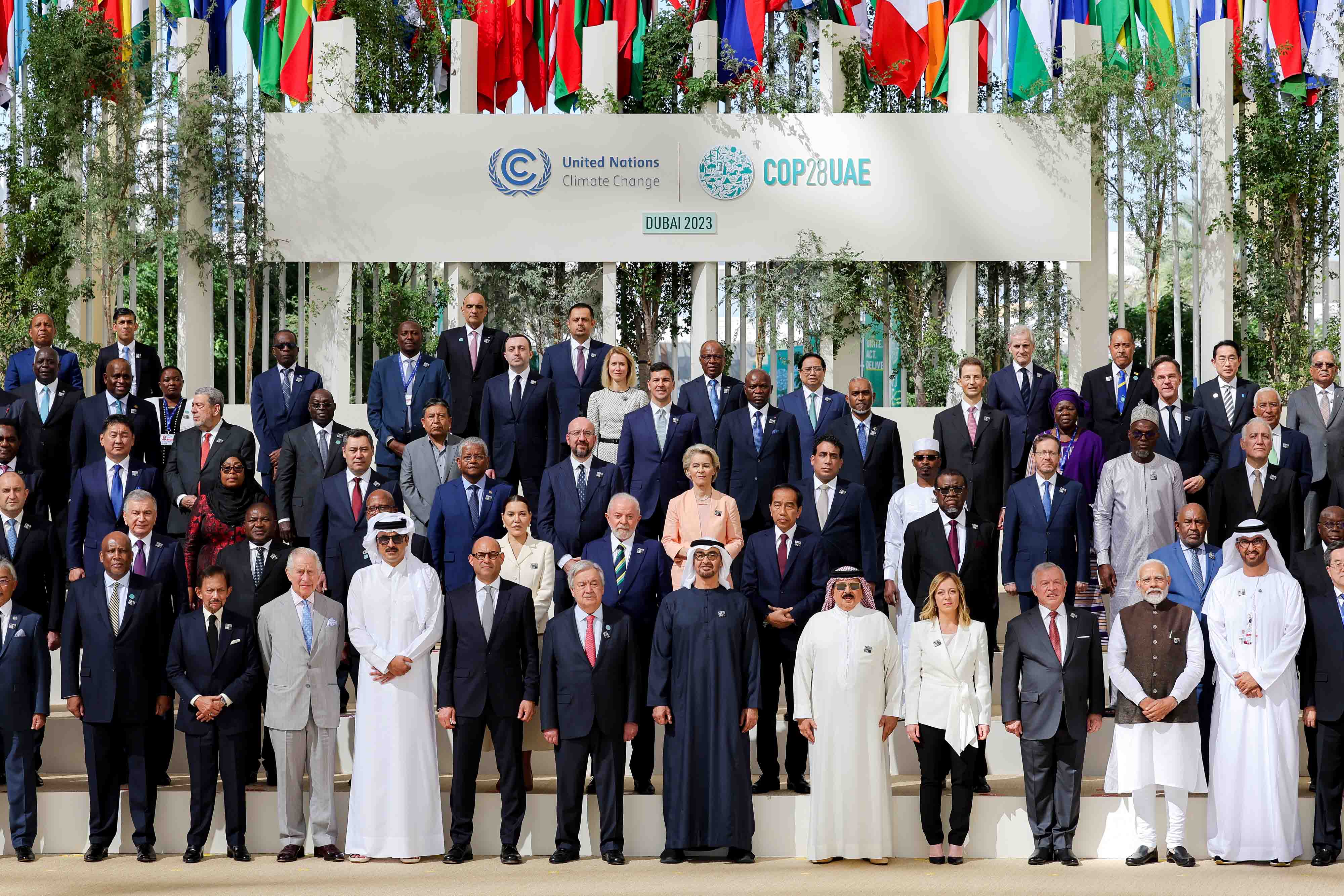
Image Source: World leaders at the United Nations Climate Change Conference, COP28, in Dubai on December 1, Reuters

Soumili Rakshit is a Research Intern at the Centre for Security and Strategic Studies, where she contributes to research and analysis on contemporary security, foreign policy, and strategic affairs. Her work focuses on critically examining geopolitical developments, policy responses, and emerging global challenges through structured research and evidence-based writing. She is particularly interested in the intersections of politics, media, and international relations. At the Centre, she aims to engage in drafting analytical briefs, contributing to research projects and supporting knowledge dissemination initiatives.