Extended Deterrence Under Strain: Credibility, Assurance, and the Stability-Instability Paradox in the Indo-Pacific
Extended deterrence has long served as the foundation of the United States' alliance architecture in the Indo-Pacific, providing security guarantees to partners such as Japan, South Korea, and Australia while reinforcing regional stability and non-proliferation. However, the strategic environment underpinning this system is undergoing profound transformation. China's rapid nuclear modernisation, North Korea's advancing missile capabilities, the growing entanglement of conventional and nuclear forces, and intensifying great-power competition have collectively raised questions about the credibility and resilience of American security commitments in the region.
This article examines the pressures facing extended deterrence through the lenses of the stability-instability paradox, alliance assurance, and escalation management. It analyses the implications of China's expanding nuclear arsenal, North Korea's ability to threaten the U.S. homeland, Japan's evolving security posture, and the strategic significance of initiatives such as AUKUS and the U.S.–South Korea Washington Declaration. The article argues that the central challenge is no longer merely demonstrating commitment to allies, but managing the growing risks of miscalculation and escalation in a region where conventional and nuclear thresholds are increasingly blurred. As the Indo-Pacific emerges as the primary arena of strategic competition, the effectiveness of deterrence will depend as much on crisis-management mechanisms and alliance coordination as on military capabilities themselves.
Introduction
Extended nuclear deterrence- the commitment by a nuclear-armed state to defend allies and security partners using its full range of capabilities, up to and including nuclear weapons- has constituted the architectural foundation of American alliance management in the Indo-Pacific since the early Cold War. The United States' extended deterrence commitments to Japan, South Korea, and Australia have provided the security guarantees that enabled these states to forgo independent nuclear weapons programmes, underpinned the non-proliferation regime in a region of acute strategic competition, and formed the credibility backbone of Washington's hub-and-spoke alliance system across the Pacific.
That architecture is under unprecedented strain. The convergence of three structural developments- China's accelerating nuclear modernisation and the dissolution of any meaningful quantitative asymmetry at the theatre level; North Korea's operationalisation of a survivable intercontinental ballistic missile (ICBM) capability that places the continental United States at risk; and the erosion of conventional deterrence stability produced by precision strike competition and anti-access/area-denial (A2/AD) developments- has created a strategic environment in which the credibility of American extended deterrence commitments is increasingly the subject of anxious debate among allies and adversaries alike.1
This article examines the structural pressures on extended deterrence in the Indo-Pacific through three analytical lenses: the classic stability-instability paradox and its application to the contemporary regional nuclear balance; the assurance dimension of extended deterrence and the indicators by which allied confidence is sustained or eroded; and the policy responses- including nuclear consultative mechanisms, conventional-nuclear integration, and the implications of the AUKUS partnership- that the United States and its allies have pursued to manage credibility under conditions of intensifying strategic competition. The article argues that the central challenge confronting extended deterrence in the Indo-Pacific is not a deficit of declared commitment but a deepening problem of escalation management: as the nuclear balance shifts and conventional and nuclear thresholds blur, the risk of miscalculation in crisis grows in ways that existing deterrence frameworks are inadequately equipped to address.
The Stability-Instability Paradox and Its Indo-Pacific Manifestation
Theoretical Foundations
The stability-instability paradox, first articulated by Glenn Snyder in 1965, identifies a structural tension within deterrence relationships at mutual nuclear sufficiency: the very stability assured by mutual second-strike survivability at the strategic level may create permissive conditions for aggression at lower levels of the conflict spectrum, because each side can calculate that the other will be deterred from nuclear escalation by the costs of strategic exchange.2 In the classical Cold War formulation, this paradox explained why superpower nuclear stalemate coexisted with proxy wars, limited conventional conflicts, and coercive crises- the nuclear umbrella paradoxically sheltered sub-nuclear aggression.
In the contemporary Indo-Pacific, the paradox operates through a more complex multi-actor geometry. China's nuclear modernisation programme- which the U.S. Department of Defense's 2023 China Military Power Report estimates will produce an arsenal of over 1,500 warheads by 2035, up from approximately 500 in 2023- is explicitly designed to achieve a secure second-strike capability that denies the United States the option of meaningful nuclear coercion in a Taiwan contingency.3 If successful, this posture would instantiate the stability-instability paradox in Sino-American relations in a form that could enable more assertive Chinese conventional and grey-zone operations below the nuclear threshold, confident that nuclear escalation would be mutually deterred.
North Korea introduces a distinct variant of the paradox. Pyongyang's development of a survivable ICBM capability- demonstrated through multiple successful test launches of the Hwasong-17 and Hwasong-18 systems in 2022 and 2023- is explicitly designed to decouple American extended deterrence by threatening the continental United States with unacceptable costs in any conflict on the Korean Peninsula.4 If a South Korean or Japanese leader doubts that Washington would accept the incineration of Seattle to honour its alliance commitments in a Korean conflict, the deterrence logic underpinning the alliance guarantee begins to unravel- a calculation that Pyongyang has clearly internalised and that the Trump administration's periodic questioning of alliance commitments has lent uncomfortable empirical support.
Conventional-Nuclear Entanglement
A structurally novel feature of the contemporary Indo-Pacific deterrence environment is the degree of entanglement between conventional and nuclear capabilities. China's People's Liberation Army Rocket Force (PLARF) fields a significant proportion of its conventional precision strike capability- including the DF-26 intermediate-range ballistic missile- on platforms that also carry nuclear variants. American and allied targeting of conventional PLARF assets in a conflict scenario would therefore involve attacking nuclear-capable systems, creating escalation pathways that did not exist in previous deterrence architectures.5
Similarly, the development of conventionally armed precision strike systems capable of threatening an adversary's nuclear command, control, and communications (NC3) infrastructure- a capability that both the United States and China are actively developing- creates first-strike incentives during crises that stability theorists identify as among the most dangerous features of nuclear competition. The fear of a disarming strike on NC3 infrastructure generates 'use or lose' pressures that compress decision timelines and create conditions in which automated or delegated launch authorities become strategically attractive, with profoundly destabilising implications.6
The Assurance Dimension: Allied Confidence and Its Determinants
What Assurance Requires
Extended deterrence has two audiences: the adversary, who must be deterred; and the ally, who must be assured. These functions impose partially conflicting demands on the extended deterrence posture. Deterrence of an adversary may be maximised by a posture that conveys unconditional commitment and high resolve- including a willingness to escalate- while assurance of an ally may require both credible commitment and restraint, demonstrating that the defending power will not entangle its partners in unnecessary escalation.7
The assurance function of extended deterrence encompasses several distinct but interrelated elements: the declaratory posture of the guarantor state; the visibility and survivability of forward-deployed assets; the quality and depth of consultation mechanisms; the credibility of conventional denial capabilities that reduce reliance on nuclear first use; and- critically- the domestic political coherence of the guarantor state's foreign policy commitments. Each of these elements has been subjected to pressure in recent years, and their collective effect on allied confidence represents the central empirical question in assessing the health of extended deterrence in the Indo-Pacific.
The 2022 U.S.-Republic of Korea Washington Declaration, concluded during President Yoon Suk-yeol's state visit, represented a significant institutional response to South Korean assurance concerns. The declaration established the Nuclear Consultative Group (NCG), provided for the regular deployment of U.S. nuclear-capable assets to the peninsula, and committed to enhanced information-sharing on nuclear planning.8 It was widely interpreted as a response to polling data indicating majority South Korean public support for an independent nuclear weapons programme- a development that, if translated into policy, would represent the most significant non-proliferation setback in decades and a fundamental challenge to the credibility of American extended deterrence globally.
Japan's Evolving Strategic Posture
Japan's December 2022 National Security Strategy, National Defense Strategy, and Defense Buildup Program- collectively described as the most significant revision of Japanese security policy since the postwar settlement- marked a decisive shift in Tokyo's strategic posture that has profound implications for the architecture of extended deterrence in Northeast Asia.9 The decision to acquire a 'counterstrike capability'- long-range precision strike systems capable of hitting targets on adversary territory, including the Tomahawk cruise missiles procured from the United States and indigenously developed Type 12 upgrades- represents a qualitative transformation in Japan's role within the alliance, moving from a purely defensive posture toward one that contributes actively to deterrence by denial and punishment.
Japan's decision to double its defence spending to two per cent of GDP by 2027, reversing the decades-long self-imposed ceiling of one per cent, provides the resource foundation for this strategic shift. The implications for extended deterrence are significant in both stabilising and potentially complicating directions. A more capable Japan reduces the burden on American forward presence and enhances the overall deterrence architecture against Chinese and North Korean aggression. However, Japan's acquisition of long-range strike capability also alters the escalation calculus in a Taiwan contingency in ways that require careful management, as the prospect of Japanese strikes on mainland Chinese territory introduces a new actor into an escalation dynamic that has historically been managed as a bilateral Sino-American affair.10
AUKUS and Conventional Deterrence Reinforcement
The AUKUS partnership, announced in September 2021 and elaborated through the Optimal Pathway agreement of March 2023, represents an ambitious attempt to reinforce the conventional deterrence architecture in the Indo-Pacific through the transfer of nuclear-powered submarine technology to Australia. The provision of Virginia-class submarines- and, in the longer term, the jointly developed SSN-AUKUS platform- is explicitly designed to enhance Australia's capacity for long-range maritime operations, undersea denial, and power projection in the approaches to Southeast Asia and the South China Sea.11
From an extended deterrence perspective, AUKUS performs several functions simultaneously. It deepens interoperability among the three parties at the most technologically sensitive level of military cooperation, creating alliance bonds that are durable precisely because of their technical intimacy. It enhances the conventional denial capabilities that reduce the pressure on nuclear first use in a regional contingency, addressing the stability-instability paradox by thickening the conventional deterrence layer below the nuclear threshold. And it signals strategic commitment to the Indo-Pacific in terms that adversaries- particularly China, whose official response was notably hostile- interpret as qualitatively significant.12
The partnership is not without complications for extended deterrence architecture. The use of nuclear propulsion technology- which involves the transfer of weapons-grade highly enriched uranium under a bespoke arrangement that has required novel interpretation of IAEA safeguards obligations- creates a precedent whose non-proliferation implications are contested. If other states invoke the AUKUS precedent to justify the acquisition of nuclear-powered submarines with reduced safeguards scrutiny, the non-proliferation regime could face a significant erosion in precisely the domain- naval nuclear propulsion- that has previously been managed through institutional ambiguity.13
Escalation Management and the Limits of Deterrence Frameworks
The Crisis Stability Problem
The deepest challenge confronting extended deterrence in the contemporary Indo-Pacific is not the credibility of commitments in peacetime but the management of escalation in crisis. The deterrence literature distinguishes between general deterrence- the background condition of strategic stability that prevents the initiation of conflict- and immediate deterrence, the specific calculations that govern behaviour when a crisis is already underway. The conditions for immediate deterrence stability in the Indo-Pacific are more precarious than the general deterrence environment suggests.14
A Taiwan contingency- widely identified by American, Japanese, and Taiwanese security planners as the most plausible pathway to great-power conflict- illustrates the crisis stability problem with particular clarity. Chinese military operations to compel Taiwanese capitulation or to frustrate American intervention would almost certainly involve attacks on American forward bases in Japan and Guam, targeting of logistics and communications infrastructure, and potentially strikes on space and cyber assets that support American military operations globally. Each of these actions would confront American decision-makers with escalation choices under conditions of intense time pressure, incomplete information, and domestic political constraint.
The compressed decision timelines of modern precision strike warfare- in which hypersonic glide vehicles, ballistic missiles, and cyber operations can generate effects in minutes- are structurally incompatible with the deliberative consultation processes that effective crisis management requires. The Washington Declaration's Nuclear Consultative Group and analogous mechanisms with Japan represent institutional responses to this problem, but they are designed for peacetime coordination rather than real-time crisis management, and their robustness under the conditions of an active high-intensity conflict has not been tested.15
Integrated Deterrence and Its Implementation Gaps
The Biden administration's formulation of 'integrated deterrence'- the concept that effective deterrence requires the seamless combination of nuclear and conventional capabilities, cyber and space assets, economic instruments, and alliance coordination- represents an attempt to address the complexity of the contemporary deterrence environment within a coherent strategic framework.16 The 2022 Nuclear Posture Review articulated this concept while retaining a relatively restrained declaratory posture, including a reaffirmation of the sole purpose aspiration- that nuclear weapons exist only to deter nuclear use- while declining to adopt it as formal policy in deference to allied concerns about the implications for extended deterrence credibility.
The implementation gap between the integrated deterrence concept and operational reality is significant. True integration of nuclear and conventional deterrence planning requires levels of interoperability, information-sharing, and joint operational planning between the United States and its allies that current institutional arrangements do not fully support. The Extended Deterrence Strategy and Consultation Group with Japan and the nascent Nuclear Consultative Group with South Korea represent steps toward deeper consultation, but they fall short of the kind of nuclear planning integration that NATO's Nuclear Planning Group has developed over decades- and NATO's own experience suggests that even that level of integration is subject to persistent tensions between the guarantor's operational requirements and allies' political sensitivities.17
Policy Implications and Pathways Forward
The analysis above suggests several directions for strengthening extended deterrence in the Indo-Pacific without accelerating the escalatory dynamics that constitute the primary risk. First, deepening trilateral security coordination among the United States, Japan, and South Korea- formalising the consultative architecture established at Camp David in August 2023 into durable institutional frameworks that can survive leadership transitions- is a prerequisite for coherent extended deterrence management across the two principal Northeast Asian contingencies.18
Second, investment in crisis communication channels with both China and North Korea- a Track 1.5 or Track 2 process designed to develop shared understandings of red lines and escalation thresholds- offers a risk-reduction pathway that does not require mutual trust or strategic alignment. The complete absence of functioning military-to-military communication between China and the United States during periods of elevated tension, as demonstrated by China's repeated refusal to engage in crisis hotline communication in 2023 and 2024, represents a structural instability that arms control and confidence-building frameworks have historically been designed to address.19
Third, the long-run sustainability of extended deterrence in the Indo-Pacific requires addressing the conventional deterrence deficit at the theatre level. The erosion of American conventional superiority in the Western Pacific- produced by China's A2/AD investments and the geographic advantages of interior lines- creates a structural pressure to compensate with lower nuclear thresholds. Reversing this pressure through investment in distributed basing, long-range conventional strike, undersea capabilities, and allied burden-sharing is as important to the health of extended deterrence as the nuclear dimensions of the architecture.20
Conclusion
Extended deterrence in the Indo-Pacific faces a structural challenge that is qualitatively different from the management problems of the Cold War era. The multiplication of nuclear-armed actors, the dissolution of clear conventional escalation thresholds, the entanglement of conventional and nuclear systems, and the compressed decision timelines of modern precision warfare have collectively created an environment in which the credibility of extended deterrence commitments is simultaneously more important and harder to sustain than at any point since the early Cold War.
The institutional responses visible in recent years- the Washington Declaration, Japan's strategic reorientation, AUKUS, and the Camp David trilateral framework- represent meaningful efforts to adapt the extended deterrence architecture to a more complex strategic environment. They are necessary but not sufficient. The deepest risks in the contemporary Indo-Pacific deterrence environment are not those of unconvinced allies or insufficiently signalled commitments; they are the risks of escalation by miscalculation in a crisis that all parties notionally wish to avoid. Addressing those risks requires not merely military investment and institutional coordination but a sustained effort to develop the crisis management architecture- communication channels, escalation roadmaps, and shared understandings of thresholds- that the region's security has so far lacked.
The stability of the Indo-Pacific nuclear order in the coming decade will be determined less by the balance of warheads than by the quality of the institutional frameworks that govern behaviour when deterrence is tested. On that measure, the work of construction is far from complete.
References
1. Acton, J. M. (2018). Escalation through entanglement: How the vulnerability of command-and-control systems raises the risks of an inadvertent nuclear war. International Security, 43(1), 56–99. https://doi.org/10.1162/isec_a_00320
2. Brodie, B. (Ed.). (1946). The absolute weapon: Atomic power and world order. Harcourt Brace.
3. Cha, V. D. (2016). Powerplay: The origins of the American alliance system in Asia. Princeton University Press. https://doi.org/10.1515/9781400880218
4. Colby, E. A. (2021). The strategy of denial: American defense in an age of great power conflict. Yale University Press.
5. Cote, O. R. (2011). Invisible nuclear submarines and invulnerable second strikes. MIT Security Studies Program Working Paper. https://ssp.mit.edu/publications/working-papers
6. Feaver, P. D. (1992). Guarding the guardians: Civilian control of nuclear weapons in the United States. Cornell University Press.
7. Frühling, S., & Tertrais, B. (2020). The future of extended nuclear deterrence: Analytical frameworks and the need for updated research agendas. The Nonproliferation Review, 27(4–6), 337–354. https://doi.org/10.1080/10736700.2021.1893906
8. Glaser, C. L., & Fetter, S. (2016). Should the United States reject MAD? Damage limitation and U.S. nuclear strategy toward China. International Security, 41(1), 49–98. https://doi.org/10.1162/ISEC_a_00248
9. Hughes, C. W. (2023). Japan's grand strategic shift: From 'proactive pacifism' to 'proactive security.' Survival, 65(2), 23–48. https://doi.org/10.1080/00396338.2023.2193097
10. International Institute for Strategic Studies. (2024). The military balance 2024. Routledge. https://doi.org/10.4324/9781003451167
11. Kang, D. C. (2017). American grand strategy and East Asian security in the twenty-first century. Cambridge University Press. https://doi.org/10.1017/9781108227902
12. Krepinevich, A. F. (2015). How to deter China: The case for archipelago defense. Foreign Affairs, 94(2), 78–86.
13. Lieber, K. A., & Press, D. G. (2017). The new era of counterforce: Technological change and the future of nuclear deterrence. International Security, 41(4), 9–49. https://doi.org/10.1162/ISEC_a_00270
14. Payne, K. B. (2001). The fallacies of cold war deterrence and a new direction. University Press of Kentucky.
15. Roberts, B. (2015). The case for U.S. nuclear weapons in the 21st century. Stanford University Press.
16. Snyder, G. H. (1965). The balance of power and the balance of terror. In P. Seabury (Ed.), The balance of power (pp. 185–201). Chandler.
17. Tannenwald, N. (2007). The nuclear taboo: The United States and the non-use of nuclear weapons since 1945. Cambridge University Press. https://doi.org/10.1017/CBO9780511491278
18. Tong, Z. (2023). China's nuclear modernisation and its implications for strategic stability. Journal of Strategic Studies, 46(3), 501–528. https://doi.org/10.1080/01402390.2022.2107448
19. U.S. Department of Defense. (2022). 2022 Nuclear Posture Review. https://media.defense.gov/2022/Oct/27/2003103845/-1/-1/1/2022-NATIONAL-DEFENSE-STRATEGY-NPR-MDR.PDF
20. U.S. Department of Defense. (2023). Military and security developments involving the People's Republic of China 2023. https://media.defense.gov/2023/Oct/19/2003323409/-1/-1/1/2023-MILITARY-AND-SECURITY-DEVELOPMENTS-INVOLVING-THE-PEOPLES-REPUBLIC-OF-CHINA.PDF
21. White House. (2023). The Washington Declaration. https://www.whitehouse.gov/briefing-room/statements-releases/2023/04/26/washington-declaration/
22. Wit, J. S., Poneman, D. B., & Gallucci, R. L. (2004). Going critical: The first North Korean nuclear crisis. Brookings Institution Press.
23. Yoshida, S., & Liff, A. P. (2022). Japan's 2022 strategic documents and the future of the U.S.–Japan alliance. Brookings Institution. https://www.brookings.edu/articles/japans-2022-strategic-documents/
(The views expressed are those of the author and do not represent the views of CESCUBE)
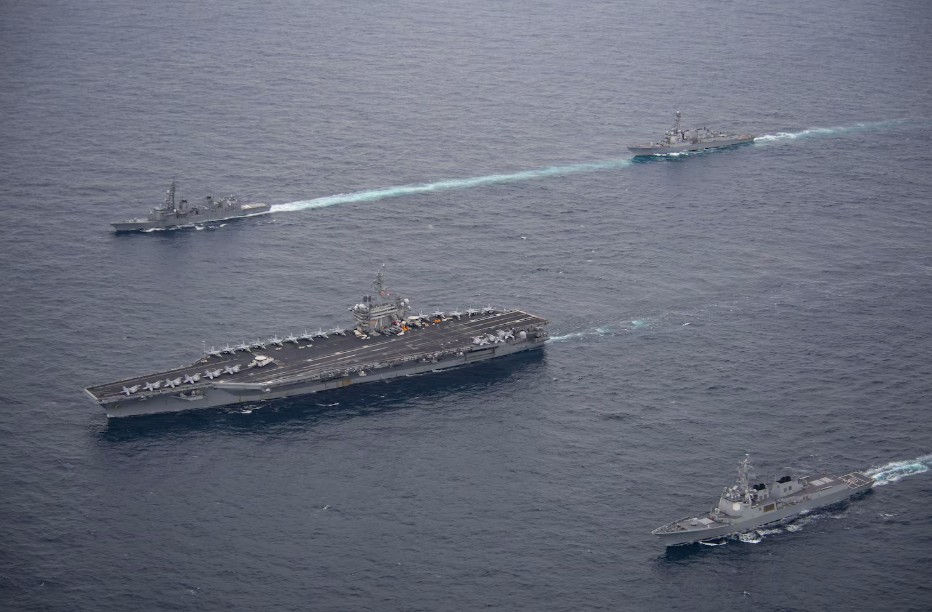
Image Source: (Commander, U.S. 7th Fleet, Department of Defense, USA) https://www.c7f.navy.mil/Media/News/Display/Article/3739256/japan-republic-of-korea-us-navies-partner-in-trilateral-maritime-exercise/

Soumili Rakshit is a Research Intern at the Centre for Security and Strategic Studies, where she contributes to research and analysis on contemporary security, foreign policy, and strategic affairs. Her work focuses on critically examining geopolitical developments, policy responses, and emerging global challenges through structured research and evidence-based writing. She is particularly interested in the intersections of politics, media, and international relations. At the Centre, she aims to engage in drafting analytical briefs, contributing to research projects and supporting knowledge dissemination initiatives.