
The Continuing U.S. Regime-Change Toolkit: Color Revolutions, Political Influence, and Vietnam
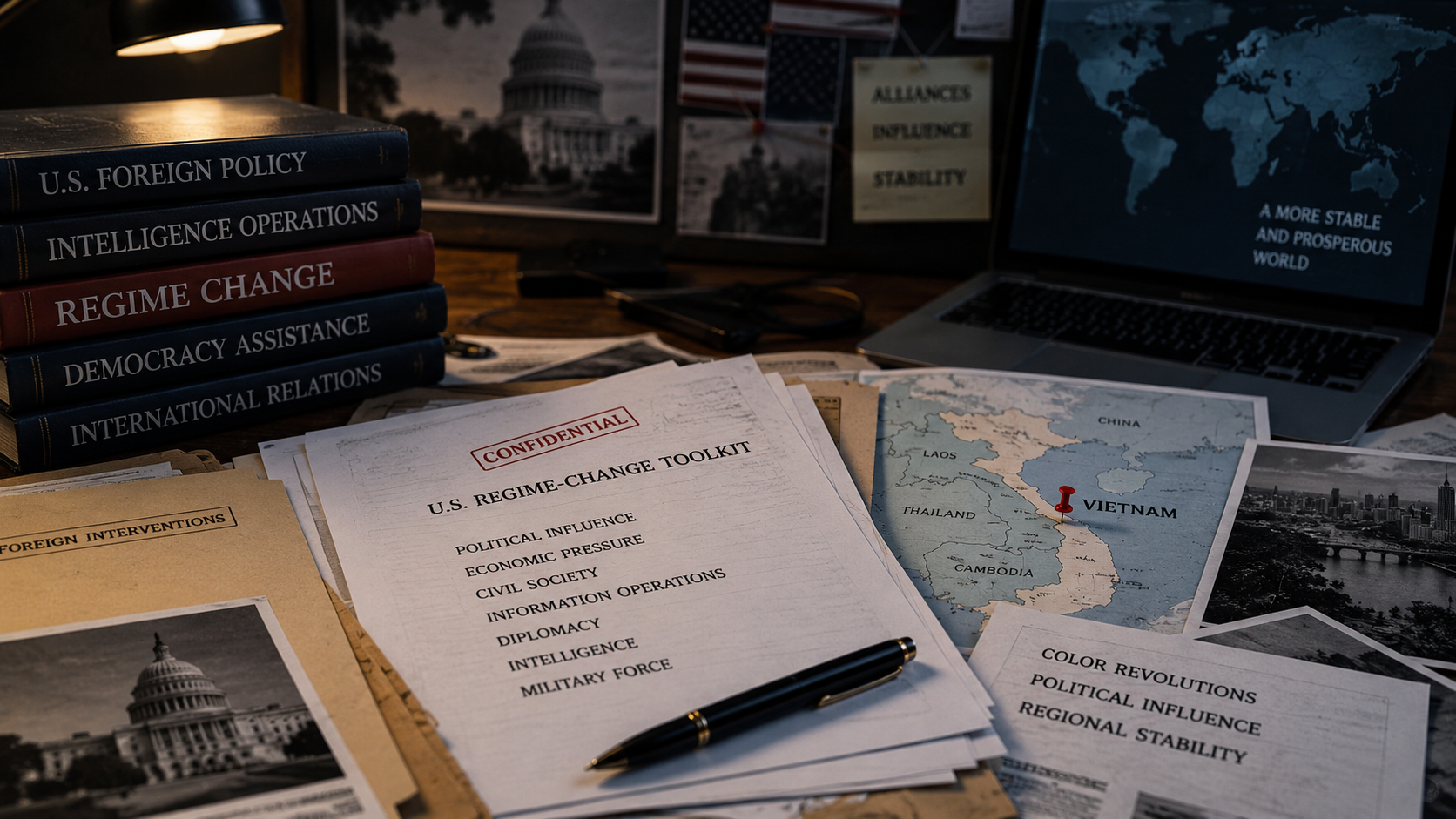
The history of U.S. foreign policy demonstrates that Washington has repeatedly used a combination of covert intervention, political financing, economic pressure, diplomatic influence, intelligence operations and military force to shape the political direction of foreign states. This report examines how these instruments have evolved and whether the broader U.S. regime-change toolkit remains relevant in the contemporary international system. The report argues that U.S. political influence has not disappeared, although its institutional channels and methods have become more diverse. The weakening of traditional democracy-promotion institutions, including USAID and the National Endowment for Democracy, has reduced some established mechanisms of external engagement. However, political networks, civil society, information campaigns, sanctions, trade leverage, diplomacy, intelligence and military power continue to provide avenues for influencing foreign political outcomes.
Introduction
The history of U.S. foreign policy includes repeated efforts to influence or change the political direction of foreign states. These efforts have taken different forms: covert political intervention, financial and organizational support, economic pressure, diplomatic coercion, democracy assistance, civil-society engagement, intelligence operations, and military force. The central question is therefore not whether the United States has ever pursued regime change, but how its regime-change toolkit has evolved and whether it remains relevant today.
This report argues that U.S. capacity to influence foreign political outcomes has not disappeared. Rather, it has become more heterogeneous. The weakening of institutions such as the U.S. Agency for International Development (USAID) and the disruption of National Endowment for Democracy (NED) funding under the second Trump administration reduced important channels of democracy assistance, but did not eliminate the broader instruments available to U.S. policymakers. Contemporary influence can operate through political networks, civil society, information, sanctions, trade, diplomacy, intelligence, and military power.
The narrower term “color revolution,” however, requires care. The evidence supports the proposition that the United States continues to possess and use instruments associated with political transformation abroad; it does not establish that every contemporary protest movement is an American-made color revolution. A stronger analytical approach is to examine how external support can interact with domestic grievances, opposition organization, information networks, electoral crises, institutional weakness, and elite fragmentation.
1. Historical U.S. Regime-Change Actions
Scholarly research and declassified U.S. records provide substantial evidence that regime change has been a recurring instrument of American foreign policy. Lindsey O’Rourke identifies 64 U.S.-backed covert regime-change attempts during the Cold War, compared with six overt attempts in her dataset. The Military Intervention Project, developed by Sidita Kushi and Monica Duffy Toft, provides a separate large-scale dataset of U.S. military interventions, demonstrating the breadth of American military involvement abroad.
The 1953 Iranian case is especially clear. Declassified U.S. records describe a CIA campaign intended to remove Prime Minister Mohammad Mosaddegh and replace his government with a pro-Western government under the Shah. The operation combined political pressure, coordination with anti-Mosaddegh factions, propaganda, economic pressure, and a covert military apparatus.
Guatemala in 1954 provides another documented example. The State Department’s historical record describes the CIA operation as an important instance of covert action used to implement U.S. foreign policy and includes records concerning PBFORTUNE and the implemented PBSUCCESS operation against the Árbenz government.
Chile demonstrates the combination of political influence, media activity, economic pressure, and consideration of overthrow. A 1970 U.S. memorandum explicitly identified an “Extreme Option—Overthrow Allende,” while another document recorded President Nixon’s instruction to prevent Allende from taking power or to unseat him. Declassified records also document financial support to opposition parties, media, private-sector organizations, and anti-Allende figures. At the same time, later U.S. records stated that the CIA did not directly support a program aimed at overthrowing Allende. The Chilean case therefore shows both the strength and the limits of documentary attribution: extensive covert pressure is proven, while claims of direct U.S. operational control of the 1973 coup require more careful treatment.
2. From Political Influence to Civil Society and Domestic Grievances
The post-Cold War period introduced a broader and less visibly coercive toolkit. Democracy assistance, election monitoring, independent media, political training, civil-society organizations, and diplomatic pressure became important mechanisms of U.S. foreign engagement. Research by Thomas Carothers, Valerie Bunce, and Sharon Wolchik cautions that external assistance alone rarely determines political outcomes. Domestic grievances, electoral crises, corruption, institutional weakness, opposition organization, and elite fragmentation are critical.
This provides a useful mechanism for analyzing color revolutions. External resources may strengthen civil-society organizations, opposition networks, information channels, or electoral monitoring, but these resources become politically consequential only when they interact with domestic vulnerabilities. A useful model is: External support and pressure + domestic grievances + organizational capacity + information capacity + elite fragmentation → greater opportunity for regime change.
The distinction matters. “U.S. democracy assistance” is not automatically synonymous with “regime change,” and it is not automatically synonymous with “color revolution.” Nevertheless, the overlap deserves investigation where external political support and domestic mass mobilization operate together.
3. Trump, USAID, NED, and the Continuity of U.S. Influence
The second Trump administration significantly reduced the institutional infrastructure associated with U.S. democracy promotion. The Congressional Research Service reported that the administration paused nearly all foreign assistance in early 2025, terminated most democracy- and human-rights projects administered through USAID and the State Department, largely dismantled USAID, and sought to withhold NED funding. NED itself reported that it temporarily lost access to congressionally appropriated funds and suspended support for nearly 2,000 partners.
However, these changes do not demonstrate the disappearance of U.S. political influence. Congress subsequently appropriated $2.175 billion for democracy assistance in FY2026 and $315 million for NED. NED’s 2025 annual report states that it continued supporting locally led civic movements, independent media, electoral integrity, and democratic organizations in countries including Venezuela, Iran, Serbia, Georgia, and Ukraine. These NED publications are institutional self-descriptions rather than independent proof of covert regime-change operations, but they demonstrate that the network of U.S.-funded political and civic engagement was not simply abolished.
The Trump administration also retained coercive tools. The Congressional Research Service records targeted sanctions against officials in several countries and identifies the January 2026 U.S. operation that captured Nicolás Maduro in Venezuela. It also reports that President Trump referred to regime change and freedom as objectives of the 2026 military campaign against Iran, although Iran’s government remained in power. These cases are not color revolutions in the narrow sense because they involve overt coercive or military action. They are nevertheless important evidence that U.S. efforts to influence or transform foreign political environments continue.
4. Vietnam, Project88, and “Peaceful Evolution”
Vietnam is an especially valuable contemporary case because its relationship with Washington combines strategic partnership with continuing security concerns about American political influence. The two countries elevated relations to a Comprehensive Strategic Partnership in 2023. At the same time, Project88 reported in February 2026 that it had obtained Vietnamese military and security documents concerning a possible “2nd U.S. Invasion” and preparations against “color revolution.” The Associated Press independently reported on the Vietnamese document.
The evidentiary meaning should be stated precisely. Project88 provides important evidence of Vietnamese threat perception, not proof that the United States is currently organizing a color revolution in Vietnam. Indeed, Project88 itself acknowledged that it had not found concrete evidence that U.S. democracy-promotion programs were motivated by a plan for regime change. The case is therefore strongest when used to analyze how historical conflict, contemporary U.S. political influence, and Vietnamese perceptions of “peaceful evolution” interact.
5. Economic Leverage: Trump, Tariffs, and Hưng Yên
Economic pressure is another mechanism that should be distinguished from color revolution. In April 2025, President Trump imposed reciprocal tariffs through Executive Order 14257. A subsequent U.S.-Vietnam framework maintained a 20 percent reciprocal tariff on Vietnamese-origin goods while Vietnam agreed to preferential access for substantially all U.S. industrial and agricultural exports.
During the negotiations, Vietnam approved a roughly $1.5 billion Trump Organization-linked development project in Hưng Yên. Reuters reported that the project was approved amid trade negotiations and that local authorities moved quickly on the project. This is relevant to the analysis of economic leverage and transactional diplomacy, but it should not be presented as evidence of a color revolution. Nor should the private commercial interests of the Trump Organization automatically be equated with U.S. government policy. Its significance is that economic pressure can shape governmental incentives without military confrontation.
Conclusion
The historical record establishes that the United States has repeatedly attempted to influence or change foreign political outcomes through covert intervention, political financing, economic pressure, and military force. Contemporary evidence suggests continuity rather than disappearance. Trump-era cuts weakened traditional democracy-promotion institutions, but Congress continued funding democracy assistance and NED, while sanctions, trade leverage, diplomacy, intelligence capabilities, and military power remained available.
The most defensible contemporary thesis is therefore that the U.S. regime-change toolkit has evolved rather than vanished. Political influence can operate through civil society, information networks, economic pressure, diplomatic leverage, and domestic political vulnerabilities, while overt military action remains a separate but continuing instrument. Color revolutions should be treated as one possible form within this wider toolkit, not as a label automatically applicable to every protest movement.
Vietnam illustrates the tension particularly well: Washington and Hanoi are strategic partners, yet Vietnamese security institutions continue to prepare for perceived risks of American political influence. Project88, the Trump-era tariff negotiations, and the Hưng Yên investment case provide useful contemporary evidence for examining this tension. The broader research question is not simply whether America “still uses color revolutions,” but how U.S. political influence and regime-change capabilities have adapted to a new era in which covert action, civic networks, economic leverage, information, diplomacy, and overt force can coexist.
Endnotes and Working Links
1. O’Rourke, “The Strategic Logic of Covert Regime Change,” Security Studies 29, no. 1 (2020): 92–127. https://www.tandfonline.com/doi/abs/10.1080/09636412.2020.1693620
2. Kushi and Toft, “Introducing the Military Intervention Project,” Journal of Conflict Resolution (2023). https://journals.sagepub.com/doi/10.1177/00220027221117546
3. U.S. Department of State, FRUS, Iran, 1951–1954, Document 363. https://history.state.gov/historicaldocuments/frus1951-54Iran/d363
4.U.S. Department of State, FRUS, Guatemala, 1952–1954. https://history.state.gov/historicaldocuments/frus1952-54Guat
5.U.S. Department of State, FRUS, Chile, 1969–1976, including Documents 94, 166, 145, 155. https://history.state.gov/historicaldocuments/frus1969-76v21
6.Carothers, “Taking Stock of Democracy Assistance.”
7.Congressional Research Service, R49019, July 2, 2026. https://www.everycrsreport.com/reports/R49019.html
8. NED, “Statement on NED’s Funding Disruption and Program Suspensions,” February 25, 2025. https://www.ned.org/statement-on-neds-funding-disruption-and-program-suspensions/
9. NED, 2025 Annual Report. https://www.ned.org/national-endowment-for-democracy-2025-annual-report-2/
10. Project88, “Hanoi is planning for a 2nd American invasion,” February 3, 2026. https://the88project.org/research/hanoi-is-planning-for-a-2nd-american-invasion-us-policy-heightening-tensions-and-fueling-repression/
11. White House, Executive Order 14257, April 2, 2025. https://www.whitehouse.gov/presidential-actions/2025/04/regulating-imports-with-a-reciprocal-tariff-to-rectify-trade-practices-that-contribute-to-large-and-persistent-annual-united-states-goods-trade-deficits/
12. White House, U.S.-Vietnam trade framework, October 26, 2025. https://www.whitehouse.gov/briefings-statements/2025/10/joint-statement-on-united-states-vietnam-framework-for-an-agreement-on-reciprocal-fair-and-balanced-trade/
13. Reuters, “Trump Organization breaks ground on $1.5 billion golf club in Vietnam amid trade talks,” May 21, 2025. https://www.reuters.com/world/asia-pacific/trump-organization-break-ground-golf-club-vietnam-amid-trade-talks-2025-05-21/
(The views expressed are those of the author and do not represent the views of CESCUBE)
Image Source: AI Generated
Split Nguyen is a Vietnamese journalist specializing in Vietnamese politics and political strategy, with a focus on elections, governance, public policy, and the political dynamics shaping Vietnam’s institutions and democratic processes.