Bridging the Fifth-Generation Gap: India's Su-57E Dilemma, AMCA, and Strategic Autonomy
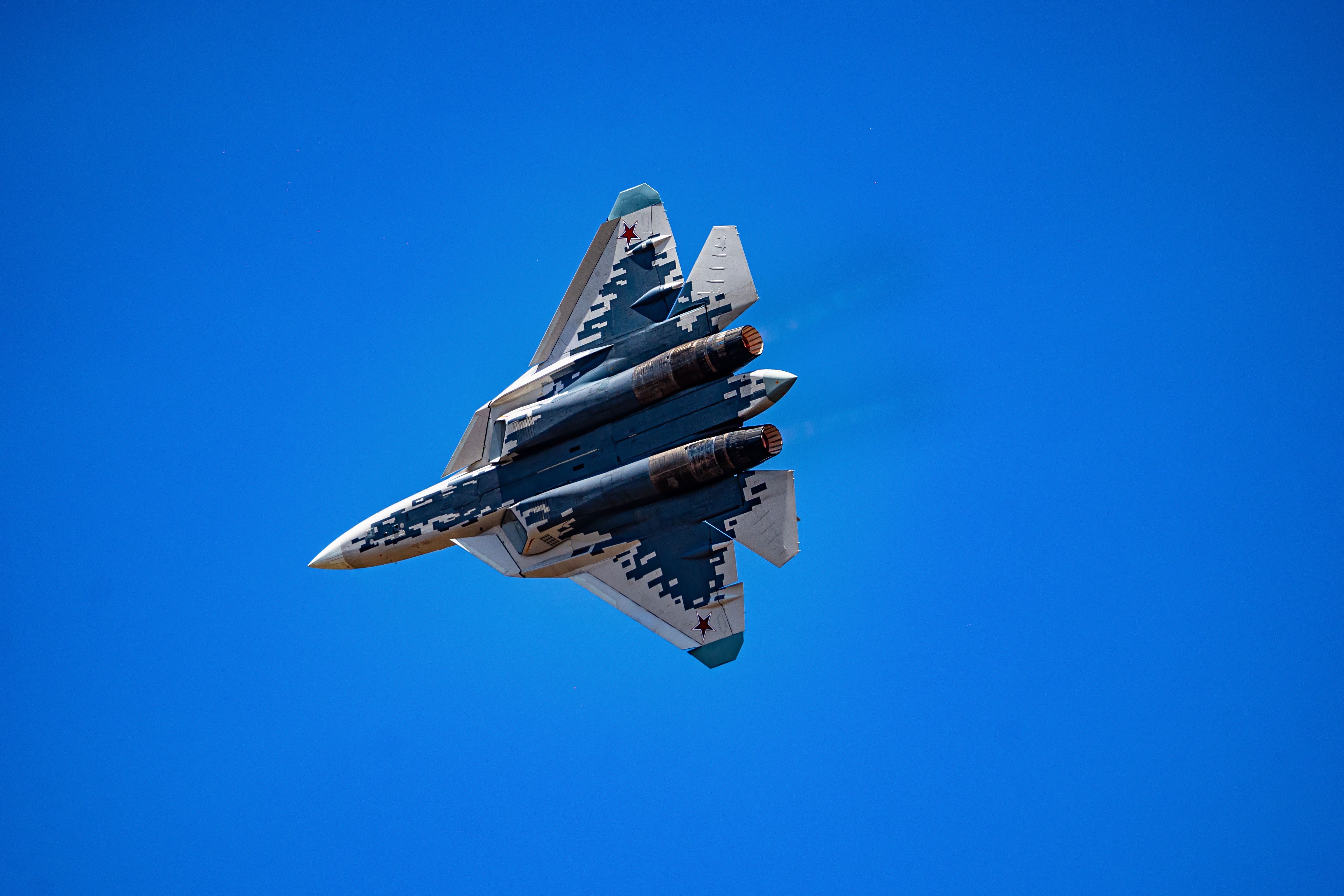
India's pursuit of fifth-generation airpower presents a strategic dilemma between immediate operational requirements and long-term technological sovereignty. This article examines Russia's Su-57E offer in the context of the Indian Air Force's squadron shortages, the legacy of failed Indo-Russian fighter collaboration, and the evolving AMCA programme. It assesses the technological, industrial, and geopolitical constraints shaping India's options, including concerns over delivery timelines, technology transfer, and the wider implications for relations with Washington and Moscow. The article argues that India's challenge extends beyond acquiring an advanced fighter: it lies in bridging the capability gap without compromising strategic autonomy or indigenous aerospace ambitions.
Introduction
Repeated Offers of Su 57 aircraft; a fifth gen fighter aircraft, by Russia, has been making headlines since Russian President Vladimir Putin arrived in New Delhi for the BRICS summit[1]. Recently, Indian Air Force Chief Marshal Amar Preet Singh also indicated at considering a foreign fighter option for the Indian Air Force[2]. But India has made it clear that it has not decided to acquire any such aircraft and its focus remains on Indigenous Advanced Medium Combat Aircraft (AMCA) programme and modernizing its Su- 30 MKI fleet.
This offer comes at a time when India’s fighter squadron is down to an alarming level of 30 against the sanctioned strength of 42[3] and the present inventory has ageing Jaguars which are being prepared to phase out while Mirage 2000s are being considered to be given a service life extension till 2039, beyond its original retirement timeline[4]. Another matter of concern is that, AMCA project will take a long time as the RFPs (Request for Proposals) phase will go on till 30th October[5]. The maiden flight of AMCA is not expected before 2029-30. The fifth gen fighter aircrafts are with only 3 countries at present - US, Russia and China, and India had already conveyed its disinterest in acquiring F-35 fighter jets from US, the only option left was Su-57 which has not received approval from India.
Russia’s Su-57 Offer:
The proposal comes with substantial technology transfer and local production at the HAL facility in Nasik to fulfil IAF’s requirements by 2030, with offer to manufacture 100 Su-57E (Export variant) stealth fighters in India. In the interim period, 36-40 Su-57s were to be supplied by 2027-28 to form 2 squadrons[6]. Russia had offered full stealth airframe manufacturing, advanced low-observable coatings, next-gen AESA radar, super maneuverability, and powerful engines etc. The offer also includes AI-based avionics, sensor fusion and data-linked weapon systems.
In addition to this, Moscow’s package offered production at Hindustan Aeronautics Limited’s Nashik line, which already manufactures the Su-30 MKI, leveraging existing tooling, workforce, and supply chains[7] . A further inducement involved integrating the AL-41 engine, powering the Su-57, into the Su-30 MKI as an upgrade path from the current AL-31FP, promising enhanced thrust, super cruise potential, and propulsion commonality across the wider Sukhoi fleet. Russia dangled assistance to India’s AMCA effort plus joint production and third-country export possibilities. This offer could entangle New Delhi’s sovereign ambitions of fifth-generation ambitions within Russian design and manufacturing ecosystems.
The Structural constrains & the FGFA legacy:
These offers might sound lucrative but they collided with hard structural constraints. First, Russia’s ability to source advanced electronics and micro-components have been degraded by sanctions, casting doubts over realistic delivery timelines for any foreign export customer. Second, the aircraft is still fielded in modest numbers by Russia’s own air force, inviting questions by Indian planners over the airframe’s operational maturity, its true-observable performance, and lifecycle costs[8].
India’s caution also results from the failed Fifth-Generation Fighter Aircraft programme. In December 2010, HAL and Russian arms export company Rosoboronexport signed a design contract worth US $295 million as part of this programme. However, India withdrew from the project in 2018 because of repeated delays, escalating costs, and bitter disputes over work-share and technology transfer, with Russia resisting source-code and design-data access India deemed essential to sovereign wartime operation and future capability upgrades[9].
The Indian Air Force has also voiced dissatisfaction with the aircraft’s stealth and low-observable performance, its combat avionics, and its overall capability margins against emerging fifth-generation jets. These factors become essential to consider because of ongoing developments in India’s neigbourhood. China is rapidly maturing its J-20 stealth programme, while Pakistan is expected to induct China’s J-35A stealth fighter over the next 2-3 years, creating a significant capability gap[10].
CAATSA and the S-400 Precedent:
These developments are unfolding at a juncture when Washington’s tolerance for countries maintain major economic ties with Moscow is diminishing. Being one of the two largest buyers of Russian crude, India have come under pressure with Trump publicly threatening secondary tariffs of up to 100 % if Moscow fails to meet US demands over ending the Ukraine war.
India has carefully balanced relationship with both countries, but its balancing act of its military relationship with Russia while also deepening its defence partnerships with the United States comes with its own consequences. The point of contention emerged over India’s decision to acquire the Russian S-400 “Triumf” air defence system, which invited repeated warnings of punitive measures under the 2017 Countering America’s adversaries Through Sanctions Act (CAATSA)[11]. Title II of the Act primarily deals with sanctions on Russian interests such as its oil and gas industry and defence and security sector. Section 231 of the Act empowers the US President to impose at least 5 of the 12 listed sanctions- enumerated in section 235 of the act on the persons engaged in a “significant transaction” with Russian defence and intelligence sectors[12]. In 2020, Turkey was sanctioned for its purchase of the S-400 system[13], although India was given a waiver in this act to help deter aggressors like China.
The AMCA Programme: India’s sovereign bet:
India’s future combat strategy rests on the AMCA, which received government clearance for prototype development at roughly ₹15,000 crore[14]. The AMCA is a twin-engine, single-seat fighter with a fuselage designed for low radar cross-section. The aircraft features internal weapons bays for munitions, a design requirement driven by the need to maintain low-observable signature, with its combat load up to 1500 kg in the internal compartments and up to 5500-6500 kg on the external hardpoints[15]. The aircraft will feature an AESA radar, a distributed aperture system for 360-degree infrared situational awareness, an advanced electronic warfare suite, and a high-bandwidth datalink for networked operations with other manned and unmanned platforms.
Current plans call for an initial batch of about 40 AMCA Mk1 fighters powered by the proven GE F414 engine, before transitioning to a more powerful engine for the future AMCA Mk2[16]. AMCA Mk1 would become India’s bridge into fifth-generation aviation. It’s true value lies in its stealthy low-observable design, internal weapons carriage, sensor fusion, and integrated electronic warfare. By using already mature engine like the F414, India could get a stealth fighter into production earlier while buying time to develop the higher-thrust engine for later variants.
Accelerating this programme has its own risks. The AMCA is a complex machine and pushing production before completing exhaustive flight testing, certification, and qualification could introduce serious safety and reliability issues[17]. Recent reports indicate that the commercial negotiations for the engine hit a roadblock in the mid-2026, with the US manufacturer reportedly asking for prices nearly three times higher than initial estimates. The current status of the program shows that first AMCA prototype will be unveiled in 2027, with the first flight scheduled between 2028 and 2029, certification by 2032, and entry into service no earlier than 2034-2035.
India’s strategic hedging and networked autonomy:
In the recent years, India has hedged strategically and developed a networked security autonomy. This approach of deliberate diversification reflects aiming at minimizing vulnerabilities in defence and energy, sustaining diplomatic flexibility, and expanding partnership in multiple security and technology networks.
Data released by Stockholm International Peace Research Institute (SIPRI) shows that Russia has retained its position as the largest supplier of India’s arms import but it has seen its share decline from 70 % during 2010-2014 to around 30 % between 2020-2024[18]. The United States- India defence trade on the other hand, rose from virtually zero in 2008 to over $20 billion by 2024, including major acquisitions such as P-8I maritime patrol aircraft Apache and Chinook helicopters, and C-17 Globemaster III and C-130J Super Hercules heavy transport aircrafts. A large portion of India’s air force, army armor, and naval submarine fleet still rely on Russian-origin technology, yet the downsizing even after the persistence of these defence linkages has been the core features of India’s strategic hedging. India has undertaken defence purchases from France, United States, and Israel and is actively exploring defence collaborations with Sweden, Spain, Italy, Germany, South Korea, Japan etc[19].
At the same time, India’s Ministry of Defence has issued five positive indigenisation lists of 5,500 items for domestic production of which 3,000 had been indigenized by February 2025[20].India’s deepening technological cooperation with Western partners ranging from undersea domain awareness to semiconductor supply chains, coexist with its ongoing defence-technical cooperation with Russia in nuclear energy, space technologies , and legacy weapons, India’s involvement in such diversified networks has allowed it to extract benefits from multiple sources, avoiding rigid constraints of formal alliances[21]. It also shows that autonomy is pursued through isolation but through dense connectivity, which enhances resilience and mitigates coercive vulnerabilities.
Conclusion:
India’s rejection of the SU-57 offer represents a calculated reassessment of the strategic costs associated with defence dependence on one country. Three factors proved decisive. First, the low squadron strength creates pressure for immediate solutions, but the Su-57’s uncertain delivery timelines diminished its value as a stopgap. Second, the CAATSA experience with the S-400 demonstrated that Russian procurement has a geopolitical cost with current environment of heightened US pressure. Third, the structural shift in India’s arms imports reflects a deliberate diversification strategy that the Su-57 purchase would have reversed.
The decision to prioritize the Su-30 MKIs upgrade and additional 114 rafales induction mitigates the capability gap until AMCA matures in the mid 2030s[22]. The AMCA programme’s success depends on private sector execution, GE 414 engine supply chain viability and indigenous engine development. These factors will determine whether India’s bet on sovereign development delivers a fifth- generation capabillty to leaves a persistent vulnerability in its air defence posture.
References:
[1] Surendra Singh /. TNN /. Updated: Sep 12 et al., “Putin’s Brics Visit: Su-57, Super Sukhois Fighter Jets, S-500 on Russia’s Defence Offer List,” The Times of India, accessed September 12, 2026,https://timesofindia.indiatimes.com/defence/pm-modi-putin-hold-defence-talks-as-russian-president-comes-up-with-long-list-of-offers-for-india-like-su-57-jets-super-sukhois-s-500/articleshow/134082252.cms.
[2] The Economic Times, “IAF Chief Hints at Foreign Fifth-Gen Fighter Option If AMCA Is Delayed, Cites Russia’s Su-57 Offer,” The Economic Times, October 3, 2026,https://economictimes.indiatimes.com/news/defence/iaf-chief-hints-at-foreign-fifth-gen-fighter-option-if-amca-is-delayed-cites-russias-su-57 offer/articleshow/134654167.cms
[3] The Economic Times, “IAF Chief Hints at Foreign Fifth-Gen Fighter Option If AMCA Is Delayed, Cites Russia’s Su-57 Offer.”
[4] Jay Menon, “IAF Plans Jaguar Retirement and Mirage-2000 Life Extension to 2039,” AGN, March 16, 2026, https://aerospaceglobalnews.com/news/indian-air-force-sepecat-jaguar-retirement-mirage-2000-extension/.
[5] The Hindu, “AMCA Bid Deadline Extended by Two Months to October 30,” India, The Hindu, August 27, 2026, https://www.thehindu.com/news/national/amca-bid-deadline-extended-by-two-months-to-october-30/article71396832.ece.
[6] Mint, “Russia Wants India to Make 100 Su-57 Fighter Jets: What Moscow Has Proposed | Mint,” August 18, 2026, https://www.livemint.com/industry/manufacturing/russia-wants-india-to-make-100-su-57-fighter-jets-what-moscow-has-proposed-11789732515102.html.
[7] India Strategic Staff/ Agency, “India Should Give a Serious Look to Russia’s Offer of Su-57s for IAF,” India Strategic, April 22, 2026, https://www.indiastrategic.in/india-should-give-a-serious-look-to-russias-offer-of-su-57s-for-iaf/.
[8] Defence Security Asia, “India Slams the Door on Russia’s Su-57 Stealth Fighter as Defence Secretary Confirms ‘No New Sukhois’ - Defence Security Asia,” January 8, 2026, https://defencesecurityasia.com/en/india-rejects-russia-su57-stealth-fighter-super-sukhoi-rafale-mrfa-amca/.
[9] Franz-Stefan Gady, India Pulls out of Joint Stealth Fighter Project With Russia, n.d., accessed September 6, 2026, https://thediplomat.com/2018/04/india-pulls-out-of-joint-stealth-fighter-project-with-russia/.
[10] Defence Security Asia, “India Slams the Door on Russia’s Su-57 Stealth Fighter as Defence Secretary Confirms ‘No New Sukhois’ - Defence Security Asia.”
[11] Rahul Bedi, “Russia’s Shadow over India-US Defence Ties,” The Wire, https://thewire.in/security/russias-shadow-over-india-us-defence-ties.
[12] Congress, “Caatsa,” Report, U.S. Congress, August 2, 2017, https://ofac.treasury.gov/sanctions-programs-and-country-information/countering-americas-adversaries-through-sanctions-act-related-sanctions.
[13] cnbc, “U.S. Sanctions Turkey over Purchase of Russian S-400 Missile System,” December 14, 2020, https://www.cnbc.com/2020/12/14/us-sanctions-turkey-over-russian-s400.html.
[14] “Opinion - 114 Rafales or Accelerated AMCA: Is India Risking Its 5th-Gen Future to Solve a Numbers Crisis?,” Defence News India, September 3, 2026, https://defence.in/threads/114-rafales-or-accelerated-amca-is-india-risking-its-5th-gen-future-to-solve-a-numbers-crisis.18597/.
[15] Defence Standard, AMCA: India’s Fifth-Generation Fighter Programme | Defence Standard, April 3, 2026, https://defencestandard.com/guides/amca-fifth-generation-fighter/.
[16] Defence Standard, AMCA.
[17] Def. News India, “Opinion - 114 Rafales or Accelerated AMCA.”
[18] SIPRI, “SIPRI Fact Sheet 2025,” January 3, 2025, https://share.google/e5Dmcc5wABH0KlOGZ.
[19] “India Defence Cooperation Deals Widen in 2025-26,” September 13, 2026, https://indiadefencewire.com/articles/india-defence-cooperation-deals-hammer-france-us-framework.
[20] Jangoulun Singsit, “India’s Defence Ministry Adds 405 Items to Positive Indigenisation List,” Army Technology, August 19, 2026, https://www.army-technology.com/news/india-defence-pil-items/.
[21] Jawaharlal Nehru University and Swaran Singh, “India and the Super-Powers: From Bilateral Anchors to Networked Strategic Autonomy for Viksit Bharat,” UNISCI Journal 24, nos. 70–71 (2026): 131–51, https://doi.org/10.31439/UNISCI-257.
[22] The Statesman, “India Likely to Finalise 114 Rafale Fighter Jet Deal with France by FY27-End, Says IAF Chief - The Statesman,” March 10, 2026, https://www.thestatesman.com/india/india-likely-to-finalise-114-rafale-fighter-jet-deal-with-france-by-fy27-end-says-iaf-chief-1503646450.html.
(The views expressed are those of the author and do not represent views of CESCUBE)
Image Source: Photo by Anil Sharma on Pexels

Vani Gautam is a Political Science graduate and Mass Communication student at Panjab University. Her published work has appeared in a think tank publication, covering West Asian security dynamics, regional conflict analysis, and India's strategic responses including contributing a chapter on political violence to a report on internal insurgency, which was presented at foreign embassies and the Union Ministry. Beyond research, she has worked on a documentary examining the evolution of warfare from conventional borders to psychological operations. She is keen to develop practical skills in OSINT and its applications in security and risk analysis, and to contribute to research on emerging security challenges.