Securing India's Digital Frontiers: Cybersecurity Challenges and Strategic Responses in the Age of Hybrid Warfare
Contemporary conflict increasingly features a mix of cyber tools, disinformation, psychological operations, other sub deeper instruments shilling economic pressure with traditional military capabilities. In a digitally linked country such as India, however, this convergence has broadened the threat to national security, going far beyond classic cyberattacks. Cyber-attacks have the capacity to disrupt critical infrastructure, while disinformation thrives in the created chaos and targets the minds of users, thus cutting public trust. They look at how the convergence of cyber operations, disinformation and other sub-threshold tools is reshaping India's approach to national security and hybrid warfare. The paper is doctrine based and states that cyber security needs to be understood as a strategic problem connected with institutional resilience, information integrity, AI previously mentioned item on the list of ‘Institute for Defence Studies’ (IDS) as well as attribution and public trust. Thats why India needs a holistic hybrid-threat framework blending cyber defence, critical-infrastructure protection, intelligence coordination along with strategic communication, AI security & whole-of-society resilience.
Introduction
The twenty-first century finds that the strategic environment is more often than not resulted from blending military and non-military instruments of power. Advanced state and non-state actors are now utilizing the cyber domain to achieve strategic aims through cyber intrusion, espionage, disinformation campaigns, economic coercion and psychological operations without inciting open armed conflict. Because this activity seldom rises above the traditional threshold for war, it is often hard to detect, attribute and counter.
Thus, Hybrid warfare is the coordinated use of a number of instruments to exploit shortcomings in political, economic, technological and social domains. Your new special training, up to even the end of dance-movie activity you have been fuelled for thinking cyber operations are critical in that they can clearly complement espionage, sabotage, disruption and coercion. Their political and psychological effects, in concert, can (and do) far exceed their immediate technical effect when paired with manipulation of information.
What makes this challenge acute for India is the ongoing rapid digitalization. Digital infrastructure connecting government services, financial systems, telecommunications, transport and other vital sectors are increasingly interconnected. In 2025 CERT-In (Indian prestigious security agency) registered a total of 2,944,248 incidents in the cyberspace as compared to 2,041,360 in 2024 altogether indicative of the intensification of India's digital exposure (Ministry of Electronics and Information Technology 2026). Hence, the challenge is not solely to prevent cyber-attacks but for India to prepare against joint cyber-information campaigns.
India and its Digital Exposure to Hybrid Threats
The main benefit of sub-threshold activity is vagueness. Assessing whether a cyber incident is criminal, politically motivated, state-sponsored or part of larger hostile concerted campaign may not be straightforward following a myriad of types of incidents. Attribution involves technical proof, reconnaissance and strategic calculus: uncertainty gives enemies the chance to evade responsibility.
With digital technologies, such activities have become all the more scalable. Cyber operations can be performed remotely; false narratives propagate swiftly on social media platforms and messaging applications. Yet, a cyberattack that knocks out a service can thus be accompanied by misleading information designed to cause panic, exaggerate damage or undermine confidence in government Institutions.
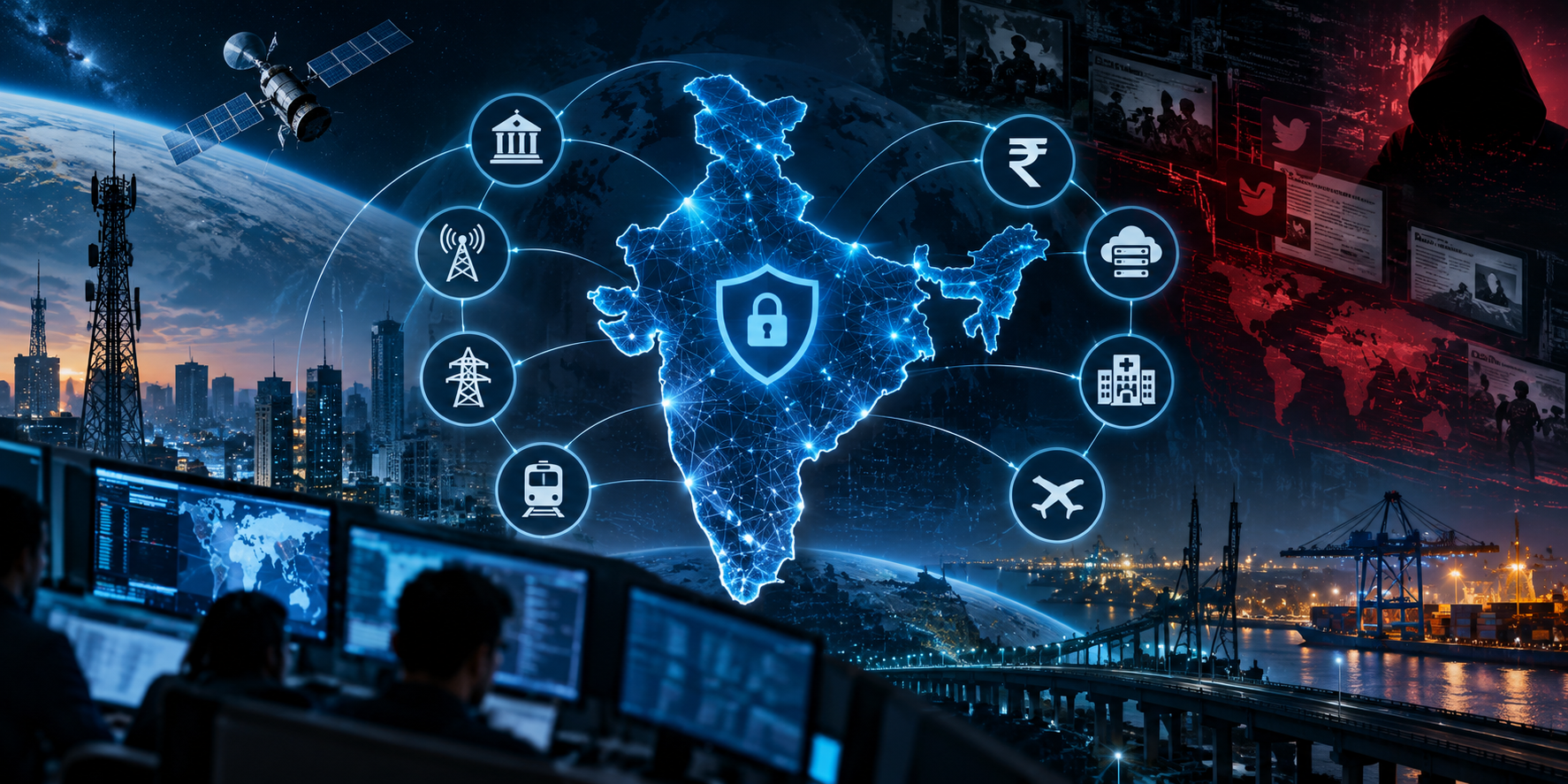
The unprecedented expansion in the digital landscape of India brings new opportunities as well as vulnerabilities. While the overall interconnectedness of telecom, cloud, online financial services and digital public infrastructure has led to substantial efficiency gains and strengthened connectivity at a time of rising geopolitical tensions, their interdependency also exposes systemic risks. A cyberattack that causes disruption or failure of financial, energy, transport, healthcare or communication systems can have repercussions that go far beyond cyberspace and lead to physical effects on public safety and economic stability.
India has created a multi-pronged cybersecurity infrastructure, comprising the CERT-In, the National Critical Information Infrastructure Protection Centre (NCIIPC), and the National Cyber Security Coordinator. They also play a role in incident response, keeping critical systems protected and coordinating at the national level. But cybersecurity cannot solely rely on prevention. As complex digital systems cannot be fully fortified against breach, resilience and reliability (Ministry of Electronics and Information Technology 2025) is equally necessary as continuity planning day recovery and steady messaging at public domain.
Cyber Power and Information Warfare
Cyber power is now an integral part of national power. It can support intelligence collection, surveillance, espionage, disruption and coercion and complements conventional military and intelligence capabilities. Nevertheless, institutional development of useful cyber capabilities is complicated as cyber operations necessitate specific know how, infrastructure and patience.
Therefore, for India, the defensive ability has to be matched with a robust strategic cyber capacity. Information on threat actors, digital forensics, attribution and legal preparedness is required to understand hostile activity and enable appropriate responses. However, cyber deterrence is not analogous to nuclear or conventional deterrence because attribution may be ambiguous and cyber effects are often hard to anticipate.
The blending of cyber plays and disinformation is another issue at hand. A cyberattack can raise doubts over whether services are available, data safe or the government competent. This ambiguity can be systematically exploited by false claims, fake images and manipulation. Rather, the aim may not be to convince people of a specific falsehood but to create uncertainty and undermine faith in institutions and trusted sources of information.
Thus, strategic communication becomes a vital part of national security. Additionally, delayed or unreliable official messages in these events elections, military crises or explosions that damage infrastructure (accidentally by hoaxes) can exacerbate the impact of hostile information operations. Hence, rather than regarding cyber incidents and the underlying information activity as discrete episodes of a wider campaign, India should analyse them as interrelated phenomena.
AI-Enabled Risks and Institutional Challenges
AI is enabling cyber and information operations at an unprecedented pace, scale, and sophistication. It can enhance phishing and social-engineering campaigns, aid malicious-code generation, even churn out high quality synthetic content. The reason deepfakes are especially alarming is that fabricated audio, video and images of political leaders, military officials or public institutions can seem compelling in a time of crisis (United Nations 2024).
A critical problem raised by this speed of information spread. Manipulation content can be broadly promised before detection or verification mechanisms are applied. As a result, simply relying on technical detection is not enough. Enhanced content authentication, media literacy for Indians: What India needs for handling misinformation. National resilience could be enhanced through national capabilities for deepfake detection and AI-supported threat analysis (United Nations 2024).
Another issue is the lack of institutional integration. Best Answer: In a cyber-collective hybrid campaign, it might include elements and components of ICOR in cyber intrusion, or intelligence collection, financial pressure; disinformation; psychological influence simultaneously with other APTs conducted to place all aspects under such authorities. This means that three gaps deserve special scrutiny: the attribution gap, the coordination gap and resilience gap. India needs integrated mechanism to facilitate nodal role for cyber agencies, intelligence organisations, defence institutions, law-enforcement agencies and strategic-communication authorities in sharing information and threat assessment in culmination.
Strategic Responses
An integrated national hybrid-threat framework linking cybersecurity, information warfare, AI governance, economic security and protection of critical infrastructure should be an urgent priority for India. This framework would allow policy-makers to recognize the connections between seemingly disparate events and respond accordingly to their larger strategic implications.
Several measures should receive priority. To start with, India should bolster cyber information fusion frameworks that can better evaluate the impact of networks and hostile narratives on online activity with regard to protests. Second, exercises need to ensure continuity and recovery from simultaneous cyber and information attacks. Public-private information sharing should be enhanced for two reasons: Much of India is already dependent on private-sector infrastructure and expertise, and India faces severe challenges in cybersecurity (Ministry of Electronics and Information Technology 2025).
Fourth, India needs to develop its own independent capabilities in cyber-threat intelligence, digital forensics and attribution to drive legal, diplomatic and strategic responses. Fifth, indigenous AI based capabilities should be developed to monitor and detect deepfakes, create verification mechanisms for synthetic content and move towards automated cyber defence. Lastly, increasing public cyber awareness and media literacy needs to be improved in order to decrease the susceptibility used by phishing, fraud and misinformation. Such measures, coupled with the increased inclusion of hybrid warfare studies into defence and strategic-policy curricula, are necessary.
Conclusion
India’s national-security environment is evolving due to the confluence of cyber operations, disinformation and other sub-threshold tools. It's not just about protecting computer networks anymore; the new challenge includes securing vital services, the integrity of information, institutional legitimacy and public trust.
While the current framework of India’s CYBERSEC architecture is strong to an extent, considering the growing scale and complexity of digital threats, it must move away from being largely reactive-based to developing a resilience-based national security environment. Cyber disruption and information manipulation support one another during hybrid warfare necessitating fused intelligence, strategic communication, and societal readiness.
This is why having secure networks alone cannot be the solution to ensure that India remains safe in this new digital era. It calls for resilient institutions, credible information systems, effective attribution, responsible AI governance as well as robust public-private cooperation and a cyber informed society able to withstand threat multidomain pressure.
References:
1.Egloff, Florian J. 2020. “Public Attribution of Cyber Intrusions.” Journal of Cybersecurity 6 (1): tyaa012. https://doi.org/10.1093/cybsec/tyaa012.
2.Hoffman, Frank G. 2007. Conflict in the 21st Century: The Rise of Hybrid Wars. Arlington, VA: Potomac Institute for Policy Studies.
3.Ministry of Electronics and Information Technology. 2025. Annual Report 2024–2025. New Delhi: Government of India.
4.Ministry of Electronics and Information Technology. 2026. Annual Report 2025–2026. New Delhi: Government of India.
5.Rid, Thomas. 2022. “Hybrid Warfare: The Continuation of Ambiguity by Other Means.” European Journal of International Security 7 (3): 394–412. https://doi.org/10.1017/eis.2022.19.
6.Smeets, Max. 2022. No Shortcuts: Why States Struggle to Develop a Military Cyber-Force. New York: Oxford University Press.
7.United Nations. 2024. Governing AI for Humanity: Final Report of the Secretary-General’s High-Level Advisory Body on Artificial Intelligence. New York: United Nations.
8.Whyte, Christopher. 2020. “Cyber Conflict or Democracy ‘Hacked’? How Cyber Operations Enhance Information Warfare.” Journal of Cybersecurity 6 (1): tyaa013. https://doi.org/10.1093/cybsec/tyaa013.
(The views expressed are those of the author and do not represent views of CESCUBE)
Image Source: AI Generated

Pranoti Bankar holds a B.Sc. and M.Sc. in Defence and Strategic Studies from Savitribai Phule Pune University, Pune. Her research interests include international relations, geopolitics, strategic affairs, space security, defence policy, and emerging technologies. Her Master's dissertation, ‘A Study of China's Space Strategy and Its Implications on Global Security’, examined the strategic dimensions of China's expanding space capabilities. She completed a research internship with the Centre for New Age Warfare Studies (CNAWS), where she contributed to the Pakistan Political Developments Team and published an article on the Pakistan–China strategic nexus. She also served as a Research Content Writer Intern at The Indian Netizens (TINS), authoring a research article on India's space strategy that is currently awaiting publication. She is committed to producing rigorous, evidence-based, and policy-oriented research on contemporary security and strategic issues.