The Indo-Pacific: Epicentre of 21st Century Geopolitics
The Indo-Pacific has emerged as the central theatre of contemporary geopolitics, linking the Indian and Pacific Oceans and encompassing some of the world’s most economically dynamic and strategically significant states. This article examines the historical evolution and growing strategic importance of the Indo-Pacific, highlighting how shifting power dynamics, maritime competition, and geoeconomic rivalry are reshaping the regional order. It explores China’s expanding maritime assertiveness, the United States’ alliance networks, India’s pursuit of strategic autonomy, and the role of middle and smaller powers adopting hedging strategies to navigate intensifying great-power competition. The study further analyses the significance of maritime chokepoints, sea lanes of communication, technological rivalry, and supply chain realignments in shaping regional security and economic interdependence. By situating these developments within broader debates on multipolarity, geoeconomic competition, and maritime strategy, the article argues that the Indo-Pacific will remain the decisive arena where global power, trade, and the future international order increasingly converge.
Introduction
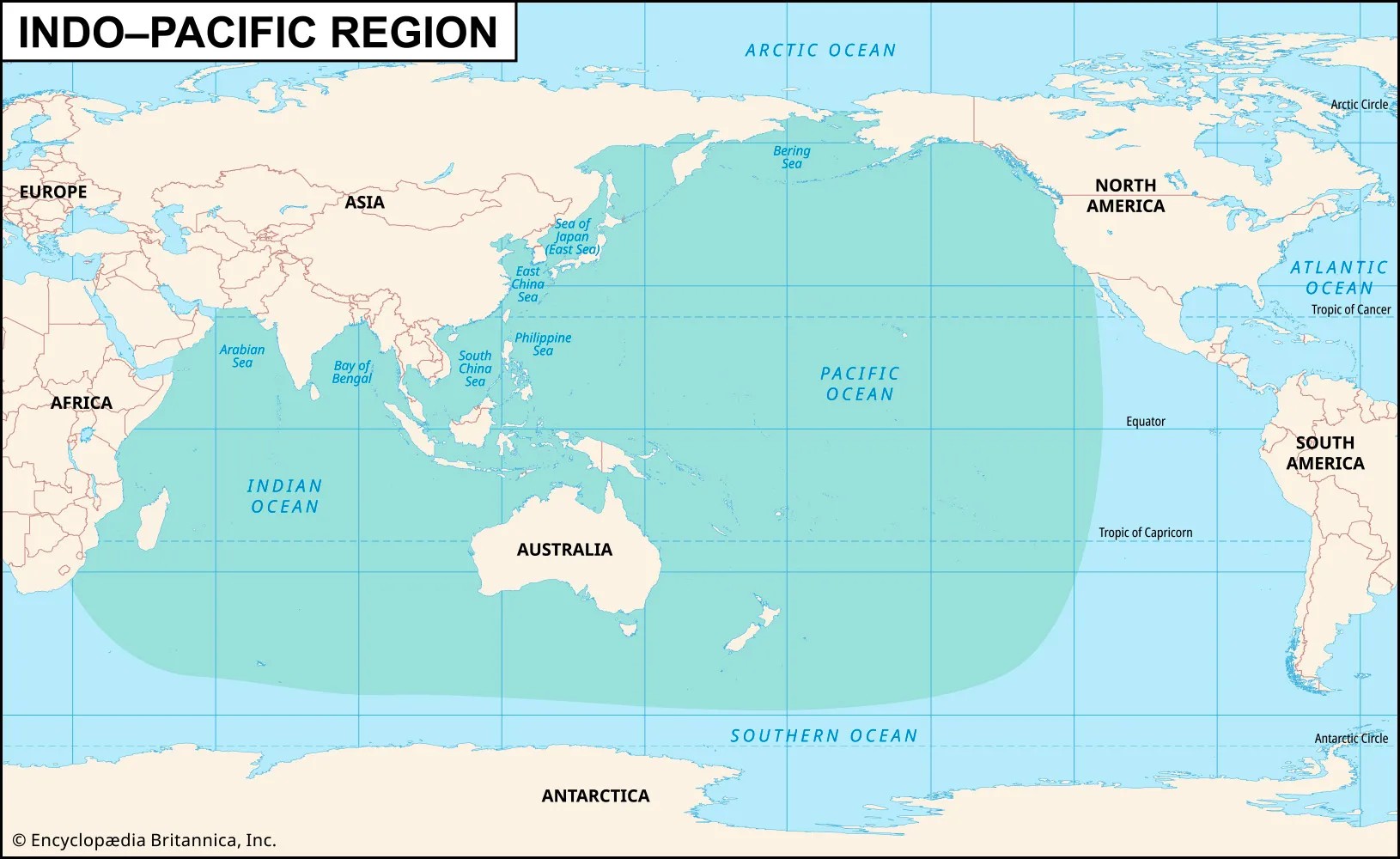
The Indo-Pacific region is a strategic geographical space encompassing the Indian Ocean and the western and central Pacific Ocean, stretching from the eastern coast of Africa to the western shores of the Americas. It includes diverse countries such as India, China, Japan, Australia, Indonesia, Bangladesh, Sri Lanka, the Maldives, Vietnam, the Philippines and the United States, among many others. This vast region contains vital maritime routes that facilitate trade and economic interaction between some of the world’s largest economies, making it central to contemporary global affairs. Its diversity in culture, politics and economics, combined with the presence of major powers, gives it extraordinary geopolitical significance.
The region is home to some of the world’s most populous and economically dynamic countries, including India, China, Japan, Australia and Indonesia. This concentration of economic and political power has transformed it into a critical centre of global geopolitics. It also contains key maritime trade routes such as the Strait of Malacca, through which a significant portion of global trade flows, linking Asia with Europe and Africa. The shift of economic gravity from the West toward Asia has reinforced the Indo-Pacific’s role as the strategic heart of twenty-first-century geopolitics.
The idea of the Indo-Pacific is not entirely new. German geopolitician Karl Haushofer used the term in the 1920s, recognizing the region’s demographic and economic importance, although his vision differed from its contemporary usage. The modern understanding gained prominence in 2007 when Japanese Prime Minister Shinzo Abe described a “confluence of the two seas,” envisioning cooperation between the Indian and Pacific Oceans to secure shipping routes and promote prosperity. Shortly thereafter, the term gained currency in foreign policy discussions within the Quadrilateral Security Dialogue, bringing together Australia, India, Japan and the United States as like-minded democracies seeking regional stability.
Historical Strategic Foundations
Since the end of the Second World War, the strategic constellation of the Indo-Pacific has been shaped by relations among the United States, the Soviet Union (now Russia), China and India. During the Cold War, antagonism between Washington and Moscow structured a bipolar world order. Some of the bloodiest proxy wars were fought in the Indo-Pacific- in Korea, Vietnam, and later Afghanistan- while the United States established a ‘hub-and-spokes’ alliance system with Japan, South Korea, Australia, Thailand, and the Philippines. Meanwhile, China initially aligned with the Soviet Union and India, under Jawaharlal Nehru, helped found the Non-Aligned Movement.
This geopolitical configuration began to shift in the late 1960s. Border tensions divided Beijing and Moscow, enabling a strategic opening between China and the United States. India, angered by American support for Pakistan during the Bangladesh war, drew closer to the Soviet Union, while China moved toward Washington. After the Cold War, the United States presided over a unipolar order and globalization expanded multilateral cooperation. Yet nuclear proliferation in India, Pakistan and North Korea underscored enduring security dilemmas.
China’s Strategic Shift and Maritime Assertiveness
When Xi Jinping assumed leadership in 2013, China recalibrated its strategic direction. Beijing fears encirclement by US alliances and worries about a blockade of supply routes through the Strait of Malacca. To mitigate this vulnerability, it has pursued overland and maritime corridors through initiatives like the Belt and Road, seeking access to Middle Eastern energy and European markets.
At sea, China has militarized features in the South China Sea to deny adversaries access to areas it considers its sphere of influence. It also aims to push beyond the US “island chain” defence perimeter and extend strategic depth into the Pacific. While Beijing frames these moves as defensive, Japan, Taiwan and maritime Southeast Asian states view them as expansionist.
Great Power Competition and Strategic Alignments
Since Russia’s annexation of Crimea in 2014 and the war in Ukraine, relations between Russia and the West have again become antagonistic. China and Russia increasingly align against the United States, though Moscow now plays a junior role. Unlike the Soviet Union, China is deeply integrated into the global economy and benefits from an open trading system.
India continues to maximize strategic autonomy but has moved closer to Washington and its Quad partners amid border tensions with China. Many smaller states, however, resist choosing sides, rejecting ideological polarization and trade bloc formation because of the economic costs. The sustainability of such balancing strategies remains uncertain.
Risk of Conflict and Strategic Flashpoints
A direct conflict between the United States and China- possibly over Taiwan- represents the most dramatic scenario facing the region. Such a confrontation could quickly spread to the Korean Peninsula, the South China Sea and the Strait of Malacca, disrupting global supply chains. US allies such as Japan, South Korea, Australia and the Philippines would likely be drawn into hostilities, while Southeast Asian states could face intense pressure to align.
India might seek neutrality but could be drawn in through Indian Ocean hostilities and Europe would face pressure to support allies. Although neither Washington nor Beijing currently seeks war, incidents in contested waters raise the risk of escalation. Both sides are preparing militarily, yet nuclear deterrence may ultimately prevent direct conflict.
Geoeconomic and Technological Rivalry
Competition between the United States and China is increasingly geoeconomic. Washington’s “small yard, high fence” approach aims to slow China’s technological rise through export controls and partnerships such as the semiconductor supply chain alliance involving Taiwan, South Korea and the Netherlands. In response, China is investing heavily in domestic semiconductor and artificial intelligence capabilities. This technological bifurcation imposes high costs on third countries.
Protectionist policies and financial shifts could fragment the global economic system. Efforts toward de-dollarization among emerging economies and geopolitical conditions attached to financial assistance illustrate growing strategic competition. Meanwhile, post-pandemic supply chain restructuring has encouraged “friend-shoring,” potentially leading to self-contained trading blocs.
Military procurement dependencies reinforce alignment pressures, as states relying on specific weapons systems remain tied to suppliers for decades. These structural constraints could force smaller Indo-Pacific nations to choose sides.
Sea Power, Trade Routes and Maritime Security
Naval strategist Alfred Thayer Mahan argued that control of sea routes determines global power. The Indo-Pacific contains vital chokepoints- notably the Strait of Malacca and the South China Sea- through which a major share of global trade and energy supplies transit. Both China and the United States have expanded naval capabilities in the region, reflecting the enduring relevance of maritime dominance. Ensuring maritime security is therefore a top priority. Piracy, territorial disputes and protection of sea lanes remain critical concerns for regional states whose economic prosperity depends on uninterrupted shipping.
Strategies of Smaller and Middle Powers
Most Indo-Pacific countries pursue hedging strategies to avoid excessive dependence on any single power. Mongolia, for example, follows a “third neighbour” policy to balance between China and Russia. Maritime Southeast Asian states adopt different approaches than mainland neighbours.
The Philippines has chosen a robust defence of its territorial claims under US protection, while Vietnam, Malaysia, Indonesia and Brunei maintain claims yet pursue equilibrium policies. Malaysia practices active neutrality, welcoming both Western semiconductor investment and relocating Chinese firms while deepening defence cooperation with Australia and the United States.
Singapore hosts US naval facilities yet serves as a major gateway for Chinese commerce, supporting open trade routes and a rules-based order. Conversely, Laos and Cambodia align closely with China and Myanmar’s military government relies on China and Russia amid international isolation. Thailand continues its flexible “bamboo diplomacy,” balancing between major powers.
South Asia and the Indian Ocean
In South Asia, rivalry between India and China increasingly shapes regional dynamics. Pakistan’s economic development is closely linked to the China-Pakistan Economic Corridor, though concerns about debt and dependence persist. Sri Lanka’s transfer of Hambantota Port to China following debt distress has fueled narratives of “debt-trap diplomacy,” while the Maldives and Nepal navigate competing pressures from larger neighbours.
Bangladesh, historically influenced by India, seeks greater strategic space amid shifting domestic politics. Smaller South Asian states often struggle to balance effectively due to political instability. India, w.r.t. the instability in its neighbourhood, pursues multi-alignment beyond the region to maximize strategic autonomy. Whether such balancing strategies will endure remains an open question.
Strategic Interests of Major Powers
The Indo-Pacific is a focal point of strategic competition among major powers. The United States seeks to maintain freedom of navigation, strengthen alliances and counter China’s influence. China aims to expand economic reach, secure trade routes and assert maritime claims. India focuses on protecting sea lanes, countering China’s influence and deepening regional partnerships, while Australia promotes a rules-based order and regional stability.
The Quadrilateral Security Dialogue has emerged as a key framework promoting maritime security, regional cooperation and a free and open Indo-Pacific. Joint exercises and maritime domain awareness initiatives enhance regional coordination.
In contrast, China’s Belt and Road Initiative seeks to expand connectivity through infrastructure investments across Asia and beyond. While it promotes economic integration, critics argue it may create debt dependency and strategic leverage. The interplay between the Quad and BRI reflects competing visions shaping the regional order.
Europe’s Role in the Indo-Pacific
Europe has increasingly recognized the Indo-Pacific’s importance, though the war in Ukraine has forced it to prioritize continental security. Economically and technologically, however, the region remains crucial for Europe’s future. Regional partners often expect Europe to act not merely as a US proxy but as a solution-oriented partner committed to multilateral cooperation.
Although European military capabilities in the Indo-Pacific remain limited, Europe is valued as an economic and technological partner and as a supporter of rules-based governance, climate action and global health cooperation. To strengthen partnerships, cooperation must occur on equal footing, acknowledging sovereignty and enabling greater representation of emerging powers in global institutions.
Why the Indo-Pacific Matters
For the United States, the Indo-Pacific represents a free and open region spanning from Africa to the American coastline. India similarly seeks to prevent domination by any single power. The region’s strategic importance stems from great power rivalry, nuclear-armed states and unresolved territorial disputes, including those in the South China Sea.
Regional organizations and forums, including Association of Southeast Asian Nations, the Quadrilateral Security Dialogue and the Indian Ocean Rim Association, play vital roles in fostering cooperation, security and economic integration. Infrastructure connectivity initiatives and climate challenges further underscore the region’s global significance.
Conclusion
The Indo-Pacific has emerged as the central arena of global geopolitics because it sits at the intersection of economic dynamism, strategic competition, maritime trade and technological rivalry. Major powers compete for influence while smaller states hedge to preserve autonomy. Critical sea lanes sustain global commerce and supply chain dependencies link regional stability to worldwide prosperity.
Whether balancing strategies will succeed or external shocks will force nations to choose sides remains uncertain. What is clear, however, is that the Indo-Pacific will remain the decisive geopolitical theatre where power, prosperity and the future international order converge.
References
1) Berkofsky, A., Miracola, S., & Magri, P. (2019). GEOPOLITICS BY OTHER MEANS. Ledizioni LediPublishing.
https://www.ispionline.it/sites/default/files/pubblicazioni/indo-pacific_web.def_.pdf
2) Cannon, B. J., Sim, L.-C., & Aminjonov, F. (2025). Central Asia and the Indo-Pacific: bridging the divide in an age of great power rivalry. International Affairs, 101(4), 1177–1191. https://doi.org/10.1093/ia/iiaf102
https://academic.oup.com/ia/article/101/4/1177/8178341
3) GSDN. (2025, February). Why the Indo-Pacific matters Geopolitically? - Global Defense News - GSDN. Gsdn.live.
https://gsdn.live/why-the-indo-pacific-matters-geopolitically/
4) Mellman, C. (2025, May 8). The “Indo-Pacific”: A Paradigm Shift in Global Governance. Encyclopedia Geopolitica; Encyclopedia Geopolitica. https://encyclopediageopolitica.com/2025/05/08/the-indo-pacific-a-paradigm-shift-in-global-governance/
5) Saxer, M. (2024, November 19). The Indo-Pacific and its Emergence as a Global Powerhouse, Internationale Politik Quarterly. Ip-Quarterly.com.
https://ip-quarterly.com/en/indo-pacific-and-its-emergence-global-powerhouse
6) Shakibur Shourov, & Uddin, M. N. (2025). “The Indo-Pacific: A New Frontier in Global Geopolitics.”
7) Significance of Indo-Pacific. (2023, September 29). Drishti IAS.
https://www.drishtiias.com/daily-updates/daily-news-analysis/significance-of-indo-pacific
Image Source: Photo by Britannica, https://www.britannica.com/place/Indo-Pacific
(The views expressed are those of the author and do not represent the views of CESCUBE)

Soumili Rakshit is a Research Intern at the Centre for Security and Strategic Studies, where she contributes to research and analysis on contemporary security, foreign policy, and strategic affairs. Her work focuses on critically examining geopolitical developments, policy responses, and emerging global challenges through structured research and evidence-based writing. She is particularly interested in the intersections of politics, media, and international relations. At the Centre, she aims to engage in drafting analytical briefs, contributing to research projects and supporting knowledge dissemination initiatives.