Private Power and Public Policy: How Non-State Actors Shape US Foreign Policy Decisions
The “eclipse of the state” theory suggests that, in the globalised world, a world that is characterised by economic integration, technological advancements, and the rise of non-state actors, the authority and the sovereignty of the state has diminished. Susan Strong, in her influential work, “The Retreat of the State: The Diffusion of Power in the World Economy (1996)”, talks about how the state’s authority has been eroded by the growing influence of multinational corporations, international organizations, and global markets. Yet, the influence of said non-state actors is not just a contemporary phenomenon.
A growing form of non-state actors are super empowered individuals, such as celebrities, business moguls, or even social media influencers. Multinational corporations, which have high profile public figures at the helm, have the power to influence social and geopolitical issues worldwide. However, this said influence does not just come from amassing great economic heft, that these super empowered individuals have, neither does it come from the interconnectedness of a globalised world. This conclusion is supported by the role private citizen William Douglas Pawley played, in the CIA backed coup d’etat in Guatemala, back in 1954.
Private power and public policy intertwine:
Before Pawley committed suicide in 1977, he enjoyed a high-profile career as an international salesman, businessman, aviation entrepreneur, U.S. ambassador, financier, transit and sugar magnate, philanthropist, and special presidential envoy. Yet, somewhat less known were Pawley’s activities on behalf of the U.S. government. His involvement in Operation PBSUCCESS (codename for the Guatemala coup d’etat), would have largely remained a secret, as the official government documents, released publicly once in 1983, and then again in 2003, had Pawley’s name mentioned for a totality of seven times. If it were not for Pawley’s unpublished memoir, much of his actions on behalf of the U.S. government in Operation PBSUCCESS would have been unknown.
Pawley’s role in lobbying the government, and influencing government action does not just start from PBSUCCESS. Pawley had entered the commercial aviation business in 1928, based on his friendship with Glenn Curtiss, one of the first commercial airplane builders. He later went on to become the president of China’s nationalised airline in 1933. Being in the good graces of the country’s dictator, Generalissimo Chiang Kai-shek, he helped lobby U.S. officials in 1937, when war broke out between China and Imperial Japan, arguing that it was crucial to defend the Burma Road into China to enable them to persevere against Japan. Pawley is also to thank for Hindustan Aircraft Limited, a manufacturing plant, built in India, which employed around 15,000 people at its peak. It was the principal maintenance and overhaul base for the entire China-Burma-India theater and saved the Allies millions of tons of shipping space during the battle for air supremacy on the Asian continent. Pawley therefore, had a role to play in the Allied victory in the Second World War, making him an indispensable asset, supporting the U.S. government whenever they needed help.
Pawley was even appointed the ambassador to Peru in 1945, by then President Harry Truman, and was later reassigned to Brazil. There is a clear difference here, from the role played by super empowered individuals, or even other non-state actors in the contemporary world. Positions of power, such as ambassadorial positions are almost no longer gifted to private citizens, individuals such as Elon Musk, Jeff Bezos, Mark Zuckerberg, and the influence that they come, along with their popularity in their respective fields, are used as a tool of spreading soft power. Musk was given a governmental position as the Senior Advisor to the President and as the de facto head of the Department of Government Efficiency, which he resigned from later. It is still very unlikely for governments to do something President Truman did in the case of Pawley. This is different from celebrities or other privileged individuals or other powerful individuals from holding office, because they are free to contest elections through a political party.
William Douglas Pawley was asked by President Truman to become an adviser on East Asian matters, in 1951, with the outbreak of the Korean War. Later, he even acted as a special assistant to the Secretary of Defense, before making the much talked about move to the Republican Party. Important to note here is the fact that Pawley was never a part of the Democratic Party, he was just a sponsor. After joining the conservative party, he went on to raise hundreds of thousands of dollars for Eisenhower’s presidential campaign, and he was later appointed to the Doolittle Commission, which evaluated the efficiency of the Central Intelligence Agency's (CIA) methods and operations, by President Eisenhower himself.
The Guatemalan case, and the subsequent coup, was orchestrated by the CIA to overthrow President Jacobo Arbenz, whose flirtation with the Soviet Union (USSR), was becoming cause of concern for the Americans. Guatemala, like Cuba, was becoming a point of influence in the Western hemisphere, right in the doorsteps of the United States, and that could not be allowed. The country had grown increasingly leftward after Arbenz came to power, and the Boston-based United Fruit Company (UFCO), whose domination of the Guatemalan economy was exceptional, had lost land holdings due to land redistribution laws started after Arbenz came to power. UFCO was single-handedly opposing the efforts of the Guatemalan government to alleviate glaring economic inequalities in the country.
Pawley was brought into the picture in May 1954, whereby his involvement, for three months, was designed with the help of President Eisenhower. Pawley later called this "Strangling a Red Dictatorship in Guatemala.” This involvement generally goes unnoticed, for it was kept under considerable wraps, going as far as doctoring the President’s appointment records to keep this a secret. To undermine the Arbenz government, the Americans used a three-pronged approach, psychological warfare, a Gulf of Honduras blockade, and a trained/funded force under Carlos Castillo Armas. Armas invaded Guatemala in June 1954. However, they lacked the required air force, which would render the coup a success. The air arm had to be sufficiently effective to matter but not so large or modern as to attract unwanted attention. Not only did Pawley take care of this with his vast knowledge in aviation, he also spent money out of his own pocket, when the acquisition of the planes from the Nicaraguan dictator got stuck in bureaucratic red tape. The aircraft helped give the Guatemalan army, which was always going to be the crucial element in the success or failure of PBSUCCESS, the excuse to capitulate to an invading force that was decidedly inferior in the field. Without the support of the army, Arbenz resigned on June 27, 1954. Ten days later, Castillo Armas was dictator.
Two sides of the same coin?
Private control, or private influence in American foreign policy, or any policy decision for that matter, is not an uncommon phenomenon. Be it private citizens like William Douglas Pawley, or the American Israel Public Affairs Committee (AIPAC), lobbying for pro-Israel decisions in the US Senate, interference in governmental decision making has become quite common. This is not just to do with the eclipse of the role of the state, the rising trend in populism, and the increasing number of populist governments, which are anti-establishment by nature, invite private individuals and even companies to take part in decision making, sometimes even privatising core institutions. Such a development, especially in welfare states, will only go on to harm the people in the long run. The failure of the people in power, deliberate or not, to cater to the needs of the common masses, and to let a few super empowered individuals to influence decisions cannot lead to welfare, or even development.
References:
1. Wills, M. (2025). A private coup: Guatemala, 1954. JSTOR Daily. https://daily.jstor.org/a-private-coup-guatemala-1954/
2. Non-State actors playing greater roles in governance and international affairs. (2023, July 5). NICM. Retrieved February 20, 2026, from https://www.dni.gov/files/ODNI/documents/assessments/NICM-Non-State-Actors_23-01637_05-18-24_.pdf
3. Holland, M. (2005). Private Sources of U.S. Foreign Policy: William Pawley and the 1954 Coup d’État in Guatemala. Journal of Cold War Studies, Vol. 7 No. 4, 36–73. https://www.jstor.org/stable/26925851’read-now=1&seq=38#page_scan_tab_contents
(The views expressed are those of the author and do not represent the views of CESCUBE)
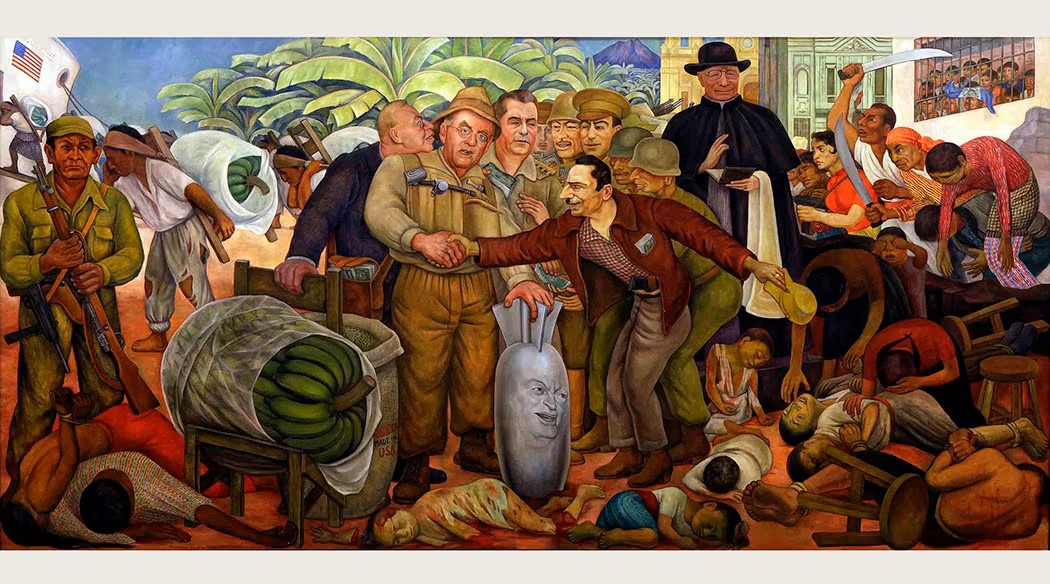
Image Source: Mural by Diego Rivera that satirizes the role of the US, UFC, Catholic Church, and the military in the Guatemalan coup.via Wikimedia Commons

Rohitaswa Das is currently pursuing his BA Hons degree in Political Science from St. Xavier's College (Autonomous), Kolkata. He takes special interest in International Relations, keenly following US foreign policy decisions, and is also a massive fan of football. He loves. to read when free, and is also a national level debater.