India's Maritime Grand Strategy on Trial : The IRIS Dena Incident and the Indian Ocean Question
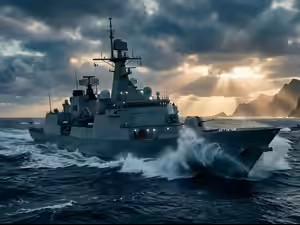
The sinking of the IRIS Dena on 4 March 2026, following a torpedo strike by a United States submarine in the Indian Ocean, marks a rare and consequential escalation in contemporary naval warfare. Occurring within a neutral state’s Exclusive Economic Zone and involving an unarmed vessel returning from a multilateral naval exercise, the incident challenges established norms of sovereign immunity under UNCLOS and raises serious questions regarding the legality of force beyond active theatres of war.
The incident ultimately crystallizes the tension between normative frameworks and power politics, revealing the fragility of a rules-based maritime order when confronted with hegemonic resolve, and forcing a reassessment of India’s maritime grand strategy in an increasingly contested oceanic space.
On the early morning of March 4, 2026, the geopolitical stability of the Indian Ocean was violently disrupted when the Islamic Republic of Iran Ship (IRIS) Dena, an Iranian frigate, was struck by a Mark-48 heavyweight torpedo and sunk. The attack, reportedly carried out by the United States submarine USS Charlotte, occurred approximately 40 nautical miles off the southern coast of Sri Lanka. Crucially, the IRIS Dena was transiting through the Exclusive Economic Zone (EEZ) of a neutral state and was completely unarmed, adhering strictly to return-voyage protocols after participating in the MILAN 2026 multilateral naval exercises hosted by the Indian Navy (Singh 2026). The torpedo detonated beneath the frigate's keel, causing it to sink within minutes and resulting in the loss of 87 crew members out of approximately 130 aboard (Singh 2026). The USS Charlotte reportedly departed immediately without undertaking search and rescue operations, leaving Sri Lankan and Indian assets to recover survivors. The strike occurred within the context of the ongoing US-Iran war, itself a textbook case of asymmetric modern warfare. By executing a lethal strike against a defenseless vessel in international waters, the United States sent immediate shockwaves across the international system.
The sinking is historically significant on multiple counts. It represents only the fourth confirmed instance since 1945 of a surface combatant being destroyed by a torpedo, and the first such instance involving a United States Navy submarine since WW2. More notably, it marks the first time since the 1982 Falklands War when HMS Conqueror sank the Argentine cruiser ARA General Belgrano that a nuclear-powered submarine has sunk an enemy surface vessel in combat.
The geographical and strategic context also magnifies the incident's significance. By conducting a lethal strike in one of the world's most heavily trafficked maritime corridors, the United States effectively internationalized what might otherwise be framed as a bilateral conflict with Iran. The spillover has exposed third-party states to immediate risk and shattered any assumption that regional waters could remain insulated from great-power confrontation, particularly in India's immediate maritime neighbourhood (Joshi 2026).
If we look at it through a critical perspective, the episode represents an acute diplomatic affront to India. The IRIS Dena was attacked while returning from MILAN 2026, a flagship exercise intended to foster an inclusive and cooperative maritime security environment under India's leadership (Singh 2026). A unilateral strike against a recent participant, reportedly without prior consultation with New Delhi, undermines India's carefully cultivated role as a regional stabilizer (Joshi 2026). The message is stark: the United States retains both the capability and the willingness to pursue its strategic objectives irrespective of partner sensitivities, even at the cost of diplomatic embarrassment within India's own sphere of influence.
The Letter and the Spirit
When confronted with international legal norms and conventions, the stark reality of the IRIS Dena's destruction stands in sharp contrast to both the internal legal assumptions governing maritime conduct and the cooperative vision that countries central to the IOR, such as India, have long articulated for the Indian Ocean Region. More significantly, the legal implications of this incident are profound. Under Article 95 of the United Nations Convention on the Law of the Sea (UNCLOS), warships on the high seas enjoy complete sovereign immunity from the jurisdiction of any state other than the flag state. A naval vessel is legally understood as an extension of sovereign territory; its destruction, therefore, amounts to a direct use of armed force against the Iranian state, which may be used in invoking the prohibitions outlined in Article 2(4) of the UN Charter (Fazal and Hussain 2026). The engagement occurred outside a formally declared active theatre of the ongoing war, and given that the Dena was unarmed and transiting peacefully, the threshold for lawful self-defense appears unmet (Fazal and Hussain 2026).
At the doctrinal level, India's formal vision for the region rests on the SAGAR doctrine—"Security and Growth for All in the Region" unveiled by Prime Minister Narendra Modi in 2015 as a framework rooted in collective action, capacity building, and regional stability. Rather than embracing overt great-power rivalry, SAGAR emphasizes inclusivity, rule adherence, and maritime cooperation, positioning India as a benign and responsible regional leader committed to a secure and predictable maritime environment ( Sarangi 2019). In operational terms, this translates into leadership in Humanitarian Assistance and Disaster Relief (HADR) missions, safeguarding vital Sea Lanes of Communication (SLOCs) through anti-piracy deployments, and strengthening maritime capacities among smaller regional states through coastal radar networks, patrol vessels, and hydrographic assistance (Sarangi 2019; Roy-Chaudhury 2022). Collectively, these legal frameworks and doctrinal commitments signal an intent not merely to participate and anchor, a rules-based regional order.
Spirit of India's Grand Strategy vs Spirit of Offensive Realism
Understanding India's doctrinal assertion of IOR requires examining the deeper "spirit" of its strategic culture and maritime aspirations. Historically, apart from kautilyan realism Indian strategic thought has been also heavily influenced by the civilizational ethos of Ahimsa (non-violence) and the enduring legacy of colonial subjugation (Khurana 2017). This fostered a post-independence philosophy of non-alignment and a distinct preference for moral leadership over coercive power projection. Consequently, India's naval establishment has felt uncomfortable assuming the aggressive mantle of a regional hegemon. The Indian Navy has traditionally preferred the more nuanced role of being a "provider of net maritime security" rather than an absolute, unilateral "net security provider" (Khurana 2017; Roy-Chaudhury 2022).
This cultural reluctance naturally translates into a cooperative maritime vision based on multilateralism and consensus. New Delhi approaches maritime security as a collective public good, preferring to build inclusive institutions rather than imposing strategic primacy. The MILAN multilateral naval exercises from which the IRIS Dena was peacefully returning serve as the embodiment of this vision, bringing diverse navies together to collaborate on shared challenges (Fazal and Hussain 2026; Singh 2026). For India, a stable, rules-based order is vastly preferable to the raw assertion of military superiority. This spirit represents India's own grand strategic vision to emerge as a somewhat realist, but benign regional hegemon in the Indian Ocean Region, anchoring security through cooperation and capacity-building rather than through dominance and coercion.
However, this singular incident of unprovoked torpedoing of the IRIS Dena has brutally revealed an entirely different "spirit" that is offensive realism. The unilateral United States naval strike, executed without prior consultation with New Delhi and targeting a vessel returning from an Indian-hosted exercise, demonstrated a fundamentally distinct operational logic (Joshi 2026). This spirit prioritizes unilateral strategic objectives over cooperative frameworks. It treats legal immunities as obstacles, not binding constraints. Partner sensitivities are subordinate to national interests. The attack occurred within India's immediate maritime neighborhood, yet India neither detected nor deterred the presence of a hostile nuclear-powered submarine operating in such proximity. More critically, it was unable to shape or respond meaningfully to the unfolding crisis (Joshi 2026).
The collision between these two spirits, India's cooperative multilateralism and America's unilateral force projection, violently hurts the regional aspirations of Indian Influence in the Indian Ocean Region. It also sends a blunt message that carefully constructed frameworks, legal principles, and appeals to rules-based orders can be rendered entirely inconsequential in the face of hegemonic resolve. Even the concept of a "net security provider," while effective against non-state threats such as piracy, falters when tested against the unilateral actions of a superpower. The cooperative vision underpinning SAGAR was overridden by raw strategic calculation, exposing a stark disjuncture between rhetoric and capability (Joshi 2026)
It also urges us to explore and expose the innate psychology of limitation within New Delhi's strategic establishment. There exists a stark gap between India’s self-perception as an emerging global heavyweight and the external perception of its actual geopolitical leverage. Driven by a cultural resistance to hard power projection, Indian policymakers have often shown a reluctance to acknowledge their hard military constraints or the ruthless, zero-sum maneuvers of global superpowers. This strategic culture acts as both a moral strength, fostering genuine diplomatic partnerships, and a severe operational limitation, leaving the nation conceptually unprepared for unilateral aggression in its own backyard.
Strategic reality of capabilities and constraints
One revealing aspect of this IRIS Dena incident is that it lays bare India's critical operational vulnerabilities, specifically its glaring deficits in Underwater Domain Awareness (UDA) and Anti-Submarine Warfare (ASW). The fact that a Los Angeles-class United States nuclear submarine could operate and launch a lethal strike undetected so close to Indian shores highlights the inability to monitor or track advanced sub-surface vessels within areas of vital national interest (Joshi 2026). This technology and infrastructure deficit, coupled with training and operational readiness gaps, is alarming given the increasing subsurface activity in the Indian Ocean Region (IOR). Unless India addresses these underwater domain shortcomings with indigenous solutions and heightened strategic priority, its maritime defence posture will remain critically impaired (Joshi 2026). The inability to detect advanced submarines poses an existential threat, not just from the US, but increasingly from the People's Liberation Army Navy (PLAN), whose nuclear attack submarines actively patrol the IOR and threaten India's sea-based nuclear deterrence (Khurana 2017).
These capability gaps place New Delhi in a profound great-power competition dilemma. To balance China's rapidly expanding naval footprint in the IOR, characterized by persistent submarine deployments, the establishment of a military base in Djibouti, and strategic port access at Gwadar in Pakistan, India has increasingly leaned on its strategic partnership with the United States (Khurana 2017). Yet, the IRIS Dena incident reveals the United States as a necessary but fundamentally unreliable partner. Consequently, a trust deficit has emerged, laying bare the absolute limits of India's security partnerships. The incident proves that the US prioritizes its own operational objectives, offering no guarantee that it will respect regional stability or the cooperative frameworks India has painstakingly built. This dynamic directly challenges India's cherished "strategic autonomy" and serves as a harsh reminder that New Delhi cannot rely on the United States for security in its own backyard.
Conclusion
In Conclusion, The Incident of the sinking of the IRIS Dena serves as a crystallizing moment that exposes a profound three-way disconnect in India's maritime grand strategy: the chasm between the "letter" of its ambitious doctrine, the cooperative "spirit" of its strategic culture, and the harsh "reality" of its capability constraints. As demonstrated by the undetected United States submarine strike, India’s maritime ambitions remain severely constrained by the ruthless geopolitical realities of great-power competition. It also undoubtedly raises acute questions about the broader viability of middle-power leadership and exposes the absolute limits of a rules-based maritime order when global superpowers choose to act unilaterally.
Consequently, the future of the Indian Ocean Region, too, is cemented as a highly contested space, leaving India to navigate a difficult path between building hard military capabilities and accepting strategic accommodation. Looking forward, New Delhi faces some stark choices: it must either invest heavily in critical Underwater Domain Awareness (UDA) and Anti-Submarine Warfare (ASW) technologies, meaningfully deepen its security partnerships, or permanently scale back its maritime ambitions. While the rhetorical recalibration toward "preferred security partnerships" will likely continue, the gap between India's strategic aspiration and its material capability remains glaring (Roy-Chaudhury 2022).
The ultimate question is whether New Delhi can successfully bridge its doctrine, culture, and reality. Until then, the IRIS Dena lies at the bottom of the Indian Ocean, a submerged monument to the vast distance between India's cooperative maritime vision and the harsh truths of power politics in its own backyard. India needs to confront the uncomfortable reality that it currently lacks the comprehensive national power required to shield its unquestionable maritime sphere of influence the Indian Ocean Region , which further highlights the necessity for India to temper its foreign policy posture, perhaps adopting a prudent strategy of hiding its capabilities and biding its time until its hard power truly aligns with its grand strategic ambitions.
References
1. Fazal, Syed Shiraz, and Twinkle Hussain. "Sinking A Warship, Testing A Charter: Lessons from the Iris Dena Incident." LiveLaw, March 10, 2026. https://www.livelaw.in/articles/sinking-warship-iris-dena-incident-525721.
2. Joshi, Neeraj. "IRIS Dena: A Strategic Wake-Up Call." New Delhi: United Service Institution of India (USI), March 12, 2026.
3. Khurana, Gurpreet S. "India's Maritime Strategy: Context and Subtext." Maritime Affairs: Journal of the National Maritime Foundation of India (April 19, 2017). https://doi.org/10.1080/09733159.2017.1309747.
4. Liliansa, Dita. "Armed Conflict Spillover into Neutral Exclusive Economic Zones: The Attack on IRIS Dena and Lessons for Southeast Asian States." Centre for International Law Blog, National University of Singapore, March 30, 2026.
5. Roy-Chaudhury, Rahul. "From ‘Net Security Provider’ to ‘Preferred Security Partnerships’: The Rhetoric, Reality and Result of India’s Maritime Security Cooperation." Journal of the Indian Ocean Region 18, no. 2 (July 2022): 87–98. https://doi.org/10.1080/19480881.2022.2118191.
6. Sarangi, Subhasish. "Unpacking SAGAR (Security and Growth for All in the Region)." USI Occasional Paper. New Delhi: United Service Institution of India, Centre for Strategic Studies and Simulation, 2019.
7. Singh, Jagatbir. "Sinking Of IRIS Dena And Rules-Based Order." New Delhi: United Service Institution of India (USI), March 13, 2026.
Borelli, Silvia. "The (mis)-use of general principles of law: lex specialis and the relationship between international human rights law and the laws of armed conflict." In General Principles of Law-The Role of the Judiciary, pp. 265-293. Cham: Springer International Publishing, 2015.
(The views expressed are those of the author and do not represent the views of CESCUBE)
Image Source: The Economic Times, https://economictimes.indiatimes.com/news/defence/iris-dena-ship-sunk-by-us-submarine-torpedo-why-was-the-iranian-ship-in-the-indian-ocean/articleshow/129069474.cms’from=mdr

Aaditya Dewansh is a postgraduate scholar of International Relations at South Asian University, New Delhi. His research interests include Geoeconomics, Grand Strategy, and the Geopolitics of the Indian Ocean Region. He also holds a Master’s degree in Arts and Aesthetics from Jawaharlal Nehru University. Beyond academia, his wider interests include travel & tourism, world cinema, and global popular culture.