Changes in Maldivian Politics
Maldives will take a decisive turn along the path of democracy when the potentially important South Asian nation elects over 950 councilors in the forthcoming local council elections. In the ten years since the Decentralization Act was passed into law there have been three Local Council Elections (LCEs). Over the course of subsequent times the Decentralization Act gave the local island councils considerable amount of political and economic power from “Haa Atoll “ in the Northern tip of the Maldives, to “Seenu Atoll” at the Southern point to pave the way for the next level of development. The island requirements were simple. They wanted more investments in fisheries harbors, health centre’s, schools and better connectivity with intra-atoll ferries. Perhaps in the fourth local council elections the voters might take a different approach in their choice of electing new island Councillors. In this decentralized system, certain socio –economic and political conditions in city to island councils vary to some degree. In far away islands of Maldives the societies are built upon networks of relationships where the ultra-conservatives and the moderates are separated beyond politics.
The New Maldivian parliament and Politics
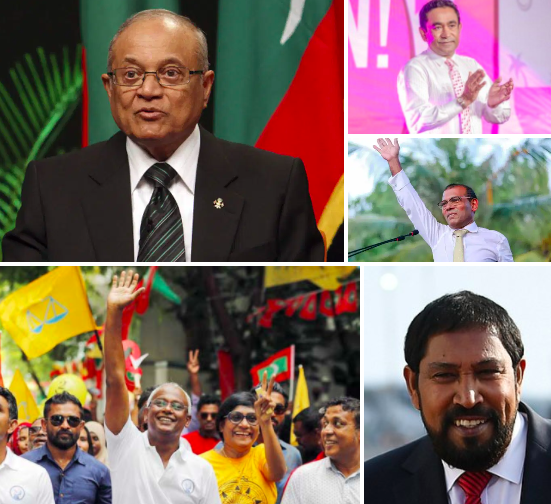
Furthermore in the 2019 parliamentary polls, Maldivian Democratic Party (MDP) won over two-thirds of the seats than arch-rivals, Progressive Party of Maldives (PPM), Jumhooree Party (JP) People's National Congress or the Maldives Development Alliance (MDA). Following the outstanding success of Ibrahim Solih led Maldivian Democratic Party (MDP) bagging 65 out of the 87 People’s Majis (parliament), seats will pose challenges as well as opportunities for both ruling and its opposition parties. After the historic election victory in the Maldives the ruling party unanimously chose Former President Mohamed Nasheed, for the speakership. At present, the ruling party has secured an absolute majority in the Maldivian parliament and it is a difficulty in finding any winning opposition coalition to challenge the ruling party. Also, it remains to be seen whether the opposition political parties like Progressive Party of Maldives (PPM) or the People’s National Congress (PNC) alliance with eight seats be able to maintain its power position in the Local Council Elections. Now in 2020, when Maldives faces fresh local council elections the PPM and PNC parties will go through a decisive stage in finding a leader for the new alliance to win hearts and minds of supporters . With all these scenarios a new opposition leadership has re-emerged. On a television program Umar Naseer emphasized that “the Opposition was in need of a strong 'vulture or lion' to lead them and 'revolutionise' the party “. This was a clear indication of Former Home Minister Naseer’s intentions in the coming years . Further more MDP will likely have little opposition at the national level, if former Maldivian Vice President Ahmed Adeeb returns back to active politics. Such a scenarios could have political advantage for Qasim Ibrahim’s Jumhooree Party (JP) and Maldivian Development Alliance . Together these two parties have seven seats that can shape a political third force in the future .In the Maldivian parliament opposition allies are 22 seats short of the majority mark of 44 . Yameen’s Progressive Party of Maldives (PPM) having weak ties with Qasim Ibrahim’s Jumhooree Party (JP) need to improve meaningful dialogues.
Presidential Election of 2018
During the darkest period of the Maldivian politics from 2017 to September 2018, the lone voice of the public opposition belonged to a few unforgettable opposition leaders such as, Former Maldivian President Maumoon Gayoom, Mohamed Nasheed, Qasim Ibrahim and Mohamed Solih. They had immense influence on Ibrahim Mohamed Solihs victory gaining 134,616 votes with 58.33 percent that brought new hopes to the island nation ending the authoritarian regime. At that time the opposition parties came together in a coalition when they appeared to be no other solution in sight to bring back democratic processes to the right path.
Coronavirus impact on Maldives Economy
On the whole, as many as 396 coronavirus cases have so far been hospitalized in the Maldives. Such a rise in coronavirus cases pushed the Maldives to impose strict border control measures. The Maldivian tourism industry that has over 145 island resorts with over 1.7 million tourists visiting the nation annually sees massive revenue losses due to the coronavirus situation. 90 percent of the resorts have decided to send almost 11,000 workers on no-pay leave. Moreover Fisheries the second largest source of livelihood has taken a massive financial hit during coronavirus crisis. In addition, the coronavirus disease is broadening social and economic divisions. As per latest reports the rate of poverty is much higher in southern atolls where one out of five live in poverty (Deutsche Welle ,2020) Further the communities living in southern atolls are further at risk of falling deeper into poverty due to the coronavirus pandemic.
After two years of long political stability Maldivian Democratic Party (MDP) led government is facing fresh uncertainty due to the current coronavirus crisis and because of influential Maldivian opposition political parties that define and shape the nations future for many years to come.
(Pic Courtesy - Srimal Fernando)
(Srimal Fernando is a Doctoral Fellow at Jindal School of International Affairs (JSIA), India and Advisor / Global Editor of Diplomatic Society for South Africa. He is the winner of the 2018/2019 ‘Best Journalist of the Year’ award in South Africa, and has been the recipient of GCA Media Award for 2016.In the field of politics, and Policy affairs, Fernando is a specialist, with over ten years of first hand experience in Sri Lanka and the Maldives. The views expressed are personal)
Srimal Fernando is a Doctoral Fellow at Jindal School of International Affairs (JSIA), India. Fernando was the recipient of the prestigious O.P. Jindal scholarship to pursue a Doctor of Philosophy (PhD) in International Affairs on “Political and Economic Integration in South Asia: A Prerequisite for Regional Community Building”. He is also the Advisor / Global Editor of Diplomatic Society for South Africa and, the winner of the 2018/2019 ‘Best Journalist of the Year’ award in South Africa .He has been the recipient of many other accolades for his journalistic work over the years including the GCA Media Awards for 2016. Having graduated with a Masters of Philosophy (M.Phil.) degree in Sociology from the South Asian University (SAU) in India, he was a South Asian University (SAU) Scholarship holder awarded under the SAARC umbrella spanning 8 regional countries in 2016 His former positions and experience include the handling of media and publications as a Publication Assistant /Press Officer to the Office of the Former President of Sri Lanka H.E Chandrika Bandaranaike Kumaratunga at the Presidential Secretariat as well as a Visiting Lecturer and International Speaker for several reputed academic institutions. A highly skilled analyst, he has undertaken various roles over the years; as Regional Advisor to International Alert UK Peace Building –INGO, he headed the Business for Peace Alliance, a consortium of 25 Regional Bossiness Chambers of Commerce during the Sri Lanka conflict period. He has also, in the past, undertaken the effective coordination of EU, UN and INGO funded projects and has been a key thought leader in the Multi party Political dialogue process in Sri Lanka. Over the years, as an Advisor, he has worked with policy makers for various peace building and conflict resolution initiatives that include working on the Post conflict Human Development Index (HDI) Report after the liberation of the Eastern Province of Sri Lanka. In the field of politics, and Policy affairs, Fernando is a specialist, with over ten years of first hand experience in Sri Lanka and the Maldives. Upon completion of his Doctoral studies , it is his aspiration to pursue a career in politics and to steer his island nation towards the path of a new and robust foreign policy.